Symbol vs Signifier: A Clear Comparative Guide
An analytical side-by-side comparison of symbol vs signifier, tracing origins, definitions, and practical use across design, linguistics, and culture.


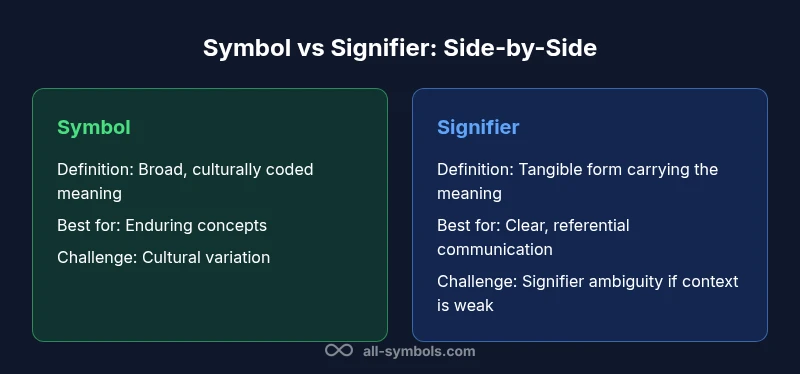
Symbol vs signifier are key terms in semiotics describing how meaning is encoded and communicated. A symbol carries culturally or historically established meaning, often with a broad, abstract linkage to ideas. A signifier is the tangible form that carries the signified meaning—the word, image, or object that points to a signified concept. Which to use depends on context, audience, and desired precision.
Historical roots of symbol vs signifier
The journey of the terms symbol and signifier begins in early semiotics, but the practical way they interact today grows from Saussure's theory of the linguistic sign: the sign consists of a signifier (the form) and a signified (the concept). Over time, scholars and designers began distinguishing symbols—signs with conventional, culturally loaded meanings—from signifiers, the outward forms that carry those meanings. The Greek root symbolon referred to a token used to bind agreements; by the 19th and 20th centuries, philosophers broadened symbol to denote a broader kind of sign that relies on shared culture. The All Symbols team notes that the symbol vs signifier distinction matters because it affects interpretation, communication strategies, and cross-cultural readability. In many contexts, a symbol stands as a shorthand for a complex idea; a signifier acts as the vessel that renders that idea visible. This distinction anchors the analysis that follows.
Core definitions and distinctions
In semiotics, a symbol is a sign with a meaning that arises through convention and cultural agreement. It evokes ideas by virtue of shared codes, history, and social practice. A signifier, by contrast, is the tangible form—the word, image, color, or gesture—that carries the signified meaning. Importantly, the signifier does not by itself guarantee a stable interpretation; context, audience, and prior knowledge shape how the signified is read. The term symbol emphasizes the destination—the idea audiences associate with the form—whereas signifier emphasizes the vehicle—the form through which meaning is conveyed. For students and designers, this distinction matters when choosing imagery that should either reference a broader culture or deliver a precise message. Throughout this article and in practice, the phrase symbol vs signifier serves as a diagnostic tool for evaluating how meaning is built, transmitted, and understood across different media.
The signifier–signified triad and related terms
The classic framework in semiotics is the sign: a mental construct formed by the pairing of a signifier and a signified. The signified is the concept or object in our minds that the signifier points to. From here, terms like icon, index, and symbol occupy specialized positions. An icon resembles its referent (an image of a cat), an index points to something through a causal or physical link (smoke signaling fire), and a symbol relies on learned codes (a national flag). The particular alignment of signifier and signified can shift over time or culture, which is why a single sign can function as both a signifier and symbol depending on usage. Analysts who work with symbol vs signifier must track these relationships to avoid conflating form with meaning.
Symbol vs signifier across disciplines
Across disciplines, the same term can imply different relationships. In linguistics, the signifier is the phonetic form, while the signified is the concept; in design, a logo acts as a symbol when it encodes corporate values and identity, but the graphic shapes and colors are signifiers that readers interpret. In philosophy and cultural studies, researchers explore how symbols carry mythic or ideological power that extends beyond immediate reference. In everyday life, a check-mark as a signifier communicates approval, while the check-mark embedded in a brand's icon may become a symbol of trust or reliability. Recognizing these shifts helps professionals tailor communication, branding, and analysis to the audience and context.
Common confusions and clarifications
A frequent pitfall is treating the signifier as if it inherently carries meaning independent of audience and culture. Another error is equating a symbol with a literal representation; a symbol can be abstract and culturally loaded even when the form itself is simple. Similarly, people often assume that all visual signs are symbols; many are signifiers designed to guide interpretation without embodying enduring ideas. The term icon often triggers confusion as well: an icon may be a signifier, but not all icons function as symbols. By explicitly separating form (signifier) from meaning (signified) and being mindful of context, observers can avoid misreadings and design more precise communications.
Practical implications for designers and researchers
For designers, clarity begins with choosing signifiers that map to a desired signified with minimal ambiguity. When the goal is enduring cultural resonance, brands often lean on symbols with established associations. Researchers, meanwhile, should document the audience, context, and cultural codes that shape how a symbol vs signifier is interpreted. A practical workflow: define the intended meaning (signified), select an appropriate outward form (signifier), test with representative audiences, and revise until the interpretation aligns with the target concept. Use concrete examples from your domain—math, icons, or daily life—to illustrate how a symbol communicates a concept versus how a signifier encodes a passable representation of that concept. This approach reduces misinterpretation and enhances cross-cultural readability.
Case studies: symbols in everyday life
Case study 1: The heart as a symbol of love. The heart shape operates as a symbol because it encodes a broad emotional concept across many cultures. The same shape can also function as a signifier when used on a postcard to indicate affection or on a medical icon to signal heart health; the surrounding context determines whether it is primarily a symbol or a signifier in that moment. Case study 2: Traffic signs. The red octagon for stop is a signifier grounded in safety codes, but its authorization by authorities gives it symbol-like authority across regions. Case study 3: The check-mark. In commerce and apps, the check signifies approval; depending on branding, it may acquire symbolic power that signals reliability and quality beyond its literal check mark form.
Analytical frameworks for study
To study symbol vs signifier systematically, apply a multi-layered framework: (1) form analysis: what is the outward shape or form? (2) meaning analysis: what concept does this form invoke? (3) cultural analysis: which community and history shape interpretation? (4) context analysis: where and how is the form deployed? (5) audience analysis: who reads the sign and how might different readers interpret it differently? This framework helps unify definitions across disciplines and ensures consistent evaluation of symbols and signifiers in research and design projects. Keep in mind the density of codes and avoid overgeneralizing from a single culture.
Debates and contemporary perspectives
Scholars debate whether the signifier and signified exist as stable pairs in a world of shifting contexts. Post-structuralist critiques argue that meaning is continually deferred in signifier chains, complicating the idea of fixed symbols. In practice, analysts balance this by foregrounding context and audience, using signals that are interpretable without excessive dependency on a single culture. For designers, this means testing interpretations in diverse settings and acknowledging that symbols may drift over time. The evolving field of semiotics blends linguistic, cultural, and digital analyses to understand how symbol vs signifier interacts with media, technology, and globalization.
Methodology: how to analyze a symbol vs signifier in a project
Begin with a problem statement: what meaning should readers derive from this form? Step 1: identify the signifier (form) and its potential signified (concept). Step 2: map cultural codes and possible divergent interpretations. Step 3: test with a diverse audience; collect insights about misreadings. Step 4: refine the form to strengthen the intended signification, or adjust the concept to fit the form. Step 5: document interpretation boundaries—where readings may differ across cultures or subcultures. This method helps ensure that your symbol vs signifier choices align with your goals, whether for branding, education, or research.
Tools, resources, and data sources
Useful resources include scholarly articles on semiotics, practical branding playbooks, and accessible overviews. Students can consult introductory chapters in textbooks, while professionals benefit from case studies in design literature. Online dictionaries, university course materials, and open-access articles provide diverse perspectives. In addition, consider cross-disciplinary resources that discuss how symbols operate in culture, media, and technology. Maintaining a curated bibliography during a project helps sustain critical awareness of symbol vs signifier dynamics.
Additional notes: terminology evolution and future directions
Terminology around symbol and signifier continues to evolve as new media emerge. Digital interfaces, emojis, and algorithmic designs create new signifiers that encode traditional ideas in novel forms. As audiences interact with these forms, researchers must reevaluate established symbol-vs-signifier distinctions, clarifying when a form becomes a symbol through sustained usage and cultural alignment. For students and designers, staying attuned to shifts in culture and technology is essential for effective communication. The ongoing conversation in semiotics invites curiosity and careful analysis of how meanings are constructed and sustained across generations.
Comparison
| Feature | Symbol | Signifier |
|---|---|---|
| Definition scope | Broad, culturally loaded meanings tied to concepts | The tangible form that carries a meaning |
| Relation to signified | Convention-based linkage to the concept (signified) | Vehicle that conveys the signified; form for interpretation |
| Examples in practice | National flags, brand emblems, myths | Words, logos, colors, or gestures used to signal meaning |
| Disciplinary usage | Semiotics, anthropology, branding, art | Linguistics, design, communication studies |
| Best For | Enduring cultural resonance and symbolic power | Clear, referential communication and immediate interpretation |
Pros
- Clarifies meaning through shared conventions
- Supports cross-cultural communication when context is clear
- Enables concise messaging in design and branding
- Facilitates interpretive analysis across disciplines
The Bad
- Can become outdated with cultural shifts
- Overly abstract signifier may obscure intended meaning
- Ambiguity if context isn't clear
- Requires reader familiarity with cultural codes
Symbol and signifier complement each other; use the one that matches your communicative goal.
Choose a symbol for cultural depth and longevity; use a signifier for precise, immediate communication. Balance both with audience in mind.
Questions & Answers
What is the difference between a symbol and a signifier?
A symbol encodes meaning through convention and culture, while a signifier is the outward form that carries that meaning. The signifier points to the signified concept, and context shapes interpretation.
A symbol is the idea people associate with something; the signifier is the form—shape, word, or image—that carries that idea to the viewer.
Can a single signifier function as a symbol?
Yes, a signifier can acquire symbolic power when a form is repeatedly used and culturally linked to a broader idea. A logo can become a symbol of a brand's values over time.
Definitely. A signifier can become a symbol through long-term usage and shared interpretation.
How should designers apply symbol vs signifier in branding?
Designers should use signifiers for clear, current messaging and rely on symbolic cues to convey enduring brand values. Align forms with audience expectations and cultural context.
Use signifiers for today, let symbols carry the lasting values—and test with real audiences.
What are common pitfalls in semiotics analysis?
Assuming universal meanings, ignoring context, or treating the form as meaning by itself. Always account for audience, culture, and media context.
Watch out for cultural blind spots and context gaps that distort readings.
Are there credible resources to learn more about symbol meanings?
Key resources include the Stanford Encyclopedia of Philosophy entries on Saussure and Peirce, and Britannica's overview of semiotics. These provide foundational and contemporary perspectives.
See Stanford's Saussure page and Britannica's semiotics overview for solid grounding.
What is the historical origin of the term symbol in semiotics?
The term symbol derives from the Greek symbolon, meaning a token used to bind agreements; later semiotics broadened it to denote culturally coded signs.
Symbol comes from Greek symbolon; it evolved to describe culturally coded signs in semiotics.
The Essentials
- Define your audience to choose symbol or signifier.
- Map the signifier to the intended signified.
- Account for cultural context and potential ambiguity.
- Apply across disciplines with appropriate framing.
- Check for consistency across media.