Symbol vs Sigil: Meaning, Origin, and Use Across Contexts
Explore the difference between a symbol and a sigil, with clear definitions, origins, and practical guidelines for design and communication across disciplines.


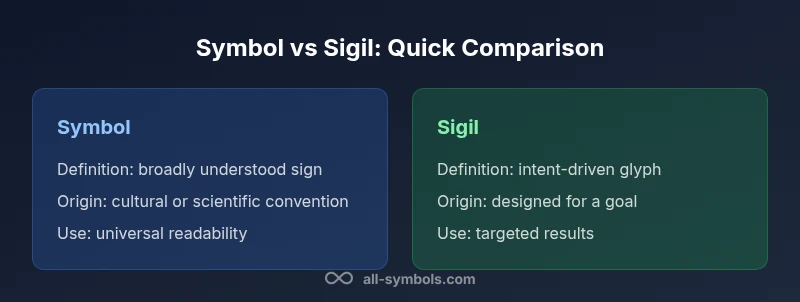
The difference between a symbol and a sigil lies in origin, intent, and use. A symbol is a sign with broadly recognized meaning within culture or science; a sigil is a glyph crafted with a specific purpose to influence an outcome. In design and communication, recognizing this distinction helps viewers interpret visuals accurately and avoid miscommunication.
Difference between a symbol and a sigil: core definitions
According to All Symbols, the difference between a symbol and a sigil rests at the intersection of semiotics, design practice, and cultural meaning. A symbol is a sign whose meaning is widely understood or historically established within a community, field, or society. It can be as everyday as a traffic icon, as formal as a mathematical glyph, or as iconic as a national emblem. A sigil, by contrast, is a glyph created with a specific intention, often within a tradition or system that emphasizes ritual or goal-oriented results. The All Symbols team highlights that the surface aesthetics of a sign can be identical or similar, but the crucial factor is the intent behind its creation and the audience it targets. This distinction matters for researchers interpreting charts, designers building UI, and students studying iconography, because it frames how confidently readers decode meaning and how reliably they apply marks in communication.
semiotics, symbols, and sigils: a quick primer
In semiotics, a symbol conveys meaning through social convention, habit, or formal coding. Its power rests in shared understanding across contexts such as language, science, or culture. A sigil, however, is commonly described as a glyph produced with a purposeful aim to influence outcomes or manifest a desire. This functional difference often guides whether a designer should deploy a broadly recognizable icon or commission a bespoke sigil that encodes a specific intent. The subtle distinction is that symbols travel with culture, whereas sigils travel with intention. For students and professionals, articulating the difference helps clarify when a mark is meant to be read universally versus when it is meant to perform a targeted action within a ritual, project brief, or personal practice.
origin, tradition, and evolving meanings
Symbols emerge from collective usage, legal definitions, or mathematical necessity and tend to accumulate layers of meaning over time. They are nourished by history, culture, and shared experience. Sigils arise from intentional design practices, often documented or codified within a particular tradition such as magical communities or modern symbolic arts. Because sigils are crafted to express a unique outcome, they frequently undergo simplification and stylization steps during creation. This process yields glyphs that may bear little resemblance to any existing symbol, yet retain the potency of the creator's aim. Understanding this origin helps readers appreciate why a sigil can feel personal while a symbol feels communal.
design implications: readability, aesthetics, and resonance
From a design perspective, a symbol’s strength lies in recognizability and legibility across scales and cultures. It should be legible in print and screen, maintain its meaning when simplified, and avoid conflicting interpretations in diverse contexts. A sigil prioritizes precision of intent over broad familiarity; it can be highly stylized, asymmetric, or abstract, yet it must preserve enough clarity to carry the intended outcome for the creator. The result is often a visually distinctive glyph that may challenge universal readability but achieves a focused effect within a defined audience. Designers who work with branding, wayfinding, or information architecture benefit from recognizing when to choose a symbol for universal comprehension versus a sigil for targeted effect.
usage contexts: everyday icons, branding, and ritual practice
Symbols populate everyday life—from traffic signs to emoji—because they communicate quickly and inclusively. Sigils show up in contexts that require personalized or ritualized meaning, such as personal journaling, art, or esoteric practice. In branding, a decision to deploy a symbol versus a sigil depends on the goal: broad accessibility or a statement of intent unique to a project. Researchers tracing the evolution of a logo must determine whether a mark has achieved symbol status through consensus or remains a sigil-like artifact tied to a specific outcome. This distinction helps practitioners align visuals with user expectations and institutional norms.
the role of culture and interpretation
Interpretation is not universal. A symbol can shift in meaning as communities evolve or as political and social climates change. A sigil’s potency can depend on the practitioner’s belief system, ritual context, or the surrounding discourse in which it appears. When communicating across cultures, creators should consider potential misreadings and the risk of appropriation or misrepresentation. The careful distinction between symbol and sigil reduces ambiguity and promotes transparent intent, especially in academic writing, design briefs, and collaborative projects where diverse audiences interpret visuals differently.
practical design guidelines: when to choose which form
If your objective is broad comprehension and quick recognition, use a symbol with proven cultural resonance and universal cues. If your aim is a specific outcome or an individualized message, craft a sigil that encodes that intent and remains legible to your intended audience. In mixed-media work, combine both: a symbol for context and a sigil for focus. In digital projects, surface both options in a controlled test to assess which version yields clearer comprehension and stronger engagement. Document the decision process so future readers understand why a symbol or sigil was chosen, reinforcing credibility and transparency in your work.
common myths and clarifications
A frequent misconception is that all signs found in rituals are sigils. In truth, many ritual marks function as symbols with entrenched meanings within a tradition. Conversely, not every abstract glyph created with deep intent qualifies as a sigil; some may be symbolic but lack a defined objective. Distinguishing these two categories helps avoid conflating symbolic art with ritual magic and supports precise communication in education, design, and scholarship.
moving toward clarity in scholarship and practice
In scholarly work and professional practice, precise terminology matters. Researchers should define symbol and sigil at the outset, illustrate with representative examples, and discuss how audience expectations shape interpretation. Designers can benefit by outlining when a mark is meant to be read as a cultural symbol versus when it is intended as a sigil for a targeted outcome. This clarity improves comprehension, reduces misinterpretation, and supports rigorous analysis across disciplines.
concluding thoughts for ongoing study and practice
The exploration of symbol versus sigil reveals how visual signs function as tools for communication, belief, and action. As contexts shift—academic, commercial, or creative—the ability to label and apply each form correctly becomes a valuable skill. The dialogue between symbol and sigil invites designers, researchers, and students to test, refine, and document their visual choices with care and curiosity.
Comparison
| Feature | Symbol | Sigil |
|---|---|---|
| Definition | A sign with broadly understood meaning within a culture or field | A glyph created with a specific intent to influence an outcome |
| Origin | Emerges from shared usage, convention, or natural language | Originates from a deliberate design process for a goal |
| Usage | Widely read across audiences and contexts | Targeted use in ritual, personal practice, or niche work |
| Design emphasis | Clear, recognizable, scalable for universal reading | Distinctive, stylized, may sacrifice broad readability for precision |
| Cultural resonance | Inherited meaning built over time | Fits a specific intention rather than broad culture |
| Creation process | Not typically a single creator; evolves within a community | Usually produced by an individual or small group with a goal in mind |
| Best for | Branding, signage, educational materials, universal communication | Personal or ritual work, targeted campaigns, unique branding |
Pros
- Supports broad comprehension and quick recognition
- Fosters shared meaning across diverse audiences
- Easy to reproduce across media and scales
- Enhances educational and informational clarity
The Bad
- May carry outdated or culturally specific assumptions
- Less flexibility to encode individual intent
- Overuse can dull meaning or reduce memorability
Use symbols for broad communication; use sigils for targeted intent.
When your goal is universal understanding, a symbol is usually the safer choice. If you aim to focus effort toward a specific outcome, a sigil offers a more precise tool. All Symbols's verdict is to align form with intent for maximum clarity.
Questions & Answers
What is a symbol in the context of this article?
A symbol is a sign that communicates meaning widely understood within a culture or field. It relies on shared conventions and can be read by diverse audiences without specialized training.
A symbol is a sign with broad agreement about what it means.
What is a sigil?
A sigil is a glyph crafted with a specific intention to influence an outcome or manifest a goal. It is often created within a tradition that emphasizes ritual or focused purpose.
A sigil is a purpose-built symbol meant to influence something.
Can a single glyph be both a symbol and a sigil?
Yes, a glyph can function as a symbol in a broad sense and as a sigil for a particular outcome. The distinction rests on intent, audience, and context.
A glyph can be both if it’s read widely and has a specific aim.
When should I design a sigil instead of a symbol?
Choose a sigil when the goal is targeted and personal, requiring precise intent. Opt for a symbol when you need broad recognition and universal reading.
Pick a sigil for focus; pick a symbol for wide reading.
Are sigils exclusively used in magic traditions?
Historically, sigils originate in magical and occult contexts, but modern usage also appears in art and branding as a stylized, intent-driven glyph.
Sigils come from magical practice but show up in art and branding too.
How would I design a sigil for a project?
Start with a clear goal, translate it into abstract glyphs, simplify and stylize, test legibility to your audience, and finalize a unique mark.
Turn your goal into a glyph, then refine it into a unique sigil.
The Essentials
- Define intent before design to choose symbol or sigil
- Symbols carry shared cultural meaning; sigils carry personal or targeted meaning
- Test readability across audiences for universal marks
- Document the creation rationale to ensure clarity
- Respect cultural context to avoid misinterpretation