Symbol vs Sigil: Meanings, History, and Design
Explore the difference between symbols and sigils, their history, design principles, and how to read and create them. A clear guide for students, designers, and researchers navigating symbol meanings.


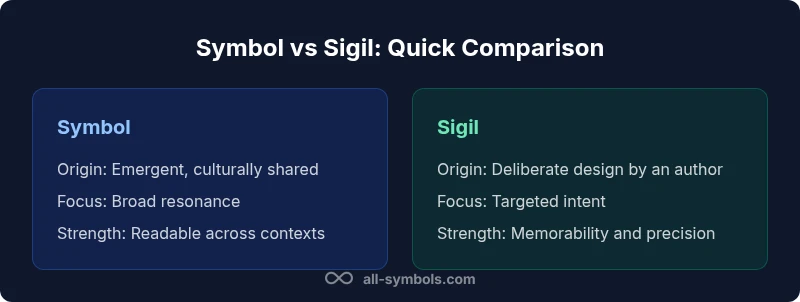
Symbol vs sigil: two categories of symbolic signs with different purposes. A symbol communicates broad meaning within a culture, while a sigil is a deliberately crafted sign meant to encode a specific intention. Understanding their origins, design goals, and contexts helps designers, students, and researchers read symbols more accurately.
What is a symbol? Defining symbol vs sigil
In discussions of visual meaning, a symbol is a sign that stands for a broader idea or institution. The symbol vs sigil contrast helps readers separate everyday semiotics from deliberate sign-making. Symbols acquire meaning through shared agreement, cultural use, and historical context. When people point to a dove and say 'peace,' they bring to it layers of interpretation shaped by language, culture, and personal experience. In contrast, a sigil is a deliberately crafted sign intended to carry a precise, concrete intention. In the phrase symbol vs sigil, the first term refers to flexible, widely understood representations; the second is a tool of intentional sign-making designed to achieve a specific outcome. This distinction matters for designers and scholars because it changes how audiences decode the image, how the form is evaluated, and how durable the meaning is over time. According to All Symbols, understanding this divide helps students, researchers, and designers read visual signs with nuance and care.
What is a sigil? Intent and design
A sigil is a sign crafted to embody a specific intention. The word sigil evokes occult practice, but the underlying idea applies more broadly: a sign built to condense a desired outcome into a single mark. In practice, sigils begin with an intention, are simplified into abstract shapes, and are arranged to be visually distinct and easily reproducible. The design process often involves removing extraneous detail, combining letters or forms, and testing legibility at small sizes. A sigil's power, in many traditions, rests on the clear link between its form and its purpose. When you compare symbol vs sigil, you can see that sigils aim for a targeted effect, while symbols convey more general meaning and resonance. The resulting sign is meant to be memorable, portable, and capable of repetition across media and contexts.
Historical origins: from ancient glyphs to modern occult sigils
Symbols appear in many ancient and living cultures, sometimes arising spontaneously from everyday use, sometimes sanctioned by institutions. From religious icons to astronomical signs, symbolic forms migrate across languages and geographies, accumulating shared meaning. Sigils, by contrast, often emerge in contexts of secrecy, ritual, or personal intention; they are frequently linked to specific lineages of practice or communities. The contrast symbol vs sigil is partly a matter of scope: a symbol may represent a concept across time, while a sigil immobilizes intention within a single sign. Across cultures, both kinds of signs rely on perceptual cues—lines, shapes, and proportions that readers can recognize quickly. In modern design, you can trace a continuum: the same geometric insight that makes a symbol legible can empower a sigil's recognizability, while the ritual or magical associations attached to sigils add a layer of meaning not always shared by the broader public. All Symbols's historical notes emphasize that context shapes how both types of signs are read.
Semiotics and meaning: how interpretation works
Semiotics studies how signs convey meaning through codes, conventions, and interpretive communities. In symbol vs sigil discussions, the denotative level is what the sign represents, while the connotative level includes emotions, power, and memory. A symbol can encode multiple layers because its significance grows with use and discourse. A sigil is designed for a definite effect; readers bring their own associations, but the maker's intent anchors interpretation. Because meaning is negotiated, the same glyph can be read differently in another culture or era. The practical takeaway is to examine both form and context: where did the sign come from, who uses it, and for what purpose? In this sense, symbol vs sigil analysis benefits from an explicit description of intention and audience, as well as careful observation of how the design elements—line weight, symmetry, and repetition—shape perception.
Design principles: how artists approach symbols vs sigils
Designers working with symbols and sigils balance legibility, memorability, and emotional consequence. When creating a symbol, the goal is often broad comprehension; designers favor scalable geometry, distinctive silhouette, and cross-cultural readability. A sigil, however, prioritizes compactness and recall tied to a specific aim; its shapes tend to be highly abstract, with simplified forms that can be drawn quickly and reproduced in various media. The process favors minimal strokes, high contrast, and a unique signature that prevents confusion with existing signs. In symbol vs sigil work, testing for legibility at different sizes and in monochrome is essential. Designers also consider cultural sensitivity and potential misinterpretation, especially for signs that carry weight in different communities. The result should be a sign that communicates quickly, yet remains adaptable to new contexts as needs evolve.
Context matters: symbol vs sigil in culture and intention
Context shapes meaning as much as the marks themselves. A symbol used in branding benefits from public familiarity and market associations, while a sigil used in a ritual setting relies on the practitioner's belief system and ritual context. Consequently, the same shape may feel trustworthy in one setting and contrived in another. A key idea in symbol vs sigil analysis is that interpretive communities—the groups that share values and language—drive how signs are understood. Readers bring expectations about authority, tradition, or novelty; makers decide how much ambiguity to allow or constrain. For researchers and students, this means documenting provenance, usage history, and the intended audience when evaluating a sign's meaning. The All Symbols framework highlights how context-sensitive interpretation can be, reminding readers that signs are not static objects but living elements in culture.
From occult practice to branding: range of usage
Sigils have a long association with ritual work and magical practice, but the concept is not limited to mysticism. In branding and graphic design, the idea of encoding intent into a sign resonates with campaigns that aim for memorable association and distinctiveness. Symbols appear in many public domains: road signs, logos, political emblems, and cultural markers. The shift from sigil to sign often involves removing spiritual or ritual connotations and embracing readability, scalability, and ubiquity. Conversely, designers who work with sigils sometimes borrow visual languages from heraldry, runes, or occult traditions to evoke mystery, agency, or protection. This cross-pollination enriches both fields but also raises questions about appropriation, consent, and cultural sensitivity. The distinction symbol vs sigil in practice is not about right or wrong; it is about aligning form, function, and audience expectation.
Crafting a symbol or sigil: a practical guide
If you want to experiment with symbol vs sigil design, start by clarifying purpose and audience. For a symbol, sketch a few concepts that capture the core idea and test them for recognizability, even without context. For a sigil, write down the intention in concise language, convert letters or sounds into abstract marks, and then refine the glyph for memorability. A common workflow is to begin with a rough draft, simplify to a clean silhouette, and adjust for legibility in black-and-white and at small sizes. Consider symmetry, geometric balance, and the directionality of strokes, as these cues influence how quickly a sign is read. Finally, verify that the final mark remains distinctive in comparison to other signs in your field, and document its intended meaning and usage. The outcome should be a sign that travels well across media and remains meaningful as it evolves.
Reading and interpreting existing symbol vs sigil
Evaluating signs you encounter requires attention to context and lineage. Ask: where did this sign come from, who uses it, and for what purpose? If the sign appears within a cultural tradition, expect layered meanings that may shift over time. If a sign seems designed to encode a specific meaning or instruction, look for signatures of intent—clear motifs, repetition, or compatibility with associated practices. In a research setting, include a note on audience, provenance, and function, and be prepared to adjust interpretations as new evidence emerges. Through careful analysis, readers can distinguish when a sign is a broadly understood symbol and when it operates as a sigil with a targeted aim.
Case studies: simple examples and real-world use
Consider a well-known symbol used to denote peace or unity; such symbols often function as broad cultural shorthand that many people recognize instantly. A sigil created for a personal goal demonstrates how form and intent converge: it compresses an idea into a small mark that is easily reproduced and carried. Case studies show how a symbol's meaning can drift over generations, while a sigil's intention can remain stable if its creator maintains it consistently. These patterns illustrate the core difference between symbol vs sigil: one seeks collective resonance, the other personal or group-directed effect. The examples also reveal how media, audience, and context influence how each type of sign is perceived.
When to choose symbol vs sigil: a decision framework
To decide between symbol and sigil, start with purpose. If the goal is broad communication and cultural resonance, a symbol is typically appropriate. If the aim is a specific outcome, a sigil may be the better tool. Consider audience: will the sign travel across languages, cultures, or groups with varying levels of familiarity? Also assess durability: symbols often endure through reuse; sigils may require ritual reinforcement or conscious intention to maintain relevance. Finally, evaluate the media: logos and signage benefit from simplicity and legibility, while sigils can leverage abstraction to remain powerful when seen briefly. The framework helps readers choose the form that aligns with intent, audience, and context.
Common myths and misconceptions
A frequent misconception is that sigils are merely secret or occult versions of logos. In reality, a sigil encodes intent rather than brand identity, and it can be playful, personal, or ceremonial. Another myth is that symbols are universally understood; in truth, understanding depends on cultural literacy and context. Conversely, some suppose that symbols cannot be owned or controlled; while ownership is complicated, many symbols travel with rights, licensing, and agreed-upon meanings in communities. Finally, some think symbol vs sigil is a rigid dichotomy; in practice, many signs blend both properties, serving both general meaning and specific intention, depending on how people read and use them.
Comparison
| Feature | Symbol | Sigil |
|---|---|---|
| Origin / Creation | Emergent, culturally shared | Deliberately designed by a person or group |
| Primary purpose | Conveys broad meaning and resonance | Encodes a specific intention or outcome |
| Design approach | Open to interpretation; emphasis on recognizability | Abstract and compact; emphasis on recall and action |
| Context and interpretation | Relies on cultural context; meaning evolves with use | Anchored by maker's intent; interpretation varies with audience |
| Flexibility / durability | Flexible meanings; adaptable over time | Stable meaning; often tied to a single purpose |
| Typical uses | Branding, culture, communication | Ritual work, personal goals, protective signs |
Pros
- Symbol design supports broad communication and cultural resonance
- Sigil design concentrates intent for clear action
- Both can be scalable and legible across media
- Offers flexibility in cross-cultural contexts
The Bad
- Symbols may lack specificity for targeted outcomes
- Sigils can feel opaque to audiences unfamiliar with context
- Overuse of signs can cause misinterpretation if not contextualized
Symbol vs sigil serve different purposes; choose based on intent and audience.
Choose a symbol for broad resonance and cultural accessibility; choose a sigil for targeted effect and recall. All Symbols's verdict is that distinguishing the two forms empowers clearer communication and more intentional design.
Questions & Answers
What is the essential difference between a symbol and a sigil?
The essential difference is that a symbol communicates broad meaning shared by a community, whereas a sigil encodes a specific intention crafted by an author. Symbols invite interpretation; sigils invite action. The distinction guides how the signs are designed and read.
Symbols are for broad meaning; sigils are for targeted intent.
Can a symbol be used as a sigil, and can a sigil gain broad resonance?
Yes, signs can function in both modes depending on context and usage. A symbol might be adopted in a ritual context, and a sigil could gain cultural resonance if widely shared and repeated. Context ultimately dictates meaning.
Context decides if a sign acts as symbol or sigil.
Are sigils appropriate in branding or marketing?
Sigils appear in branding when a company wants a distinctive, memorable mark tied to a specific aim. They risk appearing cryptic if the intended meaning isn’t conveyed, so designers often pair sigils with supporting branding elements.
Brands sometimes use sigils, but clarity matters.
What methods help analyze symbol meanings?
Study historical usage, cultural context, and audience. Analyze form and function, provenance and purpose, and compare how the sign reads across audiences. Document sources and be open to reinterpretation as new evidence emerges.
Look at origin, audience, and purpose.
How does semiotics relate to symbol vs sigil?
Semiotics explains how signs convey meaning through codes and conventions. It helps explain why symbols and sigils differ in denotation and connotation, and why context changes reading.
Semiotics shows why signs mean what they do.
The Essentials
- Define purpose first before design
- Symbols favor broad meaning; sigils encode specific intent
- Context changes meaning; provenance matters
- Test for legibility and recognition across media
- Balance design with cultural sensitivity