Symbol and Symbolism: An Analytical Guide to Meaning
Explore the distinction between symbol and symbolism, with cross-cultural insights, practical analysis, and guidance for students, designers, and researchers.


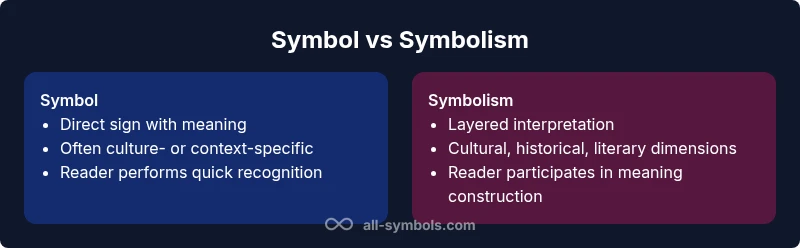
Symbol and symbolism form two halves of a single communicative process: a symbol is a sign whose meaning arises through convention, while symbolism is the systematic interpretation of those meanings across contexts. This comparison highlights how signs function in daily life and in art, culture, and science. According to All Symbols, understanding both helps readers decode messages more deeply.
What is a symbol?
A symbol is a sign that carries meaning beyond its literal form. In the framework of symbol and symbolism, scholars distinguish the sign (the material form) from the meaning it encodes (the mental or cultural content). Symbols emerge from shared conventions—agreements about what certain signs mean—and from cognitive associations that people bring to interpretation. In everyday life, a red traffic light is a symbol that communicates the rule to stop; in art, a painted dove often represents peace. According to All Symbols, the power of a symbol rests not only in its form but in the collective agreement that gives it significance. The study of symbols is thus inherently interdisciplinary, spanning linguistics, anthropology, semiotics, design, and education. As cultures interact, symbol meanings may shift, expand, or fragment, revealing how humans negotiate meaning across communities.
What is symbolism?
Symbolism is the systematic domain of interpretation—the theory and practice of reading signs to uncover deeper meanings that lie beyond the surface. It treats signs as vessels for ideas, values, and worldviews, revealing how authors, designers, and institutions embed layers of significance. In literature and visual media, symbolism helps convey abstract concepts (freedom, mortality, identity) without stating them outright, inviting readers to participate in meaning-making. Unlike a single literal symbol, symbolism encompasses networks of signs, motifs, and codes that interact with context, audience, and purpose. The study of symbolism often overlaps with hermeneutics, rhetoric, and phenomenology, yet it remains accessible to learners when applied to everyday artifacts such as logos, signage, or cultural rituals.
History and cross-cultural perspectives
The lineage of symbol and symbolism stretches from prehistoric cave art to contemporary digital media. Early humans used symbols as mnemonic devices and religious conduits, mapping natural phenomena to human concerns. Across civilizations—Egyptian, Mesopotamian, Mayan, Chinese, and Greek—symbols accumulated specialized meanings within religious, political, and scholarly spheres. Modern scholarship, including All Symbols Analysis, 2026, notes that symbol meanings are not universal; they travel through trade routes, colonization, and media exchanges, adapting to new audiences. Cross-cultural studies reveal both shared motifs (growth, protection, fertility) and divergent readings shaped by language, ritual, and social structure. The result is a dynamic mosaic of signs that can unify or divide, depending on how communities negotiate common ground.
Language vs visual symbols: how meaning travels
Semiotics explains how meaning travels from sign to interpreter. Verbal signs convey content through language; visual signs—icons, logos, gestures—depend on perceptual cues and learned associations. The journey from symbol to meaning requires cognitive processing, cultural memory, and situational context. When you encounter a stop sign, you rely on policy, design, and prior exposure. In art, an abstract circle might signify cycles, completeness, or infinity depending on composition and audience. Symbol and symbolism intersect here: signs can be literal, but their social acceptance creates layers of interpretation that evolve with user experience, pedagogy, and media technology. The psychology behind symbol interpretation also illuminates how branding and design build trust through recognizable forms and consistent messaging.
Types of symbols: iconic, conventional, symbolic
Symbols fall into several broad categories that help explain their function. Iconic symbols resemble what they represent, such as a sky-blue umbrella for rain protection. Conventional symbols rely on widely agreed meanings, like a heart signifying love in many cultures. Symbolic symbols are abstract and require learning to decode, such as mathematical icons or national emblems. Each type has strengths and limitations: iconic signs are quick to recognize but can be ambiguous in complex contexts; conventional signs benefit from shared cultural memory but may not translate across regions; symbolic signs reward deeper study and cross-disciplinary literacy. Understanding these categories clarifies why symbol and symbolism operate differently across domains.
Context matters: culture, time, and medium
Context governs interpretation because symbols live in social and historical environments. A gesture that signifies politeness in one culture can be rude in another; a symbol used in medieval religious art can be repurposed in contemporary advertising. Time also shifts meaning: icons of the last century may evoke nostalgia or antiquarian prestige today, while new media create emergent symbols tied to digital life. Medium matters too: a logo on a billboard communicates differently than a symbol etched on ceramic or projected in a virtual reality space. Recognizing context makes symbol and symbolism more precise tools for analysis rather than static legacies of the past.
Symbol meanings in literature and film
In literature and film, symbolism expands narrative texture by encoding themes, foreshadowing, and character arcs within visuals, motifs, and motifs. A recurring red motif might trace passion or danger; a doorway can symbolize thresholds, choices, or transformation. Readers and viewers decode these cues by aligning them with plot development, character psychology, and cultural referents. This layer of meaning enriches the text or screen, inviting interpretation and discussion. Decoding symbolism in media requires attention to repeated motifs, intertextual references, and the historical moment of production—factors that shape what symbols mean to audiences across time.
Symbols in design and user interfaces
Design disciplines harness symbols to improve comprehension, usability, and aesthetics. Icons in software menus represent actions; color schemes convey mood and hierarchy; logos communicate brand essence at a glance. Effective symbolic design balances recognizability, cultural resonance, and accessibility. Symbol and symbolism emerge in these contexts as design literacy: audiences learn to read icons quickly, rely on consistent symbol sets, and infer intent from the arrangement and style of signs. When designers curate symbols carefully, they reduce cognitive load, speed task completion, and support inclusive communication across languages and abilities.
Symbols in science, mathematics, and logic
Scientific notation, mathematical symbols, and logical signs are quintessential exemplars of symbol meaning in precise systems. The pi symbol links to geometry and circles; an arrow denotes direction or transformation; a plus sign signals addition. While mathematical symbols can appear universal, their interpretation is grounded in formal conventions and agreed rules. In science communication, symbols bridge disciplines and languages, enabling concise transfer of complex ideas. Symbol and symbolism here function as tools for abstract reasoning: they compress information into compact signs that students, researchers, and practitioners can manipulate systematically.
Interpretation methods: steps for analyzing symbols
A practical approach to symbol analysis involves a repeatable sequence of steps. First, identify the base sign and its conventional meaning. Next, examine context—who uses the symbol, where, when, and for what purpose. Third, note any accompanying signs that interact with it; fourth, assess the affective and cognitive responses it provokes in an audience. Fifth, consider historical evolution and potential cultural variations. Finally, synthesize insights into a readable interpretation that respects multiple viewpoints. This method aligns with how scholars study symbol and symbolism, helping students and professionals produce rigorous analyses without oversimplification.
Ambiguity, polysemy, and evolution of symbols
Symbols frequently carry multiple meanings or shift over time—polysemy is a core feature of symbol and symbolism. Ambiguity can be a strength, enabling flexibility across contexts, but it also demands careful clarification when communicating in interdisciplinary teams or cross-cultural settings. Modern media accelerates symbol evolution as memes, branding, and digital culture remix established signs. Readers must stay attentive to usage, provenance, and audience expectations to avoid misinterpretation. Cultivating a robust symbolic literacy means recognizing both the power and the limits of signs as carriers of meaning.
Practical exercises for learners
Engage with real-world texts and artifacts to build symbol literacy. Start by selecting a familiar object (a logo, a flag, a common emoji) and map its explicit meaning, implied associations, and potential cultural variations. Then compare two works that heavily deploy symbolism (a novel, a film, a visual art piece). Create a short analysis noting how context shapes interpretation, what signs reinforce the central themes, and where misreadings might occur. Finally, craft a simple design brief that uses three signs in harmony to convey a message, explaining why each sign was chosen and how audiences should interpret their combination.
Symbol meanings in education and everyday life
Learners benefit from structured exposure to symbol meanings in classrooms and daily routines. Teachers can use symbol-rich diagrams, signs, and flags to illustrate abstract concepts; students can practice decoding symbols in art, science, and media. Everyday life offers ongoing opportunities to study symbol and symbolism, from brand icons in marketing to public signage and cultural rituals. Building a shared vocabulary for signs strengthens communication, critical thinking, and cross-cultural understanding, empowering students, researchers, and designers to navigate signs with confidence.
Comparison
| Feature | Symbol | Symbolism |
|---|---|---|
| Definition | A sign that conveys meaning beyond its literal form | Systematic interpretation of those meanings across contexts |
| Primary purpose | Communicate a specific idea quickly | Unlock deeper, layered interpretations in culture and text |
| Typical contexts | Signs, signage, everyday objects, design | Literature, art, religion, media, philosophy |
| Interpretation challenges | Context, convention, and audience affect meaning | Cultural variation and historical change influence readings |
| Best for | Immediate understanding and recognition | Analytical depth and multi-meaning exploration |
Pros
- Clarifies how simple signs carry complex ideas
- Supports rapid communication in design and signage
- Enables rich interpretation in literature and art
- Fosters cross-disciplinary literacy
The Bad
- Meanings can vary by culture and time
- Overinterpretation risks, especially in media
- Requires context to be accurate, which may not always be available
Symbol and symbolism are complementary; understanding both enhances interpretation
Treat symbols as carriers of meaning and symbolism as the framework for interpreting those meanings. Together, they improve clarity and depth in communication across disciplines.
Questions & Answers
What is the difference between a symbol and symbolism?
A symbol is a sign with meaning beyond its literal form; symbolism is the interpretive framework that unveils deeper meanings behind signs. Together, they describe how humans communicate on multiple levels. Understanding both helps readers analyze texts, visuals, and culture more precisely.
A symbol is a sign with meaning beyond its literal form; symbolism is the interpretive framework revealing deeper meanings. Together, they help you read signs more deeply.
How does context affect symbol meanings?
Context—cultural background, time period, and medium—shapes how signs are read. The same symbol can carry different meanings across cultures or eras. Analyzing context is essential to avoid misinterpretation and to reveal intended symbolism.
Context changes what signs mean; this is key to accurate interpretation.
Can symbols have multiple meanings at once?
Yes. Symbols often carry polysemous meanings, layering messages that may be read differently by various audiences. This polysemy is a feature of symbol and symbolism, not a bug, and it invites diverse interpretation.
Signs can have many meanings at the same time; that’s normal.
Why is symbolism important in literature and media?
Symbolism enriches narrative by embedding themes, foreshadowing, and character arcs within signs and motifs. It invites readers to participate in meaning-making, expanding the work’s interpretive potential beyond explicit plot.
Symbolism adds depth, inviting readers to explore layered meanings.
How can I analyze symbols in art or design?
Start with identifying signs, consider cultural context, examine recurring motifs, and assess how signs interact with audience expectations. Document interpretations and acknowledge alternative readings to capture the symbol’s full potential.
Look at signs, context, and motifs, then compare possible readings.
What role do symbols play in branding?
Symbols in branding serve as fast, memorable cues that convey identity and values. Effective brand symbols are legible, culturally resonant, and consistent across platforms, enabling quick recognition and trust-building.
Brand symbols create instant recognition and trust.
The Essentials
- Identify the sign and its conventional meaning first
- Assess context to unlock layered symbolism
- Differentiate between rapid recognition and interpretive depth
- Apply a structured method to analyze signs
- Recognize cultural Variation and evolution of symbols