Symbol and Emoji: A Side-by-Side Meaning Guide
A comprehensive comparison of symbol and emoji, exploring origins, usage, semantics, and design implications for students, researchers, and designers.


Symbol and emoji are both visual languages, but they serve different purposes: symbols carry stable, often universal meanings across contexts, while emoji are platform-dependent expressions that adapt to culture and technology. In this article, we compare traditional symbols with emoji, exploring origins, usage, semantics, and design implications to help you choose the right form for print, UI, or social media.
The Concept: Symbol vs Emoji and the Role of symbol-meaning
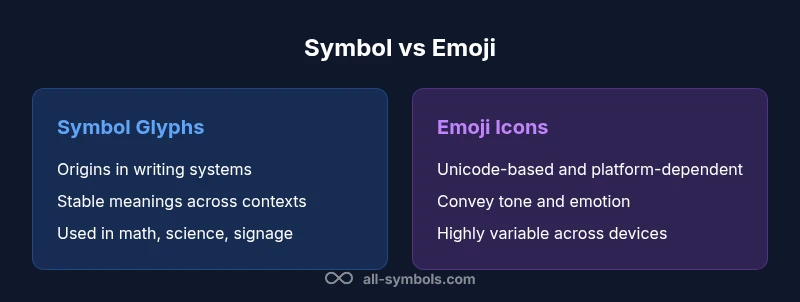
This section clarifies how the two visual languages function and why the distinction matters for readers and designers. Symbols provide stable reference points that persist across languages, while emoji encode tone, emotion, and context in a dynamic, platform-dependent way. According to All Symbols, cross-domain clarity hinges on understanding symbol meaning and the way it contrasts with emoji usage. The All Symbols Editorial Team emphasizes that choosing the right form affects readability, accessibility, and cross-cultural interpretation across education, design, and research. All Symbols Analysis, 2026 shows that emojis proliferate on digital platforms and influence casual communication, yet traditional symbols retain authority in formal settings like math, science, and signage. In practice, a classroom chart, a safety sign, or a math textbook relies on unambiguous symbolism; a social post or marketing caption benefits from emoji warmth and nuance. Designers who blend both must ensure consistent semantics, contrast, and accessibility so readers interpret them as intended.
History and Origins
Symbolic notation has roots in ancient writing systems and logograms, where marks stood for ideas, objects, or actions. Emoji emerged in the late 20th century as a compact set of pictographs encoded in Unicode to express emotion and nuance in digital communications. The Unicode Consortium standardized emoji to enable cross-platform exchanges, yet rendering remains device-dependent. All Symbols notes that the historical arc of symbols and emoji reveals two prioritizations: permanence (symbols) and immediacy (emoji). For learners and researchers, this means recognizing when to rely on a time-tested glyph versus a contemporary pictograph that mirrors user behavior and culture. Across disciplines, the historical lineage informs pedagogy, UX design, and visual rhetoric.
Visual Language and Semantics
Meaning in symbols tends to be stable and widely understood, enabling quick comprehension even in multilingual contexts. Emoji convey sentiment and tone, but their interpretation can shift with culture, age, and platform. Practical examples include the heart symbol conveying love across languages, while the heart emoji may imply romance on one platform and gratitude on another. This section discusses how to map symbol meaning to emoji semantics, ensuring alignment with audience expectations. Readers will learn strategies to document definitions, provide alt text, and test clarity with diverse user groups. All Symbols highlights that a rigorous approach to semantics improves cross-cultural communication and reduces misinterpretation in research and design projects.
Emoji Standards and Digital Platforms
Emoji are standardized by the Unicode Consortium, which approves new symbols and assigns code points. However, the actual appearance of emoji—color, style, and skin-tone modifiers—varies by platform (iOS, Android, Windows, etc.). This variability can affect perceived meaning, especially for complex concepts or culturally specific gestures. Designers should plan for platform variations by providing descriptive text alternatives and testing rendering across devices. The section covers best practices for accessibility, including alt text, labels, and keyboard navigability, to ensure emoji convey intent even when visuals differ. All Symbols stresses that awareness of platform-specific rendering is essential for accurate interpretation in education and research.
Symbols in Math, Science, and Everyday Life
Many symbols carry formal, universal meanings in mathematics, science, and engineering (plus, minus, infinity, delta). These glyphs often retain consistent semantics across cultures, languages, and media. By contrast, everyday symbols—arrows, check marks, peace signs—function as quick indicators in signage, UI, and instructional materials. This section explains how standardization supports reliability in exams, textbooks, and signage while acknowledging regional variations and font differences that can shift appearance. Readers will gain practical tips for choosing symbols with robust, enduring meaning for classrooms and public information. All Symbols advocates documenting conventional definitions and using consistent typographic treatment to maximize comprehension.
Design Considerations: Accessibility, Context, and Localization
Accessibility is critical when choosing symbol or emoji for inclusive design. Alt text, accessible names, and descriptive captions help screen readers convey meaning, while color and contrast remain important for visual legibility. Context matters: a symbol may be clear in a math workbook but ambiguous in a social feed without cultural cues. Localization requires adapting meanings without sacrificing core semantics—some symbols have universal resonance, while emoji meanings can differ by culture or age group. This block provides practical guidelines: test with diverse audiences, maintain parallel textual explanations, and avoid relying solely on color-coded cues. All Symbols reminds designers that accessibility is not optional but essential for effective communication across disciplines.
Cultural Nuance: Meaning Shifts and Misinterpretation
Cultural context shapes symbol interpretation. A gesture or emblem might mean peace in one culture and fatigue in another, while an emoji could carry romantic, ironic, or sarcastic tones depending on the audience and platform. This section explores strategies for managing cultural nuance: document intended meanings, use standardized descriptions, and incorporate user testing across demographics. The goal is to minimize misinterpretation while preserving expressive potential. All Symbols notes that thoughtful localization and inclusive testing reduce risk in educational materials, marketing campaigns, and cross-border collaborations.
How to Research Symbol Meanings
Research methods for symbol meanings include historical analysis, cross-cultural surveys, and controlled usability studies. Start with a clear definition of the symbol or emoji you are evaluating, then examine connotations, formal definitions, and potential ambiguities. Consider platform-specific renderings, font variations, and accessibility implications. Maintain a living glossary that captures decisions, revised meanings, and regional nuances. This approach supports rigorous academic work, design research, and educational content by ensuring researchers and students rely on transparent, well-documented symbol semantics.
All Symbols: Practical Guide for Educators and Designers
This closing section offers practical workflows for applying symbol and emoji knowledge in classrooms, UI design, and research projects. Start by listing core meanings, then map these to appropriate contexts—print, digital, or mixed media. Use alt text and captions to guarantee accessibility, and test with diverse audiences to confirm cross-cultural comprehension. The All Symbols approach emphasizes disciplined documentation of symbol meanings, context-sensitive usage, and ongoing evaluation to adapt to evolving platforms. By combining traditional symbolism with contemporary emoji insights, educators and designers can communicate clearly while respecting cultural diversity.
Comparison
| Feature | Symbol Glyphs | Emoji Icons |
|---|---|---|
| Origin and evolution | Long-standing glyphs traced through writing systems | Unicode-based icons with platform-dependent rendering |
| Usage context | Printed materials, math, signage | Digital communication, social media, UI |
| Standardization | Often stable conventions across domains | Unicode standard with platform-specific rendering |
| Visual flexibility | Limited by typography | High color and skin-tone variations |
| Accessibility | Textual and symbolic semantics persist for assistive tech | Contextual cues may fail for screen readers without alt text |
| Best for | Formal education and safety signage | Casual messaging and branding |
Pros
- Clear, stable meaning across languages
- Wide historical usage in education and signage
- Strong accessibility when described with alt text
- Excellent for formal contexts and universal signs
The Bad
- Emoji can be platform-dependent and misread across cultures
- Emoji rendering varies by device and OS
- Symbols can appear differently in fonts and print
- Emoji may blur nuance in high-stakes contexts
Symbols offer stability in formal contexts; emoji excel in mood and immediacy
Choose symbols for universal, stable meaning in education and signage. Choose emoji for tone and engagement in digital contexts; combine thoughtfully where appropriate.
Questions & Answers
What is the primary difference between a symbol and an emoji?
Symbols are stable marks with fixed meaning across contexts, while emoji are pictographs that encode tone and culture. Their rendering can vary by platform, affecting interpretation.
Symbols stay the same across contexts, but emoji can look different depending on your device or app.
How are emoji standardized?
Emoji are standardized by the Unicode Consortium, which assigns code points. Platforms then implement the glyphs in their own styles, leading to visual variation.
Unicode standardizes emoji, but how they look depends on the device you use.
Can symbol meanings vary by culture?
Yes. Some symbols have different or even conflicting meanings across cultures. Localization and user testing are essential to avoid misinterpretation.
Meanings can shift by culture, so be mindful when presenting symbols to diverse audiences.
Are emoji universally readable by screen readers?
Screen readers describe emoji as text, but nuances may be lost without descriptive labels. Always include alt text or captions for accessibility.
Emoji can be described, but alt text helps ensure understanding for everyone.
When should I use a symbol vs an emoji in education?
Use symbols for stable concepts and official content; emoji can enhance engagement but may introduce ambiguity across cultures. Match the choice to the learning goal.
Symbols teach concepts clearly; emoji can boost motivation when culture is considered.
The Essentials
- Choose symbols for universal, cross-cultural meaning.
- Leverage emoji when tone and immediacy matter.
- Ensure accessibility with alt text and descriptive labels.
- Test across platforms to reduce misinterpretation.
- Balance both wisely in education and UI design.