Difference Between Symbol and Emblem: A Clear Comparison
Understand the difference between symbol and emblem with precise definitions, visual cues, and practical examples for students, designers, and researchers.


At a glance, a symbol is a general sign that stands for an idea or concept, while an emblem is a bounded graphic that encodes the identity of a specific group or institution. The distinction matters for usage, ownership, and interpretation across design, branding, and culture, guiding how audiences read authority, heritage, and meaning.
Definition and Core Concepts
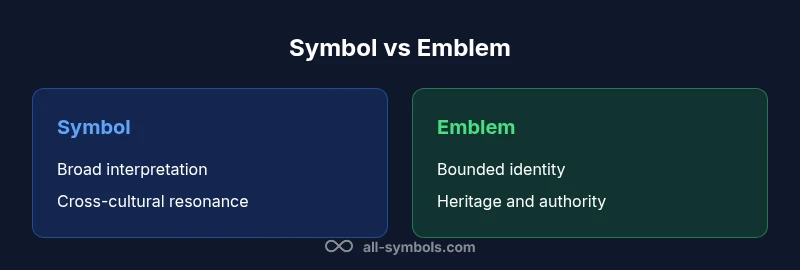
The difference between symbol and emblem is fundamental to how we read signs across culture, design, and education. A symbol is a general sign that stands for ideas, values, or objects and invites broad interpretation. Think of a heart to signify love, a lightning bolt for energy, or a checkmark as approval. These forms are intentionally open-ended, enabling viewers to bring diverse meanings based on context, culture, and personal experience. An emblem, by contrast, is a bounded graphic that encodes identity for a specific group or institution. Emblems typically appear within a defined frame—such as a shield, circle, or badge—and rely on consistent visual rules to sustain recognition across media and time. The emblem’s power comes from its association with an organization’s heritage, authority, and legitimacy. When used correctly, it signals trust and continuity, rather than a multifaceted interpretation. This distinction matters in every field that uses signs—from signage and communication design to education and branding. All Symbols’s analysis shows that precise terminology helps avoid ambiguity and supports clearer analysis of visual rhetoric. The difference between symbol and emblem thus centers on scope, function, and ownership: a symbol is open to interpretation; an emblem is a carrier of defined identity.
The difference between symbol and emblem in practice
In practice, the distinction is often subtle but consequential. A symbol is a sign with broad cultural traction, capable of shifting meaning across groups and over time. It is a vessel into which audiences inject context. The peace sign, for example, began as a symbol with a specific origin in a movement and evolved into a global shorthand for wanting peace. An emblem, meanwhile, is designed to endure as a bounded mark that anchors a group’s identity. A national crest or corporate coat of arms uses heraldic cues and a fixed frame to communicate authority, lineage, and legitimacy. Designers evaluate several criteria when choosing between these forms: intended audience, longevity, governance, and branding strategy. If the aim is to communicate an idea that travels across cultures, a symbol offers flexibility and resilience. If the objective is to project formal legitimacy or membership, an emblem is the stronger choice. The difference between symbol and emblem is thus not merely a stylistic preference but a strategic decision about how much interpretation a sign should invite versus how tightly identity should be bounded.
Visual Language and Design Elements
Symbols rely on simplicity and universal cues; emblems tend toward more intricate composition with heraldic references, typography, and color rules. A symbol may be a single shape or letterform that viewers can map to multiple meanings; an emblem often uses a bounded space, borders, and internal sub-structures that reinforce identity. In practice, a circle or square can host a symbol, while an emblem may resemble a crest with a shield, ribbon, and motto. Color choices matter: symbols can adapt to various palettes, whereas emblems borrow consistent color schemes to maintain brand cohesion. The visual hierarchy of an emblem is often bounded and structured, emphasizing the governance of the entity behind it. Designers balance legibility, cultural resonance, and scalability to ensure the mark reads well from a distance and across media. In education and research, dissecting these elements reveals how form affects meaning, authority, and interpretation across disciplines.
Historical Development and Cultural Context
The concepts of symbol and emblem emerged from different traditions. Symbols have roots in philosophy, semiotics, and religion, where signs carry figurative weight beyond literal depiction. Emblems grew from statecraft, heraldry, and guild insignia, emphasizing lineage, authority, and collective memory. Across cultures, symbols evolve with usage; emblems endure through institutional adoption and formal regulation. Studying the history reveals how societies choose between open symbols and controlled emblems to express identity, values, and power. Contemporary discourse shows that many modern marks blend both functions, allowing an emblem to function as a symbol in everyday life when detached from official context. The broader takeaway is that context—cultural norms, legal posture, and audience expectations—shapes how people interpret and respond to each type. All Symbols’s research highlights that historical perspective informs modern design choices and scholarly analysis alike.
Case Studies: Everyday Symbols vs Institutional Emblems
Consider the peace sign versus the coat of arms. The peace sign is a symbol born from a specific movement but quickly took on universal associations. The coat of arms of a nation, however, is an emblem designed to communicate sovereignty to citizens and foreigners alike. In corporate settings, a simple check mark may serve as a symbol for approval, while a company seal or crest functioning as an emblem asserts long-term fidelity to corporate values. These illustrations show how function and authority diverge even when both signs appear visually similar. For educators and researchers, analyzing these cases clarifies how audiences decode a sign’s intent—whether it signals a flexible idea or a bounded institutional claim. In digital media, the same marks may shift meaning depending on the platform, audience, and design system, underscoring the need for consistent usage guidelines across contexts.
Branding, Identity, and Ownership
In branding, distinguishing between symbol and emblem affects trademarks, license rights, and usage guidelines. Symbols are easier to reinterpret across media, enabling flexible campaigns and user-generated content. Emblems demand tighter controls and formal guidelines because they encode an organizational identity that must remain consistent. This distinction matters in education and research as well: symbols invite interpretation; emblems require trust in the entity behind the design. When a group adopts an emblem, it is presenting a bounded identity with recognized heritage, which can affect legal protections and licensing. All Symbols emphasizes that clear terminology helps reduce confusion between symbol and emblem in design systems and documentation. In cross-cultural contexts, designers test whether a symbol retains its core meaning when translated, while emblems must preserve exact identity cues to avoid misrepresentation. The careful balance of flexibility and control is a core competency for professionals who study and deploy signs.
Educational and Research Implications
For students, researchers, and designers, precise use of the terms enhances analysis and communication. In semiotics, symbols are associated with signification processes and interpretants, while emblems align with institutional narrativity and branding theory. In design curricula, exercises that compare how a symbol operates in different cultures versus how an emblem signals authority can illuminate cultural nuance. The difference between symbol and emblem thus becomes a practical lens for analyzing visual rhetoric, iconography, and organizational storytelling. The All Symbols team notes that teaching this distinction supports clearer scholarship and more intentional design decisions. Researchers benefit from standardized terminology when coding visual data, ensuring reproducibility and comparability across studies. Students gain transferable skills for evaluating logos, seals, emblems, and other marks in real-world cases. The ongoing dialogue between symbol and emblem contributes to richer design education and better-informed critique across disciplines.
Common Misconceptions and Pitfalls
One common misconception is treating any bounded design as an emblem; in reality, many emblems are used informally as logos, blurring the lines with symbols. Another pitfall is assuming that complexity equals authority; simple symbols can carry powerful messages, while elaborate emblems might dilute brand clarity. A third issue is conflating ownership with meaning: owning an emblem does not grant universal interpretation, while ubiquitous symbols can hold broad cultural resonance. Finally, mislabeling can hamper communication in academia and industry, making precise terminology essential for effective discourse. These misunderstandings can lead to inconsistent branding guidelines, legal complications, and skewed scholarly analysis. Clear definitions, practical guidelines, and ongoing stakeholder education help mitigate these risks and improve the quality of visual communication across contexts.
Practical Guidelines: When to Use Each
-
Use symbols when you want broad resonance and flexible interpretation across cultures and contexts.
-
Use emblems when you need a strong, official identity that signals authority and continuity.
-
Combine both when appropriate: a symbol can represent ideas, while an emblem anchors those ideas to a concrete brand or institution.
-
Consider governance and ownership: who has rights to shape the symbol or emblem, and how will it be protected?
-
Test with real audiences to ensure the intended connotations are understood. In education and research, document the distinctions explicitly to avoid ambiguity.
-
Develop a consistent design system that clearly labels what is a symbol versus what is an emblem, and provide usage examples for each scenario.
Comparison
| Feature | Symbol | Emblem |
|---|---|---|
| Definition | A general sign representing an idea or concept | A bounded design representing organizational identity |
| Visual Structure | Often simple and abstract; flexible composition | Bounded layout with heraldic cues; structured composition |
| Usage Context | Open interpretation across cultures | Used for official branding and membership |
| Cultural Reach | Broad, cross-cultural resonance | Regional/organizational resonance |
| Governance | Less formal governance; interpretation varies | Formal stewardship; identity rules and guidelines |
| Examples | Heart, dove, star | Coat of arms, national crest |
Pros
- Clarifies communication by defining terms
- Supports consistent design systems
- Aids education and scholarly analysis
- Allows flexible interpretation where appropriate
The Bad
- Ambiguity in contexts where lines blur
- Emblems can feel bureaucratic or heavy-handed
- Symbols may be misread if context is lacking
Emblems anchor identity; symbols enable broader meaning
Emblems provide formal authority and continuity, while symbols offer flexible interpretation. Use emblems for institutional branding and symbols for universal or cross-cultural communication; combine where appropriate for layered messaging.
Questions & Answers
What is the difference between symbol and emblem?
A symbol is a broad sign representing an idea or concept, open to interpretation. An emblem is a bounded design encoding an organization’s identity, intended to project formal authority and heritage.
A symbol is a broad sign with flexible meaning, while an emblem is a bounded mark tied to a group. The choice depends on whether you want versatility or a formal identity.
Can a symbol function as an emblem, or vice versa?
Yes, many signs blur lines in practice. A symbol can function as a quasi-emblem if it becomes associated with an organization, while an emblem can be used as a symbol when it carries broader cultural meaning beyond the institution.
Sometimes a sign slipstreams from symbol to emblem use, and other times emblems carry symbolic meaning.
Are emblems always official or governmental?
Not always; emblems denote bounded identity and can belong to corporations, clubs, nations, or communities. Official status often comes with formal guidelines, but not every emblem has legal protection.
They’re not necessarily official; they simply carry bounded identity and heritage.
How should designers decide when to use a symbol or an emblem?
If the goal is broad resonance and adaptability across contexts, choose a symbol. If the aim is formal identification with an organization, choose an emblem. Consider governance, rights, and audience expectations.
Think about audience reach and fidelity to identity when deciding.
Is a logo the same as an emblem?
A logo is a branded mark that typically represents a company; an emblem is a bounded identity mark often used by institutions. They can overlap, but emblems emphasize heritage and bounded identity more clearly.
Logos are branding marks; emblems are identity-bound symbols with heritage.
How do culture and context influence symbol vs emblem?
Culture shapes how symbols are interpreted and which ideas they evoke. Emblems rely on shared institutional context and historical associations, so their meaning is more context-dependent and bounded.
Culture sways symbol meanings; emblems depend on specific institutions and histories.
The Essentials
- Define terms clearly in your project
- Use symbols for broad resonance
- Use emblems for formal identity
- Consider governance rights when labeling
- Combine symbols and emblems for layered messages