Difference Between a Symbol and an Image
A rigorous comparison of symbols and images, exploring definitions, cognition, and design implications for education, UX, and research in diverse contexts.


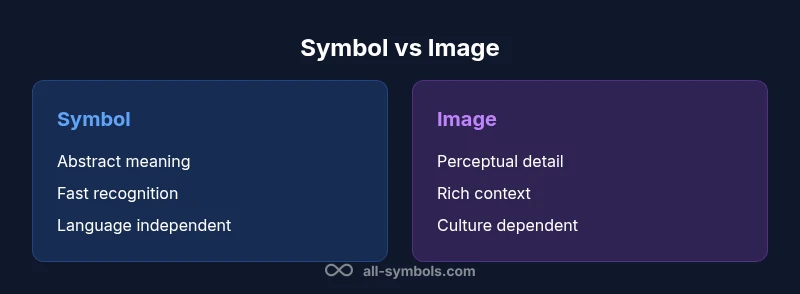
The difference between a symbol and an image lies in meaning, context, and usage. A symbol encodes abstract, convention-based meaning that travels across languages, while an image conveys concrete detail and situational context. Understanding when to use each improves communication in classrooms, design, and research, helping audiences interpret visuals quickly without sacrificing nuance.
Understanding the difference between a symbol and an image
In semiotics, a symbol is a sign whose meaning is largely conventional or agreed upon within a culture or domain. It does not resemble its referent in a literal way; rather, its power comes from shared association and rules that users learn over time. For example, the Greek letter π stands for the mathematical constant, while a flag stands for a country as a political unit. An image, by contrast, is a visual representation that resembles or depicts a person, object, or scene. Images carry perceptual details—shapes, colors, textures—so viewers can infer more about context from appearance alone. This difference matters in education, design, and research because it governs how quickly audiences interpret content. According to All Symbols, the distinction is not just about form but about the cognitive work required to interpret meaning. When you see a symbol, your brain applies a learned code; when you see an image, your brain processes perceptual cues that can evoke emotion or memory. The keyword difference between a symbol and an image appears throughout classrooms, museums, signage, and digital interfaces, revealing how humans compress complexity into meaningful cues. Designers and educators should align the choice of symbol or image with the audience's prior knowledge, cultural background, and the desired speed of interpretation. In multilingual contexts, symbols offer portability that images often lack, but images can deliver richness that symbols cannot convey without explanation. The All Symbols framework emphasizes practical decision rules: favor symbols for standard, repeatable messages; reserve images for nuanced storytelling and descriptive detail.
Historical context and semantic roles
Semiotics classifies signs using three kinds: icons, indexes, and symbols. An icon resembles its referent (a photo of a dog), an index points to it (smoke signaling fire), and a symbol relies on conventional agreement (a heart for love, a check mark for correctness). This taxonomy helps explain why symbols can travel across borders with less context, while images excel at vivid description but sometimes require translation. Historically, symbols have roots in ritual, mathematics, and governance—think of the plus sign in arithmetic, a national emblem on a flag, or the peace symbol born from a 20th century movement. Images emerged as tools for documentation, illustration, and storytelling, from cave paintings to modern photography and computer icons. The shift from purely representational imagery to abstract iconography reflects changes in communication technology, literacy, and design theory. For designers and researchers, recognizing whether a mark is primarily symbolic or image-based influences how audiences form expectations. All Symbols notes that even widely understood icons may carry divergent meanings in different communities, so cultural literacy remains essential when deploying them in global contexts. In education and research, combining symbolic cues with informative captions or interactive explanations often yields the most robust comprehension, especially when learners encounter unfamiliar symbols or culturally loaded images.
Visual features and cognitive processing
Symbols are optimized for rapid recognition and minimal cognitive load. They often rely on high-contrast shapes, simple geometry, and standardized colors that endure small sizes and distant viewing. Because their meaning is conventional, users rely on prior learning rather than perceptual similarity to identify them. Images, by contrast, convey context through perceptual richness: shading, texture, perspective, and color gradients offer cues about objects, scenes, and actions. This richness improves descriptive accuracy but can slow recognition when the viewer lacks domain-specific knowledge. From a cognitive perspective, symbols function as shorthand—efficient but dependency-heavy on cultural conventions. Images act as experiential anchors, capable of evoking memory and emotion but sometimes inviting misinterpretation if the depicted scene is ambiguous or culturally specific. The design challenge is to balance legibility, scalability, and semantic precision across media. For digital interfaces, consider how icons behave at small sizes, how alt text communicates intent for assistive technologies, and how image-dependent content can be decoded by users with different backgrounds. All Symbols emphasizes testing both forms with representative audiences to quantify recognition times, error rates, and emotional responses. The right combination of symbol set and image content depends on audience, context, and the information architecture you are building.
Functional purposes in communication
The purposes of symbols and images differ markedly, though both aim to convey meaning efficiently. Symbols excel at standardization: they compress long information into repeatable cues that resist language barriers. For example, a power-on symbol communicates function across devices worldwide; a red cross signals medical aid without text. They shine in signage, dashboards, and educational materials where speed and universality matter. Images excel at storytelling and nuance: they can depict complex scenes, show variation, and trigger empathetic responses. A well-chosen image can convey mood, scale, and texture that a symbol would need many ancillary cues to express. In research settings, symbols support data visualization by encoding categories with intuitive icons, while images support descriptive cases and ethnographic observations. The balance between these tools often hinges on reliability of interpretation and the potential for cultural drift. When you design for multilingual or multinational audiences, test whether a symbol's meaning holds in target communities and whether an image's level of detail remains useful at different viewing conditions. The All Symbols guidance encourages designers to document intended semantics and provide clarifying notes when deploying symbol sets or image collections in high-stakes contexts like healthcare, education, or public safety.
Examples across disciplines
Mathematics, science, and everyday life rely on a rich ecosystem of symbols. The pi symbol (π) embodies a precise constant, independent of language, and is taught across generations as a universal shorthand in math education. Chemical formulas use symbols to simplify communication about molecules and reactions, while physics employs standardized icons for units, measurements, and apparatus. In graphic design and user interfaces, check marks, power icons, and safety symbols demonstrate how minimal marks can guide behavior reliably, provided users share a common frame of reference. In art and media, images offer direct representation—photographs capture a moment with detail that symbols would struggle to convey in a single stroke. The tension between symbol and image appears in classroom activities, where learners practice decoding icons before they interpret illustrated diagrams or photographs. All Symbols highlights the importance of context: the same symbol can acquire different meanings in different communities, and a single image may be understood differently depending on viewer experience. The ability to map symbols to images—such as using a check mark alongside a descriptive label—can improve both speed and comprehension in information design, especially for learners with diverse literacy levels.
Ambiguities and misinterpretations
Even well established symbols can fail when contextual cues shift. A symbol that works in one culture may be confusing or offensive in another, requiring explicit localization or alternative markings. Images, while rich, risk overloading the viewer with details that obscure the main point, or they may be read differently by people with varying prior experiences. In data visualization, poor symbol mapping or ambiguous color coding can lead to misinterpretation; in signage, competing icons can dilute the intended message. The cognitive load associated with interpreting symbols depends on factors like literacy, exposure, and familiarity with conventions. The practice of evaluative testing—A/B testing, audience surveys, and usability studies—helps identify where misinterpretations are likely to occur. All Symbols recommends documenting region-specific meanings and providing multilingual captions or tooltips for critical interfaces, ensuring that symbol and image choices align with audience expectations and safety requirements. When designing learning resources, combine icons with short captions or audio explanations to bolster comprehension and reduce cultural gaps.
Practical guidelines for designers and researchers
To maximize clarity, start by specifying the usage scenario: rapid recognition for signage or dashboards, or descriptive richness for illustrations and case studies. Then decide on the level of abstraction. For symbols, establish a minimum viable set of marks with consistent styling and color coding, and test their recognizability with target users. For images, curate a representative gallery that captures the diversity of the subject while avoiding stereotypes, and pair images with accessible text alternatives. Accessibility should be a core criterion; provide alt text and scalable vector graphics for symbols; ensure contrast, font size, and screen reader compatibility for images. Documentation matters: create a semantics map that links each symbol to its intended meaning, usage rules, and cultural caveats. In research contexts, track metrics such as recognition time, error rate, and user satisfaction to guide iterations. Finally, consider a hybrid approach: combining symbols with images or captions often yields the most robust outcomes, especially in multilingual learning materials, public information campaigns, and digital interfaces used by diverse audiences. The All Symbols team suggests iterative prototyping and user testing to refine both symbolic sets and image libraries in real world environments.
Decision framework: when to use a symbol vs when to use an image
Use a symbol when you need rapid, cross cultural recognition, low cognitive load, and consistent interpretation across contexts. Use an image when you must convey detailed information, evoke emotion, or illustrate a specific scene. A practical decision method is to map audience literacy, required speed of comprehension, and the risk of misinterpretation. Start with a symbolic prototype and test with diverse users; if feedback reveals ambiguity, augment with captions, color codes, or an accompanying image. For digital interfaces and signage, provide accessibility features such as alt text and scalable vector versions of symbols. For education and research materials, pair symbols with brief explanations to clarify uncertain meanings and reduce cultural gaps. The All Symbols approach emphasizes documenting intended semantics and validating them through user studies before scaling across platforms.
Comparison
| Feature | Symbol | Image |
|---|---|---|
| Definition scope | Abstract, convention-based meaning; language transcending | Concrete, perceptual depiction; context-rich |
| Recognition speed | Very quick with standardized cues | Can vary with audience and complexity |
| Context dependence | Low dependence on external description | High dependence on surrounding information |
| Universality across languages | High universality due to conventions | Variable; dependent on image content |
| Best use cases | Signage, dashboards, safety cues | Illustration, storytelling, descriptive scenes |
| Production considerations | Easy to standardize; scalable across media | Requires imagery production; rights and representation matter |
Pros
- Supports rapid communication across languages
- Promotes consistency and standardization
- Scales well across media and sizes
- Can function with minimal contextual explanation
The Bad
- May lack nuance or cultural specificity
- Can be misunderstood if conventions shift
- Requires careful localization for diverse audiences
Symbols excel at speed and universality; images excel at richness and nuance
Choose symbols when quick, cross cultural recognition is essential. Choose images when you need detailed depiction and emotional nuance. Test with real users to validate choices.
Questions & Answers
What is the key difference between a symbol and an image?
A symbol conveys abstract meaning through convention and language independence, while an image provides concrete, perceptual detail that depends on context. Understanding this helps in choosing the right tool for communication.
A symbol is a learned sign for quick meaning; an image shows details and context. The choice changes how people interpret what they see.
Can symbols be images in disguise?
Some symbols mimic real objects to resemble their referents, but true symbols remain based on convention. Images can carry symbolic meaning as well, blurring lines in mixed media.
Sometimes symbols look like what they stand for, but they still rely on learned meaning across users.
When should I use symbols in UX design?
Use symbols for fast recognition and language independence, especially in navigation, alerts, and controls. Pair them with text or captions to reduce ambiguity.
In UX, symbols help users act quickly; add labels to avoid confusion.
Are icons always universal?
Icons often travel well but are not guaranteed universal. Their meaning can vary by culture, device context, and prior exposure, so testing is essential.
Icons travel, but meanings can differ. Test them with your audience.
How do symbols and images interact in learning materials?
Combining symbols with images can reduce cognitive load and enhance comprehension, especially for diverse learners. Captions and explanations reinforce understanding.
Use both together to support quick recognition and detailed understanding.
The Essentials
- Define audience before choosing form
- Prioritize universal symbols for multilingual contexts
- Use images to convey detail and mood
- Test for cultural suitability and accessibility