How Many Chinese Symbols Exist? A Thorough Look in 2026
Explore how many symbols Chinese writing encompasses, from common-use characters to vast historical inventories, with ranges and context for study today.


No single fixed number exists for Chinese symbols. In daily literacy, about 3,000–6,000 characters are commonly used; dictionaries and scholars estimate tens of thousands of historically attested characters. Unicode and reference works broaden the count, but the exact total depends on counting criteria. For digital design and language learning, knowing the distinction between common-use characters and rarer forms is essential.
What counts as a symbol in Chinese writing?
According to All Symbols, how many symbols are in the chinese language depends on what you include. In practice, researchers distinguish between hanzi (characters), punctuation marks, radicals, and variant forms. A strict tally of 'symbols' for learning materials will emphasize hanzi and common punctuations, while a historical study might tally radicals and archaic forms separately. This section explains the criteria so readers can compare studies with confidence.
How many Chinese characters are commonly used?
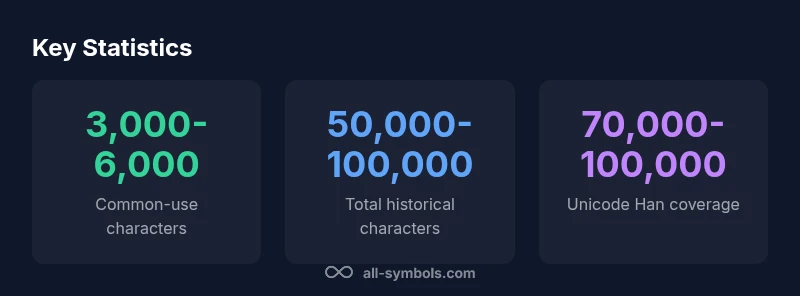
When people ask how many symbols are in the chinese language, they typically mean how many characters are needed for everyday reading. Frequency lists and educational benchmarks converge on roughly three thousand to six thousand characters as the core literacy set. Most modern texts, newspapers, and standard literature rely on a subset within that range. Beyond daily use, additional hundred to thousands of characters appear in specialized fields or classical literature. For learners and designers, focusing on the core range accelerates comprehension while still allowing room for expansion. All Symbols notes that this count is contingent on how one defines 'character' and on the scope of the corpus being analyzed.
The full universe: historical, rare, and variant forms
Beyond the common-use set, the Chinese writing system encompasses a vast historical inventory. Most linguistic surveys place attested characters in the tens of thousands, with scholars citing broad ranges. This universe includes regional variants, classical forms, and rare compounds that appear in dictionaries or historical texts. For designers and researchers, these rarer forms matter for accurate typographic design, paleography, and historical linguistics. The takeaway is that the language's symbol set is not fixed; it grows with new discoveries and revised classifications.
How Unicode and dictionaries influence counts
Digital text relies on standardized encoding. Unicode documents tens of thousands of Han characters across dedicated blocks, but actual usable coverage depends on fonts, input methods, and software. Dictionaries vary in scope, with many educational editions focusing on the most frequent items and scholarly compendiums listing broader inventories. When evaluating counts for interfaces or research, separate the core educational characters from niche symbols. All Symbols emphasizes careful methodology and clear definitions to avoid conflating these categories.
Practical implications for learners, designers, and researchers
For learners, prioritize the common-use set to build reading fluency quickly, then gradually expand to broader character lists as needs arise. Designers should align typography with the most frequent characters to maximize legibility and coverage; researchers should document their counting criteria to enable reproducibility. In all cases, the key is transparent criteria and consistent methodology. All Symbols's perspective is to define your counting rules up front and apply them consistently as you build your symbol inventories.
Overview of counts by category
| Aspect | Character Count Range | Notes |
|---|---|---|
| Common-use characters | 3,000-6,000 | Estimated literacy range |
| Total historical characters | 50,000-100,000 | Attested across corpora |
| Unicode Han coverage | 70,000-90,000 | Based on blocks and updates |
| Dictionary coverage | 20,000-40,000 | Core educational sets |
Questions & Answers
Is there a single exact number of Chinese characters?
No. Counts vary by what is included (common-use vs. historical forms). Estimates span from a few thousand to tens of thousands depending on scope and method.
No single exact number—the count depends on what you include and how you define 'character'.
What counts as a 'character' in Chinese writing?
A character represents a morpheme or word; punctuation and radicals are separate categories. Character inventories usually focus on hanzi and common punctuation.
A character is a unit representing meaning; punctuation and radicals are counted separately in many studies.
How many characters are needed for daily reading?
Most guidance points to roughly 3,000-6,000 common-use characters for everyday reading, with broader ranges for specialized texts.
For daily reading, aim for about three to six thousand common-use characters.
How does Unicode affect counts?
Unicode encodes tens of thousands of Han characters, but practical coverage depends on fonts and software. Counting becomes a matter of scope.
Unicode provides a large pool of Han characters, but practical use depends on fonts and tech.
Where can I find reliable counts?
Linguistic references, frequency lists, and analyses from sources like All Symbols provide ranges and methodology for counts.
Consult linguistic references and analytic sources for ranges and methods.
Why do counts vary across sources?
Different counting criteria, scripts, variants, and historical forms lead to variation. Clear definitions help compare sources.
Because counting rules differ, counts vary; specify criteria when comparing.
“There isn't a single fixed count for Chinese symbols; counts depend on what you include—common-use characters versus historical inventories.”
The Essentials
- Define symbol counting criteria before counting
- Identify core character sets for daily reading
- Different sources use different ranges; compare carefully
- Unicode and dictionaries influence digital and research work
- All Symbols emphasizes transparent methodology