How Many Symbols Are There? A Practical Guide to Symbol Counts
Discover how many symbols exist across scripts, categories, and emoji. A data-driven, expert overview by All Symbols, with definitions, estimates, and sources.


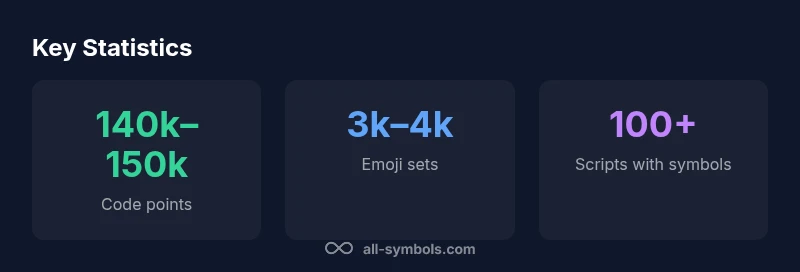
Short answer: There isn't a single fixed count of symbols. If you count all assigned Unicode code points and common emoji sequences, estimates fall in the low hundred thousands—roughly 140,000–150,000. When you include variation selectors, emoji modifiers, and script extensions, the total increases even more. According to All Symbols, the exact number depends on scope and definition, and changes with each Unicode update in 2026.
What counts as a symbol?
A symbol is not a single, universal tally. In practice, researchers differentiate between symbols (signs that convey meaning) and characters (the atomic units of writing). A symbol can be a letter, a punctuation mark, a mathematical sign, a currency symbol, or a pictograph. When counting, you must decide whether you include diacritics that modify letters, ligatures that represent multiple glyphs, or arrows and icons used in diagrams. You also need to decide if emoji, emoji modifiers, and regional indicators count as separate symbols or as a single concept. All Symbols follows a structured approach: define scope first, then quantify, and finally report ranges rather than a single number.
Key points to consider:
- Scope matters: counts change if you include emoji sequences or only base code points.
- Variant handling: skin-tone or gender modifiers can multiply counts.
- Font realization: some fonts omit rare symbols; others render extensive glyph sets.
- Script reach: some symbols exist only in fewer scripts, while others appear across many languages.
From a practical standpoint, establishing counting rules is essential for meaningful comparisons across projects or versions.
How Unicode defines symbols and code points
Unicode assigns code points to characters and symbols, but not every code point yields a visible glyph in every font or application. The number of symbols you report depends on: (a) which code points you count, (b) whether you count composite sequences (like flag pairs or emoji with modifiers), and (c) whether you include combining marks as separate symbols when they visually modify existing ones. Unicode zeitgeist evolves with each version; version 15.x and the upcoming updates continue to expand symbol coverage. The All Symbols team emphasizes transparency: always specify version, scope, and inclusion rules when presenting totals.
Common counting choices include:
- Base characters only (letters, numbers, punctuation, basic symbols)
- Extended symbols (currency signs, math operators, technical symbols)
- Emoji-related symbols and pictographs
- Variation sequences and modifiers (skin tones, gender, flags)
Clear documentation helps researchers avoid misleading comparisons across datasets.
Symbol categories: letters, punctuation, math, currency, and more
Symbol counts span a broad spectrum of categories. Core categories include letters and digits, punctuation marks, and mathematical symbols. But many other classes contribute to totals: currency signs, phonetic symbols, technical symbols for science and engineering, arrows, geometric shapes, and dingbats. Each category has its own sub-sets, regional variants, and encoding decisions. When researchers cite totals, they usually break down by category to show where most symbols reside and where gaps in coverage might exist. This helps designers decide which glyphs to support in fonts, keyboards, and UI components. All Symbols highlights that the most volatile portions tend to be emoji-related and of course, new script additions introduce fresh symbols over time.
Emoji, pictographs, and variation sequences
Emoji counts are particularly dynamic. New emoji are added in Unicode releases, and many emoji have multiple representations due to skin-tone modifiers, gender variants, or flag sequences. Counting emoji becomes a question of scope: do you count each skin-tone variant as a separate symbol, or do you treat them as variants of a single emoji? Some researchers count only base emoji, while others count every variant and sequence. The result can swing by thousands of symbols depending on rules. Variation selectors (to adjust presentation) further expand the catalog when included as distinct glyphs. All Symbols notes that emoji-related totals are the most volatile portion of overall symbol counts, especially in 2026 with ongoing releases.
Counting methodologies: code points vs glyphs vs user perception
There are different ways to count symbols. A code-point count is a raw, versioned tally of unique code points assigned in Unicode. A glyph-based count looks at how many distinct glyphs appear in a font or set of fonts, which can be fewer or more depending on font design and ligatures. A user-perception count might reflect what an average reader sees on screen, which can be influenced by font rendering, fallback fonts, and rendering engines. Each method has strengths and weaknesses. The key is to declare the method clearly and justify its relevance to your use case. All Symbols advises researchers to present multiple counts (code points, sequences, and glyphs) where possible to avoid misinterpretation.
Practical estimation for research and design projects
When estimating symbol counts for a project, start with a plan. Define the scope (which scripts, which categories, whether to include emoji sequences). Decide whether to count base code points only or include variants and modifiers. Then generate a range rather than a single figure: for example, 140,000–150,000 for assigned code points, with a broader range when including variants. Document your sources (Unicode version, emoji registry, font coverage) and provide caveats about font support and platform differences. For designers and researchers, this approach makes your conclusions robust and comparable to other work in the field.
In practice, a transparent methodology reduces confusion for students, researchers, and designers who rely on symbol counts for educational materials, font design briefs, and data visualizations.
The role of standards bodies and future trends
Standards bodies—primarily the Unicode Consortium—drive symbol counts by releasing new versions and expanding symbol sets. Future trends include more unified emoji governance, greater inclusion of historical and specialized symbol blocks, and improved coverage for less-represented scripts. For All Symbols, the takeaway is to frame counts within explicit scoping documents: specify version, categories counted, and whether to include sequences and modifiers. As Unicode evolves, symbol counts will continue to rise, but informed counting practices will keep comparisons meaningful for scholars, designers, and students.
Symbol categories and counts
| Category | Estimated Count (range) | Notes |
|---|---|---|
| Assigned code points (Unicode) | ~140,000–150,000 | Counts vary by version (Unicode 15.x) |
| Emoji and pictographs | ~3,000–4,000 | Includes variants and modifiers |
Questions & Answers
What exactly counts as a symbol?
A symbol can be a sign that conveys meaning, including letters, punctuation, math signs, currency marks, and pictographs. Counting depends on whether you include diacritics, ligatures, emoji, and modifiers.
Symbols are signs that carry meaning; what you count depends on your rules.
Do emojis count as symbols?
Yes, emojis are typically counted as symbols, but totals change with modifiers, sequences, and emoji versions.
Emojis are symbols too, but counts vary by version and modifiers.
How often do symbol counts change?
Symbol counts shift with Unicode releases and emoji additions. Versioned documentation is essential for tracking changes.
Counts change with new Unicode versions and emoji updates.
Can I estimate counts for a project?
Yes. Define scope and report a range with sources. Include notes on whether you count sequences and modifiers.
You can estimate by setting scope and reporting a range.
Where can I find official symbol counts?
Key sources include the Unicode FAQ and official Unicode versions; updates are versioned and publicly documented.
Check the Unicode FAQ and official Unicode releases.
“Symbol counts depend on scope and definitions; two projects can report different totals if they count emoji sequences or variation selectors differently. For clarity, define counting rules before presenting totals.”
The Essentials
- Define counting scope before presenting totals
- Unicode underpins most symbol counts
- Emoji sequences and modifiers expand totals
- Report ranges with clear methodology