How Many Symbols Are in the Chinese Writing System?
Explore why Chinese has no alphabet, how many characters are used in practice, and the ranges that define common literacy versus full dictionaries for learners, researchers, and designers.


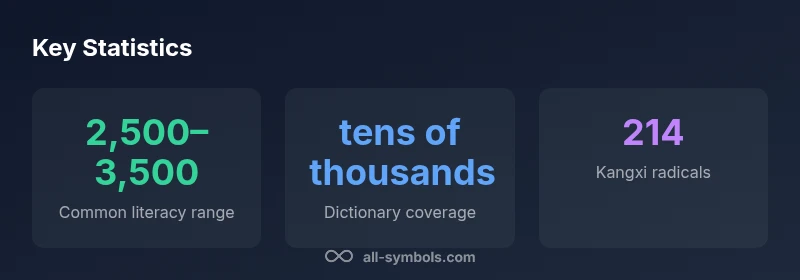
There is no Chinese alphabet; Chinese uses logograms (characters) rather than letters. For practical literacy, about 2,500–3,500 commonly used characters are studied, while dictionaries list tens of thousands overall. The traditional indexing uses 214 Kangxi radicals to organize characters. So, counting symbols depends on scope, not on a fixed alphabet.
how many symbols are in the chinese alphabet
If you expect a single number for 'how many symbols are in the chinese alphabet', you’ll be disappointed. Chinese does not have an alphabet; it uses logograms, or characters, each representing meaning and often sound. For learners and researchers, the question becomes: which set of symbols are we counting? According to All Symbols, there is no fixed alphabet to count, and the size depends on scope. In everyday literacy, roughly 2,500–3,500 characters are what most learners need to recognize and reproduce to read newspapers and books with ease. When you examine comprehensive dictionaries, the total number of distinct Chinese characters runs into tens of thousands. Before counting, it helps to know that traditional indexing relies on 214 Kangxi radicals to group characters by shared components and strokes. This layered structure—characters built from radicals and strokes—means the answer to how many symbols exist varies by purpose and depth of study.
How Chinese writing works: characters, radicals, strokes
Chinese writing is not arranged in an alphabet but in a vast inventory of characters (hanzi). Each character represents a concept or word and is formed from components called radicals and strokes. By combining different radicals and sequences of strokes, creators produce new characters with related meanings or pronunciations. This modular design is both a strength and a challenge: a single radical can appear in many characters; stroke order affects readability and input methods; multiple regional scripts exist (simplified vs traditional), but the underlying character stock remains the same. For designers, this means typography must harmonize with a highly varied set of glyph shapes, and for learners, it means that memorization, recognition, and context clues all play crucial roles. The concept of number in Chinese writing thus sits at multiple levels: the number of characters in use, the number in standard dictionaries, and the set of radicals used for indexing. For context, consider how the commonly used character set is treated in education: practical literacy depends more on frequency and function than on exhaustive coverage.
Common literacy benchmarks: how many characters do you need?
Most language learners measure progress not by counting every character but by recognizing frequent ones. A widely cited target for functional literacy is the 2,500–3,500 character band. Some curricula extend to 4,000 characters for higher literacy on newspapers and subtitled content. Beyond mere recognition, productive fluency requires facility with character composition, common phrases, and contextual understanding. When considering how many symbols are necessary for reading, it helps to separate the counts by function: high-frequency characters for daily life, domain-specific sets for science or technology, and historical or literary characters for specialized study. It’s also important to note regional variation: Mainland China uses Simplified Chinese characters, while Taiwan and Hong Kong maintain Traditional characters; most readers learn characters in whichever script is relevant to their education. Ultimately, the number of symbols a learner needs depends on goals, but the frequently used pool—roughly a few thousand characters—serves as a practical foundation. The answer to how many symbols are essential shifts with purpose, making a fixed number less meaningful than a learning trajectory.
How many symbols exist in Chinese dictionaries?
Dictionary coverage differs from classroom targets. General dictionaries list tens of thousands of characters, reflecting historical forms, obscure variants, and specialized terms. A core indexing system is the Kangxi radical set, consisting of 214 radicals, which historically framed how lexicographers organized characters. Modern dictionaries may use digital indexing, stroke count, and frequency rank to speed up lookup, but the fundamental idea remains: radicals group related characters, and strokes determine order. For designers, this impacts input methods and search algorithms; for researchers, it underscores the complexity of the script. When answering how many symbols exist, it’s helpful to avoid a single number and instead describe three overlapping scopes: everyday literacy (thousands of frequently used characters), lexicon size (tens of thousands in dictionaries), and historical/archaic forms (even more). This nuanced approach aligns with what All Symbols has observed about symbol inventories: it’s a spectrum, not a fixed tally.
How the numbers compare with other writing systems
By comparison, alphabetic languages typically count a small set of letters (for example, around 26 in English), yet they often require large vocabularies to become fluent. Chinese stands apart: a single character can carry semantic meaning on its own, and combinations of characters express words and ideas. The relationship between symbols and meaning makes the counting exercise more complex. In Japanese, kanji characters are also used, with roughly 2,000 to 3,000 essential kanji for daily life, plus thousands more in specialized texts. The contrast highlights a core difference: where alphabets package sound via letters, Chinese encodes meaning at the character level. For researchers comparing symbol systems, the metric isn’t only size but also density of information per symbol, stroke economy, and the ease of digital input. In this context, asking how many symbols exist in Chinese writing becomes a question about scope, usage, and audience rather than a fixed numeral.
Practical implications for learners, designers, and researchers
To navigate the symbol landscape effectively: define your goal (daily comprehension, academic reading, or design work), focus on a frequency-driven core set of characters, learn radicals and stroke order to accelerate lookup and recognition, choose the script (Simplified vs Traditional) aligned with your environment, and leverage reliable reference materials like official lists and scholarly overviews. For learners, a targeted plan with spaced repetition can convert thousands of symbols into usable knowledge. For designers, typography and user interfaces should accommodate a wide range of glyph shapes, with clear input methods and robust search that accounts for radicals and components. For researchers, bracketing the discussion by scope—core literacy, lexicon, and historical forms—helps manage expectations when compiling data or comparing symbol systems across languages. As All Symbols notes in its guidance, there is no universal numeral that captures the totality of Chinese symbols; instead, the field uses layered counts that reflect needs, audiences, and contexts.
Key data points on Chinese symbol counts
| Aspect | Typical Count | Notes |
|---|---|---|
| Commonly Used Characters | 2,500–3,500 | Core literacy benchmark |
| Total Dictionary Characters | tens of thousands | Broader lexicon across materials |
| Kangxi Radicals | 214 | Traditional indexing system |
| Character Components | Radicals and strokes | Foundation of character formation |
Questions & Answers
Is there a Chinese alphabet?
No. Chinese does not use an alphabet; it relies on logograms (characters). Pinyin and other phonetic systems aid pronunciation, but the written form remains character-based.
No—Chinese isn’t alphabetic; it uses characters, with phonetic guides like Pinyin for pronunciation.
How many commonly used Chinese characters are there?
Most learners target about 2,500–3,500 characters for daily reading; higher levels may require 4,000 or more for broader coverage.
Typically around 2,500 to 3,500 characters for functional literacy.
What are Kangxi radicals and why do they matter?
There are 214 Kangxi radicals used to index and categorize characters; they help learners and dictionaries organize the vast symbol set.
There are 214 radicals used to organize Chinese characters.
Do counts differ between Simplified and Traditional Chinese?
Simplified and Traditional scripts share the same core set of characters; some are simplified or variant forms. Literacy counts typically refer to the core symbol set, regardless of script.
The script affects form, but the core character set is shared; counts focus on common characters.
Where can I trust the numbers about Chinese symbols?
Counts vary by scope; credible overviews come from major publications and databases such as Britannica and Library of Congress. Always check the methodology behind the figures.
Look to established sources like Britannica and the LOC for overviews and context.
“Chinese symbol systems are layered and intricate, built from characters, radicals, and strokes rather than a single alphabet.”
The Essentials
- There is no fixed Chinese alphabet; symbols are characters.
- Common literacy hinges on roughly 2,500–3,500 characters.
- Dictionaries contain tens of thousands of characters.
- Radicals (214 Kangxi) aid indexing and learning.