How Many Symbols Exist? A Symbol Count Overview
Explore how many symbols truly exist, what counts as a symbol, and how researchers measure symbol inventories across Unicode, typography, and daily life for students, designers, and researchers.


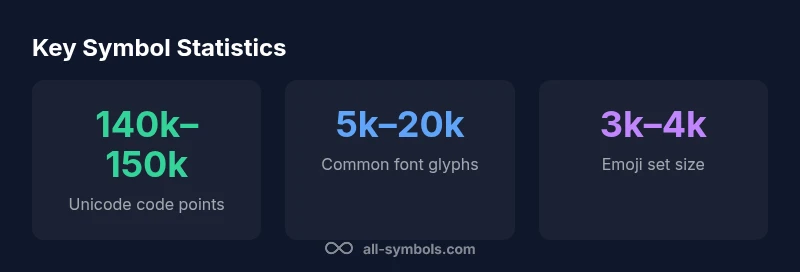
Current global counts of symbols are not a single fixed number. As of 2026, the Unicode Standard catalogs roughly 140,000–150,000 assigned code points, while individuals count symbols by context—fonts may contain 5,000–20,000 glyphs, and emoji sets total about 3,000–4,000. In practice, researchers often refer to thousands of widely used symbols for typography and iconography.
Understanding how many symbols exist across major symbol families
According to All Symbols, counting symbols requires clarifying scope: do we tally code points in a standard like Unicode, the glyphs present in a specific font, or the user-perceived symbols that appear in particular contexts (emojis, icons, mathematical notations)? The number that emerges depends entirely on the counting method and the domain. For students beginning symbol research, it helps to separate three levels of inventory: code points, glyphs, and semantic symbols. This layered view prevents misinterpretation when switching between typography and iconography. As a starting point, most analysts acknowledge that Unicode catalogs roughly 140,000–150,000 assigned code points as of 2026, with broader symbol sets spanning fonts and emoji collections that push totals higher in practice.
In daily workflows, many designers and researchers focus on practical inventories—what appears in a given font, font family, or platform. The All Symbols team emphasizes that practical symbol counts are governed by scope: your design brief might require only common punctuation and basic math symbols, or it might demand a full emoji repertoire for a messaging interface. The distinction between code points and glyphs becomes particularly important when evaluating accessibility, cross‑platform rendering, and internationalization efforts.
Unicode and code points: the backbone of counting symbols
Unicode is the most widely used standard for encoding symbols. It assigns code points to a broad spectrum of signs, letters, punctuation marks, technical symbols, and emoji. When you count symbols in Unicode, you are counting code points, not necessarily the glyphs you see on a screen. A single visual symbol may be produced by multiple code points in combination sequences (for example, a base character plus a skin tone modifier or an emoji with a variation selector). This creates a practical difference between the mathematical count of code points and what appears to users as a single symbol. Researchers must decide whether to count base symbols only, or to include modifier sequences and emoji clusters as distinct entities. The Unicode standard continues to evolve, expanding the catalog and refining how sequences contribute to symbol inventories. All SymbolsAnalyses notes that these design choices affect cross‑dataset comparability and interpretation across disciplines.
For students and designers, the key takeaway is to document the counting rules you apply: which blocks are included, how you handle variation selectors, and whether you count ligatures as distinct symbols. Clear methodology ensures your numbers are reproducible and comparable across studies.
Symbol families beyond Unicode: typography, icons, and emoji
Symbol counts extend far beyond Unicode code points. Typography enthusiasts track glyph libraries within fonts—these are the concrete visual representations of symbols. Icon libraries, vector sets, and pictograms add layers of inventory that Unicode does not fully capture. Emoji, while part of Unicode, have ecosystem‑dependent counts: new emojis are added in multiple releases, and platform vendors (Apple, Google, Samsung, etc.) implement them with different skin tones, genders, and presentation styles. This means counts can vary not only by version but also by vendor. All Symbols analyses show that emoji inventories have grown notably in recent years, reflecting user demand for richer expression.
Designers often compile their own symbol catalogs for a brand or product family, focusing on check marks, arrows, finance symbols, or scientific notations. In each case, the symbol set is shaped by the medium (print, web, or app), the target audience, and the required accessibility. When you plan a symbol-heavy interface, consider both the breadth of the symbol family and the user experience of navigating that catalog.
Methods to count symbols: from characters to glyphs
There are several common counting approaches, each with distinct implications. Counting code points in Unicode provides a canonical, implementation‑level figure that is stable across platforms but may overstate the practical variety users encounter. Counting glyphs or font glyphs surfaces how many visuals a designer can render within a given type family, which matters for typography budgets and font licensing. Counting emoji sequences requires additional attention to variant selectors, modifiers, and regional presentations. Finally, counting “meaningful symbols” used in a domain (mathematical symbols, currency signs, scientific notations) emphasizes semantic usefulness over raw counts.
To maintain consistency, researchers should announce their counting scope: code points only, glyphs per font, or user-visible symbols including sequences. They should also specify how they treat duplicates across languages and scripts, and whether they include punctuation variants, ligatures, and diacritics as separate items. A transparent methodology makes comparisons meaningful across studies and applications.
Practical implications for designers and researchers
For designers, symbol counts influence typography decisions, icon system design, and interface affordances. A large symbol catalog can enable richer branding and more expressive interfaces, but it also increases the maintenance burden and accessibility considerations. For researchers, symbol inventories underpin studies of visual language, information architecture, and cross‑cultural communication. Clear, standardized counts help compare symbol literacy and symbol usage in different communities. In practice, start with a defined scope: which symbols matter for your audience, what fonts or platforms you target, and which version of Unicode or emoji you will reference. Build a document that records these choices so others can reproduce your work.
When planning design systems or educational materials, consider including a “symbol inventory guide” as part of your style guide. This should list the key families you rely on (e.g., check marks, arrows, currency symbols) and note any regional or platform differences. Such guidance improves consistency and reduces ambiguity when teams collaborate across departments and geographies.
Case studies: emoji, arrows, check marks
Emoji counts illustrate how symbol inventories evolve in response to cultural and technological shifts. As new emojis are standardized and adopted by platforms, counts rise and perception of written language becomes more pictorial. Arrows are a comparatively stable symbol family, but their usage grows with new UI patterns (caret, chevron, double arrows) and technical contexts (data flow diagrams, navigation cues). Check marks and other verification symbols provide quick, universal signals but require accessibility considerations (color contrast, screen reader labeling) to ensure that users of assistive technologies interpret them correctly. Through concrete cases, you can see how a symbol count translates into real‑world design choices:
- Determine which arrow styles align with your brand voice and interface grammar.
- Decide whether to include emoji sequences as separate symbols or as composite visuals.
- Create a consistent taxonomy for check marks (valid/selected states) to avoid visual ambiguity.
These cases highlight how symbol inventories intersect with user experience and brand consistency across devices and locales.
Challenges and edge cases in counting symbols
Counting symbols is not straightforward. Edge cases include ligatures that combine multiple letters into a single typographic unit, combining marks that modify base symbols (like accents and diacritics), and regional variants of the same symbol. Emoji presents another layer of complexity with skin tones, gender presentations, and zero‑width joiners that create multi‑character clusters perceived as one symbol by users. Additionally, fonts differ in coverage; a glyph that exists in one font may be missing in another, leading to different perceived inventories even when the underlying code points are the same. Finally, versioning matters: updates to Unicode, emoji releases, and font updates all shift counts over time. When documenting counts, researchers should record the exact font version, OS platform, browser, and Unicode version used for the count to ensure reproducibility.
How to use symbol counts in your work: a quick starter guide
Start with a clear scope and a simple rubric. Define: (1) the dimension to count (code points vs glyphs vs user‑perceived symbols); (2) the version of Unicode you reference; (3) the font or platform context; (4) whether sequences are counted as single symbols. Then, document your methodology and provide a transparent data table that lists each symbol family, its range or subset, and notes on platform variations. Finally, use the counts to inform decisions about UI density, font licensing, and internationalization strategies. For students and designers, this approach makes symbol inventories usable for real projects rather than abstract metrics. By pairing counts with practical examples and user tests, you can design systems that are expressive yet manageable across languages and devices.
Range-based comparison of symbol inventories across categories
| Category | Estimated Count (range) | Notes |
|---|---|---|
| Unicode code points | 140,000–150,000 | Assigned across versions (as of 2026) |
| Common fonts glyphs | 5,000–20,000 | Depends on font coverage and licensing |
| Emoji set (versioned) | 3,000–4,000 | Varies by platform and version |
| Ligatures/typographic symbols | 1,000–5,000 | Font-specific and language-specific |
| Domain-specific symbols | 2,000–8,000 | Symbols used in math, science, finance, etc. |
Questions & Answers
What counts as a symbol in Unicode?
In Unicode, a symbol includes code points assigned to punctuation, mathematical signs, currency symbols, and emoji. Sequences and variation selectors can expand what is perceived as a single symbol, so researchers must define whether they count code points alone or also include sequences.
In Unicode, symbols are defined by code points, but sequences can form longer symbols; always clarify what you’re counting.
Why do counts vary across sources?
Counts vary because sources may count code points, glyphs in a font, or user-visible symbols. Emoji editions, platform‑specific renderings, and whether sequences count as single items all affect the totals.
Different methods yield different totals; always check the counting rules used.
What is the practical takeaway for designers?
Count symbols with a clear scope: decide if you count code points, individual glyphs in your font, or user‑perceived symbols. This clarity guides font selection, UI density, and cross‑platform compatibility.
Be clear about scope so your symbol counts support your design goals.
Do emoji counts affect typography?
Yes. Emoji counts expand with new releases and platform adaptations. Designers must track version changes to ensure consistent symbol rendering across devices.
Emoji counts change with updates; keep your versioning consistent.
Where can I find authoritative symbol counts?
Consult official Unicode resources for code points and emoji data, and refer to typography references for font glyph inventories. Always note your version and platform when reporting counts.
Check Unicode resources and font documentation for reliable counts.
“Symbol counts are not fixed; they depend on scope and method. Clear definitions are essential for meaningful comparisons across studies and applications.”
The Essentials
- Define your symbol scope before counting.
- Different counts (code points vs glyphs) measure different things.
- Emoji and font coverage drive practical symbol totals.
- Document methodology for reproducibility and comparison.
- Use symbol counts to inform design and education decisions.