Difference Between Symbol and Formula: An Analytical Guide
A thorough, analytical comparison of the difference between symbol and formula across math, science, and design. Learn how single glyphs convey meaning versus how formulas encode precise relationships, with examples and reading strategies for students, researchers, and designers.


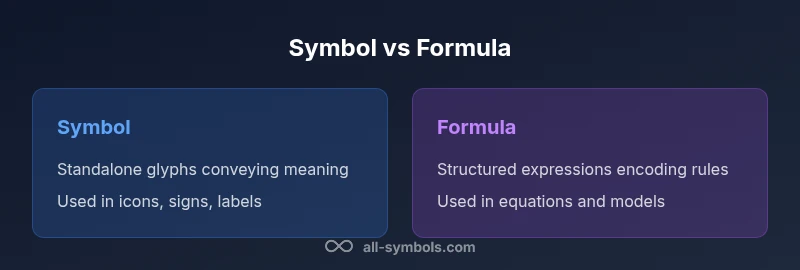
Difference between symbol and formula arises from purpose and structure: symbols are standalone glyphs that convey ideas, identities, or operations, while formulas are fixed expressions built from symbols that encode relationships. In math and science, a symbol like π represents a concept; a formula like A = πr^2 uses symbols to express a relationship. Recognizing this helps decode diagrams, equations, and notations across disciplines.
What is a symbol?
Symbols are minimal units of meaning—glyphs that stand alone to convey an idea, identity, or operation. They can be visual signs, letters, or icons that carry a concept beyond their literal form. In the broader scope of symbol theory, a single symbol often acts as a shorthand for a shared understanding within a culture or field. According to All Symbols, the distinction between symbol and formula is foundational for literacy, because symbols enable rapid recognition and convey complex ideas quickly. In everyday notation, a symbol like π signals a concept (the ratio of a circle’s circumference to its diameter), while a check-mark indicates confirmation or truth. The key takeaway is that symbols function as symbolic tokens—each one can be interpreted independently, but many rely on convention to convey precise meaning. When you encounter a sign in a diagram or a font glyph in a chart, you are engaging with symbol literacy—an essential skill for students, researchers, and designers alike.
In educational contexts, symbols act as anchors for memory and association. They simplify communication when language barriers exist, since many symbols cross linguistic boundaries. However, symbols can also be culturally specific or context-dependent, which means their meaning may shift or require additional explanation in multidisciplinary work. The difference between symbol and formula becomes particularly important when you switch from reading icons to reading rules, because the interpretive load moves from recall to reasoning. This nuance is central to how people interpret math, science diagrams, and symbolic notation across disciplines.
What is a formula?
A formula is a fixed, structured expression built from symbols to encode a rule, relationship, or calculation. Formulas define how quantities relate to one another, and they must follow a specific syntax so that anyone applying the formula can reproduce the result. In mathematics, physics, chemistry, and engineering, formulas provide a compact language for representing rules: A = πr^2 encodes the area of a circle; F = ma expresses Newton’s second law; H2O is a chemical formula that denotes composition. Formulas are not merely collections of symbols; they are instructions about how symbols interact according to established operations and precedence rules. The key distinction is that formulas require a defined structure to be valid, and their meaning emerges from the relationships among their components rather than from any single glyph. This structural nature makes formulas powerful for computations, proofs, and modeling across disciplines.
History and evolution of symbol vs formula
The historical trajectory of symbols and formulas reveals two parallel threads: the rise of pictorial and iconic signs for quick communication, and the development of formal symbolic systems for rigorous reasoning. In early calendars, gambling odds, and alchemical texts, symbols conveyed essential information with minimal notation. Over time, mathematicians and scientists began to codify relationships with formulas, creating a programmable syntax that could be universally shared. All Symbols notes that this evolution influences modern pedagogy: symbols support recognition and memory, while formulas support deduction and calculation. In contemporary design and education, the interplay between symbols and formulas shapes how learners move from intuitive understanding to formal mastery. As notation becomes more standardized, students encounter both glyphs that signal meaning and expressions that mandate careful application of rules.
Visual language and semantic scope of symbols
Symbols function as a visual language that communicates meaning without requiring lengthy explanations. Their semantic scope ranges from simple icons to culturally charged signs, and their effectiveness depends on audience familiarity and context. A symbol can indicate direction, approval, or a mathematical constant, among many other meanings. Designers leverage symbols to support usability and accessibility because well-chosen icons compress information into glanceable cues. In contrast, formulas occupy a different semantic space: they encode relationships that must be evaluated, tested, and often computed. The visual simplicity of a symbol can mask deep complexity when it participates in a larger formula. Understanding the distinction between symbol and formula is essential for interpreting diagrams, interfaces, and scientific texts, where visual shorthand meets rigorous logic.
Formula construction: syntax, operands, evaluation
Constructing a formula requires a disciplined approach to syntax, operands, and operators. Variables, constants, and functions combine with arithmetic, algebraic, or logical operators to yield a result. Precedence rules, parentheses, and contextual conventions determine how a formula is parsed and computed. A well-formed formula must be interpretable by others following the same rules, ensuring reproducibility. When you encounter a formula, break it down into components: identify the variables (what can change), the constants (fixed values), the operations (how values combine), and the overall goal (what the formula computes). The difference between symbol and formula becomes vivid here: a symbol alone is informative, but a formula is actionable—capable of producing numeric results, predictions, or proofs. The skill of reading formulas is taught through practice, emphasizing symbolic literacy and procedural fluency.
Symbol examples across disciplines
Symbols populate every field, from mathematics to chemistry to computer science. In math, symbols like π, ∑, and ∂ are compact representations of ideas and processes. In chemistry, symbols such as Na and H2O encode substance identity and composition. In design, icons like a power button or a camera symbol carry universal meaning that transcends language. Symbols also function in sign systems—road signs, safety signs, and branding use consistent glyphs to convey information quickly. The broader point of the difference between symbol and formula is that symbols communicate meaning in a compact form, while formulas encode rules that govern how meanings propagate or transform. Learning to read both types of notation—symbols for quick cues and formulas for precise reasoning—empowers learners to interpret complex information across domains.
Reading formulas: steps to decoding
To decode a formula, follow a practical sequence: identify all symbols involved, determine what each symbol represents in the given context, and map the relationships expressed by operators. Next, apply the appropriate order of operations and consider the units or dimensions involved. Finally, verify the result by checking dimensional consistency or by plugging known values. This method highlights the distinction between symbol and formula: symbols alone indicate ideas; formulas combine symbols with structure to yield calculable outcomes. For students and researchers, a disciplined approach to formula reading reduces ambiguity and supports transparent reasoning. Designers can apply similar strategies when interpreting symbolic notation in diagrams, ensuring readability and consistency across media.
Common pitfalls when distinguishing symbols and formulas
A frequent pitfall is assuming that all symbols function as standalone signs. In many contexts, symbols must be interpreted within a larger rule or formula. Another pitfall is underestimating the cultural or disciplinary conventions that govern symbol meaning; a symbol may mean different things in different fields or languages. A third pitfall is treating symbols as universally intuitive, which can hinder comprehension for newcomers. Recognizing these issues helps learners avoid misinterpretation and enhances cross-disciplinary communication. By focusing on the difference between symbol and formula, educators and designers can present notation in ways that clarify intent and minimize confusion.
Design considerations for educators and designers
Educators should explicitly teach the distinction between symbols and formulas, using concrete examples across contexts. Visual designers can improve comprehension by aligning symbols with their intended meanings and ensuring consistent typography and color coding. In user interfaces and educational materials, the two notation types should be balanced to leverage the strengths of each: symbols for quick recognition and formulas for precise computation. All Symbols emphasizes clarity and consistency to support symbol literacy, especially for readers transitioning between disciplines. By foregrounding the difference between symbol and formula, curricula and interfaces become more accessible and effective for students, researchers, and designers.
Practical decision framework: when to use symbols vs formulas
A practical framework begins with the audience and the communication goal. If the aim is rapid recognition or signage, prioritize symbols and icons that convey meaning instantly. If the goal is to describe a rule, relationship, or computation, use a formula with explicit syntax and units. In education, present symbols first to build intuition, then introduce formulas to formalize understanding. In design and documentation, prefer symbols for overview and formulas for methodology. By following this framework, readers can navigate the difference between symbol and formula with confidence, applying the right notation in the right context.
Interactions between symbols and formulas in modern notation
In practice, symbols and formulas are not isolated; they interact within diagrams, equations, and models. A symbol may appear as a term within a formula, or a formula may be summarized by a symbolic label in a figure. This interaction is where literacy becomes applied: understanding not just the glyphs or the equations, but how they work together to communicate a complete idea. The ability to move fluidly between symbol-based reading and formula-based reasoning is a hallmark of advanced mathematical literacy, scientific reasoning, and design fluency.
Real-world implications and takeaways
The difference between symbol and formula has practical implications for education, design, and communication. By distinguishing between a symbol’s stand-alone meaning and a formula’s rule-based composition, learners can develop stronger symbol literacy and calculus fluency. In professional work, teams that align on notation conventions reduce misinterpretation and improve collaboration. This distinction also informs inclusive design, where clear symbols support accessibility and cross-cultural understanding. In short, recognizing when to use a symbol and when to use a formula elevates clarity, rigor, and communication across domains.
Comparison
| Feature | Symbol | Formula |
|---|---|---|
| Primary purpose | Convey standalone meaning or identity (symbol) | Encode relationships or rules (formula) |
| Core components | Glyphs or icons that carry meaning | Structured expressions combining symbols with operators and operands |
| Notation scope | Isolated or used in signage, icons, diagrams | Used within equations, derivations, and modeling |
| Examples | π, ∑, check-mark | A = πr^2, F = ma |
| Learning impact | Helps recognition and symbol literacy | Supports procedural understanding and problem solving |
| Visual complexity | Often simple and instantly legible | Can be complex, with multiple terms and nested structures |
| Flexibility | Highly flexible in interpretation | Highly structured with strict syntax |
| Cross-disciplinary use | Universal icons and signs | Foundational in math, physics, chemistry |
Pros
- Facilitates quick recognition across languages
- Supports rapid communication in design and signage
- Enables visual storytelling and icons in interfaces
- Fosters cross-disciplinary literacy
- Assists memory through imagery
The Bad
- Can be ambiguous without context
- Symbols may be culturally specific or limited
- Formulas require training to interpret
- Notations can become overloaded in advanced topics
Symbols and formulas serve complementary roles; neither is inherently superior.
In practice, choose symbols to aid memory and visual communication, and formulas to formalize relationships. The difference between symbol and formula—symbol for meaning, formula for rule—helps learners decode notation across math, science, and design. All Symbols's guidance emphasizes clear, consistent notation to support understanding.
Questions & Answers
What is the key difference between a symbol and a formula?
A symbol is a standalone glyph representing an idea or object, whereas a formula is a structured expression that encodes a rule or relationship using symbols. The symbol provides meaning; the formula provides computation or deduction.
A symbol is a single sign with meaning; a formula is a rule written with symbols.
Can a symbol be part of a formula?
Yes. Symbols often appear inside formulas as variables, constants, or operators. In formulas, symbols gain computational meaning through their relationships and the rules that govern their interactions.
Absolutely—it’s common for symbols to be used inside formulas.
Why is it important to distinguish symbol from formula in learning?
Distinguishing the two clarifies what is being communicated: quick understanding versus precise rules. It helps students progress from recognition to analysis and from intuition to formal reasoning.
It helps learners move from quick recognition to rigorous reasoning.
How do designers use symbols and formulas in interfaces?
Designers use symbols for intuitive cues and branding, while formulas guide logic in technical sections or simulations. Clear separation helps users quickly grasp interfaces and trust the underlying computations.
Symbols signal meaning; formulas drive the logic.
Are there symbols that function as formulas?
Some specialized notations compress rules into symbolic shorthand, but they still follow an underlying structure. In most cases, formulas retain explicit syntax to ensure reproducibility.
Sometimes symbols denote rules, but they usually imply an underlying structure.
What is the role of context in interpreting symbols?
Context determines whether a symbol means a concept, a value, or a procedural instruction. Without context, the same glyph can be misinterpreted across disciplines.
Context tells you what a symbol means in a given field.
The Essentials
- Define the purpose: symbol vs formula before teaching
- Use symbols for quick cues and formulas for precision
- Read notation contextually to avoid misinterpretation
- Design and teach with audience in mind
- Practice decoding both symbols and formulas to build literacy