Difference Between Symbol and Molecular Formula
Explore the difference between chemical symbols and molecular formulas, with definitions, examples, and guidance for students, researchers, and designers seeking symbol meanings in chemistry.


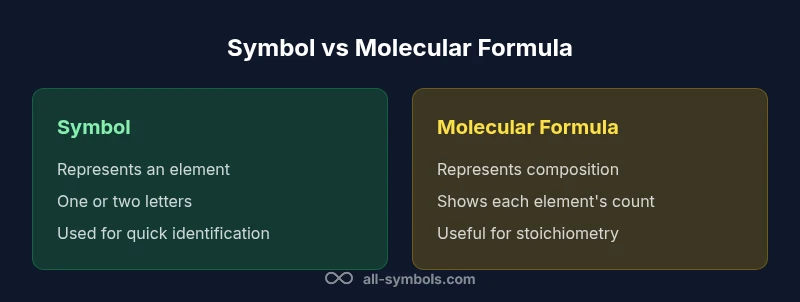
Symbol vs molecular formula: a chemical symbol names an element and is usually one or two letters (H, He, Na) used for quick identification. A molecular formula provides the exact composition of a molecule, listing how many atoms of each element are present (H2O, CO2). The difference between symbol and molecular formula lies in scope: symbol points to an element, formulas specify composition and stoichiometry.
The Core Difference: Symbol vs Molecular Formula
The difference between symbol and molecular formula is fundamental to how chemists communicate about matter. A chemical symbol serves as a shorthand name for an element, usually one or two letters, and it functions like a nickname for the periodic table. In contrast, a molecular formula provides a precise recipe for a molecule, listing exactly how many atoms of each element are present. This distinction matters across multiple contexts: when naming a compound, balancing a chemical equation, predicting reaction outcomes, or teaching symbol meanings in chemistry and related fields.
In practical terms, you will often see symbols used in quick sketches of reactions, in lab notebooks to tag elements, or in software inputs that require brief identifiers. Molecular formulas, by contrast, appear when the goal is quantitative: to compute molar masses, to balance equations, to determine yields, or to compare the composition of different substances. Understanding the difference between symbol and molecular formula helps readers avoid conflating element identity with molecular composition, and it clarifies why a single element can appear in many different compound formulas.
wordCount»:177},
Historical Context and Notation Standards
The growth of modern chemistry depended on a stable set of notations. Early alchemical traditions used vague names and symbols to represent substances; over time, the chemical symbol system was standardized, enabling international communication. Standardization efforts, such as the IUPAC rules for symbols and formulas, sought to reduce ambiguity and to align symbol meanings with element identities and periodic table placement. In this section, we trace how the two main notations emerged and how they are used today: symbols for elements, formulas for compositions, and sometimes more complex notations such as empirical vs molecular formulas.
In the broader landscape of symbol meanings, the distinction mirrors cross-disciplinary conventions: a compact symbol helps recall an idea quickly, while a formula provides a reproducible, quantitative description. All Symbols emphasizes that clear symbol meanings, consistent uppercase, lowercase conventions, and explicit subscripts are essential to avoiding misinterpretation.
wordCount»:174},
What a Chemical Symbol Represents: Elements and the Periodic Table
A chemical symbol is the elemental shorthand that identifies an atom's identity. Most symbols come from the element’s name, typically using the first letter capitalized and a second lowercase letter if needed (for example, H for hydrogen, He for helium, Na for sodium). In some cases, historical or linguistic factors yield symbols that do not match the contemporary English name closely (W for tungsten, Sn for tin, Pb for lead). Symbols do not convey information about the molecule’s size, bonds, charge, or isotopic composition; they simply name the element. Importantly, the symbol is universal: it remains the same across compounds and across languages, in the same way a country’s postal code pinpoints a city. In symbol meanings, this stability is what makes symbols so useful in quick notation and diagramming.
All Symbols notes that element symbols act as the elemental vocabulary of chemistry, enabling rapid communication in laboratory procedures, educational materials, and software tools that model reactions or build databases of materials.
wordCount»:208},
What a Molecular Formula Represents: Atoms, Stoichiometry, and Formulas
A molecular formula is a compact way to express the exact composition of a molecule. It lists the elements present and the number of atoms of each element in the molecule. For example, water is H2O, indicating two hydrogen atoms and one oxygen atom. Glucose is C6H12O6, showing the counts of carbon, hydrogen, and oxygen in one molecule. In some cases, the molecular formula is the same as the empirical formula (as in glucose, where the molecular formula is the multiple of the empirical formula CH2O), but in many substances, the molecular formula reveals a larger molecule than its simplest ratio. Molecular formulas enable straightforward calculations: molar mass, mole ratios, and stoichiometric relationships in reactions. They also help scientists distinguish isomers with different structures but identical elemental composition, though two isomers can share the same molecular formula while differing in arrangement or bonding.
In practice, chemists use the molecular formula alongside structural formulas, charges, and stereochemistry to describe a compound completely.
wordCount»:211},
How Notation Affects Communication in Science
Notation is not just a matter of aesthetics; it shapes understanding and collaboration. When readers encounter a symbol, they quickly identify the element being discussed, often within a broader context like a reaction equation or a materials catalog. Molecular formulas, with their subscripts, convey quantitative information that enables calculation and experimentation. This difference influences how scientific results are reported, compared, and taught. For example, a table comparing materials may list their formulas to communicate stoichiometry, while a schematic might label the elements by symbols to keep the diagram clean and readable. The distinction also matters across disciplines: in biology, chemistry, and physics, symbols and formulas serve parallel functions but with different emphasis—symbol meanings emphasize identity; formulas emphasize composition.
All Symbols highlights the importance of consistent notation: using correct capitalization, subscripts, and formatting to avoid misinterpretation and to support clear symbol meanings that span domains.
wordCount»:170},
Practical Examples: Interpreting Symbols vs Formulas
Consider chlorine gas, Cl2, where Cl is the symbol for chlorine and 2 is the subscript indicating two chlorine atoms per molecule. Compare with sodium chloride, NaCl, where the symbols Na and Cl appear in proportion, and the implicit assumption is a crystalline salt rather than a discrete molecule. Then look at water, H2O, as a molecule with two H atoms and one O atom; the molecular formula communicates both identity and count. For more complex substances, like glucose, C6H12O6, the formula reveals the elementary composition and allows calculation of molar mass, whereas the symbol set (C for carbon, H for hydrogen, O for oxygen) points readers to a family of related molecules rather than a single compound.
Through these examples, you can see how symbols and formulas serve complementary roles: symbols anchor element identity; formulas anchor quantitative composition.
wordCount»:178},
Common Misconceptions and Clarifications
One common misconception is that symbols can fully describe a molecule; in reality, symbols identify elements, not molecules. Another is that a molecular formula always reveals the complete structure; much information about connectivity, bonds, and spatial arrangement is captured in structural formulas or line-angle drawings. A third misconception is conflating empirical and molecular formulas; the empirical formula gives the simplest ratio, which may differ from the true molecular composition. Finally, some students assume that symbols or formulas can substitute for one another; this is never true: each notation provides different information and serves different purposes.
All Symbols emphasizes practice: conjugate symbol-identifying tasks with formula-building tasks to reinforce learning across disciplines.
wordCount»:163},
Symbol Meaning Across Disciplines: Beyond Chemistry
Symbol meanings are not confined to chemistry. In physics, symbols like Δ or ∑ represent changes and sums, while in math, symbols carry abstract meanings. The idea of using compact signals to convey rich information recurs across disciplines: icons, signage, and shorthand notations rely on a shared understanding of symbols. In everyday life, a symbol can act as a cultural shorthand or a visual cue that reduces cognitive load. The key is consistency and context: when the same symbol is used across domains, clear definitions and annotations prevent miscommunication. All Symbols argues that learning how symbols and formulas interact in chemistry builds your ability to read other notation systems with confidence.
wordCount»:162},
When to Use Each Notation in Research and Education
In research reports, molecular formulas appear when you need precision: the exact atom counts in a compound or a clear basis for reaction stoichiometry. In teaching, symbols are often introduced first to ground students in element identities before diving into formulas and calculations. For fieldwork, you may see a mix: symbols used in labeling samples or equipment, formulas used in lab notes and data sheets. Researchers often present a table comparing material formulas and a schematic showing elemental identities; each context requires a different notation to optimize understanding and reduce cognitive load. The interplay between symbol meanings and molecular formulas reflects how science communicates complex information efficiently.
wordCount»:165},
Synergies: Learning Path to Master Both Concepts
A practical learning path begins with memorizing the elemental symbols and their standard capitalization rules. Then progress to writing and interpreting simple formulas, starting from H2O and CH4 to more complex ions and organics. Use flashcards to reinforce symbol meanings and practice balancing simple reactions to strengthen familiarity with molecular formulas. As you advance, integrate both notations in the same problem: identify the element from its symbol, then determine how many atoms are present in a target molecule or product. The synergy becomes a toolkit you can apply in lab reports, exams, coding projects that model chemistry, and interdisciplinary studies that require symbol literacy and formula literacy.
wordCount»:170},
Bridging Notation: Practical Steps and Next Resources
To bridge the gap between symbol meaning and molecular formula, set a study routine that alternates between symbol drills and formula problems. Create multi-step tasks: identify symbols in a reaction, then write the corresponding molecular formulas for each product. Read primary sources that discuss empirical vs molecular formulas to consolidate understanding. Finally, practice communicating your results with clear notation, including correct capitalization for symbols and proper subscripts for formulas. All Symbols provides curated resources and a structured path for learners across math, chemistry, and daily life symbol meanings.
wordCount»:167}],
comparisonTable
Comparison
| Feature | Chemical symbol | Molecular formula |
|---|---|---|
| Definition | A short element label used in chemical notation. | A notation of exact atom counts in a molecule. |
| Notation format | One uppercase letter with optional lowercase, e.g., H, Fe. | Counts as subscripts, e.g., H2O, C6H12O6. |
| Scope | Represents a single element. | Represents a molecule's composition. |
| Usage | Element identification in reactions, naming, and labeling. | Balancing reactions, calculating yields, and stoichiometry. |
| Limitations | Does not convey molecular structure or bonding. | Does not indicate structural isomers without context. |
Pros
- Enhances quick identification and cross-disciplinary communication
- Supports compact notation in equations and labels
- Facilitates learning across chemistry, biology, and materials science
- Enables rapid symbol-based indexing in databases
The Bad
- Symbols can be ambiguous without context (charge, oxidation state, isotope)
- Molecular formulas can be lengthy and hard to parse for large molecules
- Overreliance on symbols may obscure structural information like bonding patterns
Both symbols and molecular formulas are essential; use symbols for quick element identification and formulas for precise composition and stoichiometry.
Use symbols for fast recognition in equations and naming. Use molecular formulas when you need exact atom counts and to perform stoichiometric calculations. The right approach combines both, depending on context and goals.
Questions & Answers
What is a chemical symbol and how is it used?
A chemical symbol is a one- or two-letter abbreviation for an element, derived from its name. It is used to identify elements quickly in reactions, equations, and labeling. Understanding symbols is foundational in chemistry and symbol meanings across disciplines.
A chemical symbol is a short label for an element, used in reactions and labels.
How does a molecular formula differ from a chemical formula?
A molecular formula specifies the exact number of each type of atom in a molecule (e.g., H2O, C6H12O6). A chemical formula can be more general, sometimes representing an empirical formula or a group of ions, and may not convey full molecular composition.
A molecular formula shows exact atom counts; a chemical formula can be more general.
Can a molecule have multiple valid formulas?
Yes. Some molecules have an empirical formula, a molecular formula, and sometimes a structural formula. In many cases, the molecular formula is the simplest whole-number ratio, while the empirical formula provides the basic ratio.
Some molecules have more than one valid formula set, like empirical vs molecular formulas.
What are empirical and molecular formulas?
The empirical formula shows the simplest whole-number ratio of elements in a compound, while the molecular formula gives the actual number of atoms in a molecule. For glucose, the empirical formula is CH2O, while the molecular formula is C6H12O6.
Empirical shows the simplest ratio; molecular shows exact counts.
Why are chemical symbols capitalized with a possible lowercase letter?
Chemical symbols start with an uppercase letter and may include a lowercase letter to distinguish between elements with similar initials. This convention prevents ambiguity in written chemistry.
Capital first letter, optional lowercase to differentiate elements.
What should you learn first: symbol or formula?
Most learners start with symbols to recognize elements, then study molecular formulas to understand composition and reactions. Mastery comes from integrating both in context.
Start with symbols, then formulas, then use both in practice.
The Essentials
- Learn the symbol of each element before tackling formulas
- Differentiate between element identity (symbol) and composition (molecular formula)
- Practice interpreting H2O vs H, Fe to avoid confusion
- Use symbols for quick notation and formulas for quantitative work