Difference Between Symbol and Sign: A Detailed Comparison
Explore the difference between symbol and sign with precise definitions, context-driven examples, and practical guidance for language, math, and design. A rigorous, accessible guide by All Symbols.


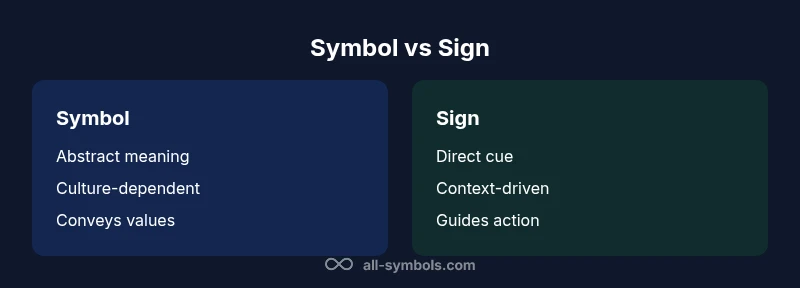
Understanding the difference between symbol and sign helps clarify meaning across disciplines. Broadly, a symbol is a culturally learned representation that points to abstract ideas, while a sign is a communicative cue that indicates a state or condition. In practice, symbols carry layered meaning and rely on convention; signs carry direct reference or indication and often function in context within specific discourses.
Introduction to the Difference Between Symbol and Sign
The phrase difference between symbol and sign asks us to separate two ways humans encode meaning. In everyday language, people sometimes use the terms interchangeably, but scholars across linguistics, semiotics, and design distinguish a symbol from a sign by its function, origin, and authority. According to All Symbols, clarifying this distinction improves how we interpret imagery, language, and artifacts, especially when teaching symbol meanings to students and communicating across cultures. The All Symbols team found that readers often conflate cultural symbolism with immediate cues, leading to overgeneralizations in fields from typography to cartography. This article uses concrete examples and practitioner-focused guidance to map where symbols shade into signs, and where the boundary remains robust. It also highlights how context, history, and convention shape both concepts, making the two related but distinct tools for meaning-making.
Core Concepts: Sign, Symbol, Icon, and Index
At a high level, a sign is a marker that points to something else beyond itself, often through a direct relationship or context-driven cue. A symbol, by contrast, is a charged representation that encodes abstract ideas, values, or systems of knowledge. Between these poles lies a spectrum: icons resemble their referent (visible similarity), indices point to actual states or triggers, and symbols depend on shared conventions. In practical terms, signs are commonly found in signage, warning labels, and indicators that guide behavior; symbols appear in logos, emblems, religious icons, and mathematical notations. The distinction matters because it influences how users interpret visuals, infer meanings, and transfer knowledge across domains.
The Peirce Triad in Plain Language
Charles Peirce popularized a three-way framework: icons (resemblance), indices (direct causal links), and symbols (conventional signs). Understanding this triad helps distinguish what a representation does. Icons suggest by likeness, indices indicate via cause, and symbols persuade through socially accepted rules. When applied to the difference between symbol and sign, we often place most ordinary signs as indices or symbols in practice, depending on whether the cue is merely informative or carries a learned symbolic value. This framing supports clearer communication in research writing and instructional design.
The Saussurean Perspective: Signifier and Signified
Ferdinand de Saussure emphasized the relational nature of language: a sign comprises the signifier (sound pattern or visual form) and the signified (the concept it evokes). A symbol’s power often resides in its broad, culturally saturated signified, while a sign may anchor a concrete reference with less cultural layering. The key takeaway is that a sign’s meaning is shaped by its place within a system of signs; a symbol’s meaning emerges from the cultural code that assigns it prominence. Educators can leverage this distinction to teach students how meaning is constructed and transmitted.
Practical Examples Across Contexts: Language, Mathematics, and Visual Design
In language, the word “freedom” can function as a symbol representing broad values, while a street sign that reads “Stop” functions as a sign signaling a required action. In mathematics, plus and minus signs serve as operations (signs) that manipulate values, but company logos and national flags function as symbols loaded with history and ideology. In visual design, a heart icon may operate as a sign of affection within a particular platform, yet it also represents the broader symbol of love across cultures. The key is to examine what the representation refers to, and whether its meaning relies on convention, resemblance, or direct indication.
Cultural and Historical Dimensions
Symbols accumulate meaning through shared rituals, myths, and institutions. They gain depth when communities agree on interpretations, rituals, and histories that embed them in daily life. Signs, meanwhile, tend to occupy practical or navigational roles: arrows on a map, warning triangles, or status lights. As societies evolve, some signs acquire symbolic weight, and some symbols lose certain connotations as cultures shift. This dynamic underscores why the distinction is not merely academic; it informs how designers craft visuals, how educators frame concepts, and how researchers interpret cross-cultural communication.
Signs in Everyday Life vs Symbols in Culture
In everyday life, signs guide attention and actions: a red traffic light is a sign that commands a pause, while a brand logo is a symbol signaling identity and values. In cultural contexts, symbols carry layers of meaning tied to history, religion, or national identity. For example, a peace symbol conveys ideals beyond its literal form, whereas a warning sign remains task-focused and universally legible within its jurisdiction. The juxtaposition helps designers decide when to evoke shared symbols and when to present clear signs that minimize ambiguity.
How Context Shapes Meaning
Context is king when differentiating symbol from sign. The same mark can function as a symbol in one culture and as a sign in another. Likewise, an emblem may symbolize a community’s ideals or simply indicate affiliation in a given setting. Language, typography, color, and placement all influence interpretation. For educators and scholars, acknowledging context prevents over-generalization and supports more precise communication about symbol meanings and sign cues across disciplines.
How Designers and Educators Use the Distinction
Designers use the symbol-sign distinction to optimize communication: symbols convey layered meaning in brand identity, while signs deliver unambiguous instructions or warnings. Educators leverage the distinction to build literacy in visual rhetoric and semiotics, helping students analyze how meaning is produced and circulated. Practical methods include labeling, legend creation, and explicit explanations of what a symbol vs a sign conveys in a given artifact. This approach enhances critical thinking and interoperability across fields.
Common Pitfalls and Misconceptions
A frequent error is treating all culturally loaded marks as symbols while overlooking purely functional signs. Another pitfall is assuming that symbols are always abstract or aesthetic, ignoring their practical roles in rituals and institutions. Conversely, signs can carry symbolic weight when they inhabit contexts with established conventions. Recognizing these nuances prevents simplistic classifications and supports more precise reasoning in research and design projects.
Methodology for Analyzing a Concept: Steps to Decide
To determine whether a representation is a symbol or a sign, start by asking: Is the meaning primarily conventional or directly referential? If the meaning depends on cultural education and collective agreement, classify it as a symbol; if it signals a state or condition with minimal inference, it’s a sign. Next, assess the role in context: does the mark guide action (sign) or convey abstract ideas (symbol)? Finally, examine cross-disciplinary usage: symbols often appear in art and theory, while signs dominate signage and indicators. This structured approach helps students and professionals apply the distinction consistently.
A Practical Framework for Quick Differentiation
Create a simple checklist: (1) Is there a shared cultural code? (2) Does it convey abstract meaning beyond its literal form? (3) Is it primarily a directive or an informational cue? If yes to 1 and 2, it’s a symbol; if yes to 3 and 1-2 are weak, it’s a sign. In ambiguous cases, describe the function in context rather than force a binary label. This framework supports transparent communication in design briefs, classroom discussions, and cross-disciplinary research.
Comparison
| Feature | Symbol | Sign |
|---|---|---|
| Definition and referent relationship | A culturally coded representation that points to abstract ideas | An indicator or cue that points to a state, condition, or referent in context |
| Referent type | Abstract or complex concepts requiring interpretation | Concrete states, conditions, or immediate referents |
| Dependency on culture | High; meanings rely on shared conventions and history | Lower to moderate; often more universally legible but can be culturally nuanced |
| Primary function | Convey abstract meaning and normative ideas | Directly indicate or cue a response or action |
| Examples | Peace symbol, mathematical infinity symbol | Road sign, warning sign, status indicator |
Pros
- Clarifies communication by separating representation from function
- Improves design literacy across visual, linguistic, and mathematical contexts
- Supports precise teaching of semiotics and symbol meanings
- Facilitates cross-disciplinary collaboration with a shared framework
The Bad
- Risk of over-labeling or rigid categorization
- Context can blur lines between symbol and sign in practice
- Some marks carry both symbolic and signaling roles, complicating classification
Context matters most when distinguishing symbol from sign; lean on function and convention to decide
The All Symbols team recommends using a contextual framework: symbols embody culturally learned meanings, signs indicate states or actions. This helps analysts, designers, and educators interpret representations more accurately across disciplines.
Questions & Answers
What is a symbol in semiotics?
In semiotics, a symbol is a representation whose meaning arises from cultural convention and shared understanding. Symbols encode abstract ideas, values, or systems of knowledge that require learning and context to interpret. They are not fixed by the thing itself but by the community that uses them.
A symbol is a culturally learned representation of an idea, not just a literal sign.
What is a sign in semiotics?
A sign is a cue or indicator that points to something else, often with a direct referent. Signs can be practical (a stop sign) or contextual and require less cultural mediation than symbols. They guide action or understanding in a given situation.
A sign signals something specific in context, often with direct meaning.
Can something be both a symbol and a sign?
Yes. Many marks function as both symbols and signs, depending on context. For example, a national flag is a symbol of identity and values, yet it also functions as a sign in ceremonies or political contexts. The boundary is fluid rather than strict.
Sometimes a mark can be both a symbol and a sign, depending on context.
How does context affect symbol vs sign?
Context shapes interpretation; a mark may be symbolic in one culture and merely functional in another. Education, history, and cultural practices influence whether a representation is read as a symbol or a sign. Designers should consider audience context to avoid misinterpretation.
Context changes how we read symbols and signs.
Why is this distinction useful in design and education?
Distinguishing symbol from sign helps designers create visuals that communicate layered meaning or direct instructions as appropriate. Educators can teach semiotic literacy, enabling students to read visuals critically and apply concepts accurately in writing and analysis.
It helps people read visuals more accurately and teach semiotics effectively.
The Essentials
- Define symbol as a culturally grounded representation of ideas
- Define sign as a cue that signals a state or condition
- Use context and convention to determine the correct label
- Apply the distinction in design, education, and research for clarity