How Symbols Differ from Chemical Formulas: A Detailed Comparison
Explore how does a symbol differ from a chemical formula, with clear definitions, distinctions, and practical guidance for students and researchers interpreting notation.


A symbol communicates meaning or function, while a chemical formula encodes actual composition. In practice, symbols connect ideas, rules, or identities; formulas specify which elements and how many atoms are present. The two tools serve different purposes: one aids interpretation, the other supports quantitative calculations and messaging about substances.
What a symbol is: scope and purpose
A symbol is a visual or textual sign used to stand for an idea, object, operation, or relationship. In mathematics, for instance, the plus sign represents addition, while in everyday life a heart icon stands for love. But a central question in symbol study is how does a symbol differ from a chemical formula. The answer lies in function, scope, and encoding: symbols tend to convey concepts, rules, or categories, while formulas encode the actual composition of substances. Throughout history, humans have used symbols to compress complex ideas into compact marks, enabling rapid communication across diverse contexts. In teaching and research, recognizing whether a mark is a symbol or a formula helps readers interpret intent, accuracy, and the required level of detail. In short, symbols guide interpretation; formulas guide calculation and specification. This distinction matters when assessing diagrams, educational materials, and lab notes.
What a chemical formula communicates
A chemical formula encodes which elements are present in a substance and, in many cases, their relative numbers. The common notations H2O, NaCl, and C6H12O6 each reveal a precise composition that informs molar mass, stoichiometry, and reaction predictability. Formulas can be empirical (simplest whole-number ratio) or molecular (actual number of atoms in a molecule). Parentheses indicate grouping and subscripts indicate multiplicity, all of which compress a three-dimensional arrangement into a two-dimensional string. In educational settings, formulas are used to solve balance equations, compute reactant quantities, and model reaction yields. The key is that a formula represents composition, not a general idea or sign; it is a code that translates substance identity into measurable quantities.
Key differences: structure, scope, and precision
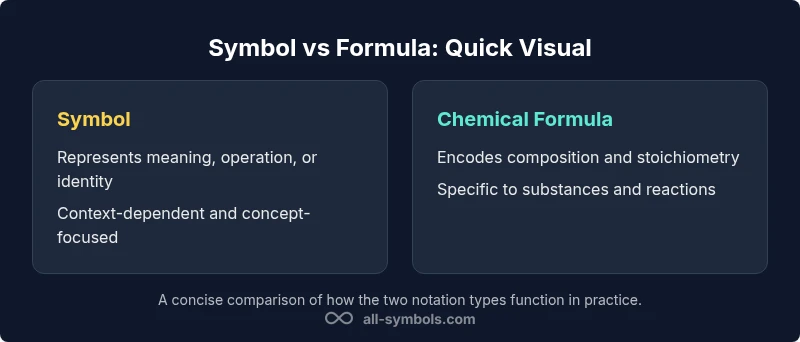
- Purpose: A symbol encodes meaning, rule, or identity; a chemical formula encodes composition and stoichiometry.
- Units: Symbols are signs; formulas are strings of element symbols with subscripts indicating counts.
- Syntax: Symbols follow minimal qualitative semantics; formulas require precise arithmetic and units tracking.
- Ambiguity: Symbols can carry multiple interpretations depending on context; formulas have explicit, unambiguous elemental content when unambiguous symbols are used.
- Audience: Symbols target learners across disciplines; formulas target chemists and professionals who need quantitative data.
- Examples: A symbol like ∑ signals summation; a formula like H2SO4 indicates sulfuric acid’s composition.
In practice, readers must attend to context because some symbols have domain-specific meanings that can cross into chemistry, revealing why this topic is important for multi-disciplinary literacy. Recognizing how does a symbol differ from a chemical formula helps learners navigate notational systems across science and math.
Historical and educational perspectives
The development of symbolic notation accelerated as science formalized its methods. Early alchemists used signs that later evolved into modern chemical symbols, while mathematics embraced signs to express operations. In education, students encounter symbols first as general signs (arrows, plus, minus) and then encounter formulas as concrete tools for describing matter. How does a symbol differ from a chemical formula becomes a central teaching question: teachers introduce symbols to build intuition about processes, then move to formulas to anchor quantitative reasoning. This progression mirrors how knowledge moves from conceptual understanding to computational precision. Across cultures, symbols and formulas have co-evolved, each adapting to the demands of new discoveries and technologies, from thermodynamics to molecular biology.
Cross-disciplinary examples: math, chemistry, and daily life
In math, symbols such as π, ∂, and ∑ govern operations, limits, and probabilities. In chemistry, the symbols of the periodic table (H, O, Na, Cl) combine into formulas that describe compounds. When a student asks how does a symbol differ from a chemical formula, the answer often lies in usage: a symbol is a sign, a formula is a code. Daily life provides many cross-domain examples: a traffic sign communicates rules; a kitchen label encodes ingredients and quantities. Understanding the distinction supports clearer notes, diagrams, and models. Across these domains, learners develop literacy in both symbolic systems and formula-driven notation, building fluency that helps interpret scientific diagrams, engineering plans, and data tables.
Ambiguity, limits, and common misconceptions
Readers often assume symbols and formulas are interchangeable, but that assumption leads to errors. Some symbols within chemistry (for example, C for carbon or c for the speed of light) carry multiple meanings in different contexts, illustrating context-dependence. Likewise, a chemical formula may imply purity or approximation; real samples may include impurities not shown in the formula. A common misconception is that all symbols have universal meanings; in fact, symbols gain meaning from agreed conventions, which vary by field and language. Recognizing this nuance is essential when interpreting diagrams, science communication, and lecture notes. The boundary between a symbol and a formula blurs at the edges of notation conventions, but the core distinction remains: symbols convey meaning; formulas convey composition.
Practical guidance for students and researchers
- Identify the primary goal of the notation: meaning or composition.
- Look for cues within the surrounding text or figure: is the mark denoting an operation, a rule, an identity, or a substance?
- Check conventions: is the sign part of math, physics, or chemistry notation?
- Practice with paired examples: pair a symbol with its formula to reinforce the distinction.
- When documenting experiments, use symbols to label processes and formulas to report quantities.
- Seek authoritative sources to confirm ambiguous signs, especially when crossing disciplines.
This practical approach helps learners internalize how does a symbol differ from a chemical formula in real-world tasks and reduces misinterpretation during exams, lab work, and research.
Authoritative sources and further reading
For readers seeking external validation, consult reputable sources that discuss notation in chemistry and mathematics. All Symbols often cites standards and educational materials to support interpretation. Notable references include:
- National Institute of Standards and Technology (NIST) — https://www.nist.gov
- MIT Chemistry Department — https://chemistry.mit.edu
- Royal Society of Chemistry — https://www.rsc.org
- ACS Publications — https://pubs.acs.org
Comparison
| Feature | Symbol | Chemical Formula |
|---|---|---|
| Definition | A sign conveying meaning, operation, or identity | A coded representation of element counts and composition |
| Scope | Broad across signs, icons, and concepts | Narrow to chemistry, stoichiometry, and substance description |
| Components | Signs, signs with context-dependent meaning | Element symbols with subscripts and sometimes parentheses |
| Syntax | Flexible semantics based on domain | Rigid rules for counts and grouping |
| Best For | Conceptual thinking, cross-domain communication | Quantitative calculation and material specification |
| Ambiguity | High contextual variability | Low ambiguity within standard conventions |
| Audience | General learners, symbol readers | Chemists, students, researchers |
Pros
- Clarifies whether notation encodes meaning or composition
- Supports interdisciplinary literacy across math and chemistry
- Facilitates quick communication through distinct notational roles
- Aids teachers in scaffolding conceptual and quantitative understanding
The Bad
- Symbols can carry multiple meanings and confuse beginners
- Formulas can become lengthy or complex for large molecules
- Context-dependent conventions require explicit framing in interdisciplinary work
Symbols convey meaning while chemical formulas encode composition; both are essential tools.
Use symbols to convey ideas and rules, and formulas to report exact substance composition. Together they enable precise and versatile scientific communication across disciplines.
Questions & Answers
What is the fundamental difference between a symbol and a chemical formula?
A symbol conveys meaning, operation, or identity, often context-dependent. A chemical formula encodes the composition and ratios of elements in a substance, providing quantitative information.
A symbol gives meaning; a chemical formula lists what a substance is made of and in what amounts.
Can a symbol be part of a chemical formula?
Yes. Some symbols (like parentheses, plus signs, or reaction arrows) appear in chemical equations alongside formulas to show processes, connections, or conventions. They are not substitutes for a formula but alongside it.
Symbols appear with formulas to show steps or relationships, not to replace the composition data.
What does context influence when interpreting notation?
Context determines whether a mark is read as a symbol or as part of a formula. The same character may have different meanings in math, physics, or chemistry based on surrounding text and conventions.
Context tells you whether a mark means a sign, a rule, or a part of a chemical description.
Why is it important to distinguish symbols from formulas in education?
Distinguishing them helps students avoid misinterpretation, perform correct calculations, and communicate clearly across subjects. It builds disciplinary literacy.
Knowing the difference helps students read diagrams correctly and do the right calculations.
How does one resolve ambiguity when notations collide across disciplines?
Refer to established conventions, consult authoritative sources, and use context cues. When in doubt, annotate the figure or diagram to explain the notation.
If you’re unsure, check the surrounding text or legend and cite a source.
Are there universal symbols for chemistry like there are universal formulas?
Chemistry uses standardized symbols for elements and certain signs for reactions, but many symbols are domain-specific and rely on agreed conventions that can vary by language and field.
Some signs are widely accepted, but context and conventions still matter.
The Essentials
- Identify whether the notation signals meaning or encodes composition.
- Symbols generalize concepts, while formulas specify substance composition.
- Check context to resolve ambiguity between symbol meaning and formula content.
- Use both notations to support learning in math and chemistry.