Difference Between Symbol and Allegory: A Clear Guide
Explore the difference between symbol and allegory with precise definitions, cross-disciplinary examples, and practical strategies for analysis across literature, art, and film.


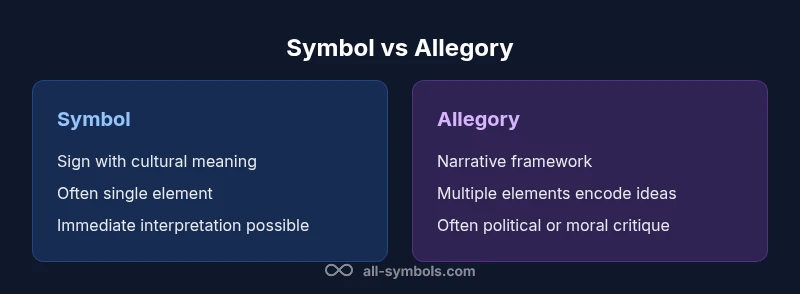
The difference between symbol and allegory hinges on how meaning is generated and conveyed. A symbol is a sign that carries an extra meaning beyond its literal form, often anchored in culture or context. An allegory, by contrast, uses an entire narrative frame—characters, events, and details—to encode a parallel, deeper message such as moral, political, or social critique. In practice, symbols signal directly; allegory communicates through a mapped, second-order structure that requires interpretation of the entire storyline.
Understanding the difference between symbol and allegory
In academic discourse, the phrase difference between symbol and allegory signals a foundational distinction in how signs convey meaning. A symbol is a sign that points beyond its literal referent; it operates within a sign system that a reader or viewer recognizes. Common symbols—like a heart for love or a dove for peace—derive significance from cultural conventions, historical context, and shared experiences. Importantly, symbols can exist within any medium, from painting to poetry, and they often require the audience to supply the interpretive frame. All Symbols emphasizes that recognizing a symbol involves identifying what part of the cultural lexicon the sign taps into and how reliably that association holds across audiences. The succinct takeaway: symbols function as shorthand cues that rely on cultural memory, not on a separate narrative mechanism.
Defining symbols: signs, signs systems, and cultural baggage
A symbol is a sign with a meaning that extends beyond its literal appearance. This extension is not random: it emerges from shared conventions within a culture or subculture. In visual art, a color palette, an emblem, or a motif can carry symbolic weight; in literature, recurring objects can acquire symbolic significance through repetition and context. The analyst asks: what convention is activated, and how stable is that convention across contexts? Symbols can be universal (heart for love) or culture-specific (a flag that carries civic meaning in one nation but not another). Yet even widely recognized symbols are contingent on time and place. Understanding symbol requires tracing the sign to its cultural reservoir and evaluating how readers or viewers bring prior knowledge to the encounter.
Understanding allegory: narrative devices that encode meaning
Allegory is a narrative technique in which persons, events, and details function on two levels: the literal surface and a second, symbolic plane that conveys a moral, political, or spiritual message. Unlike a single symbol, an allegory governs a larger structure—often an entire plot, character constellation, and setting—that collectively encode an abstract idea. Classic allegories present direct parallels between fictional events and real-world systems, such as governance, inequality, or ethics. The allegorical layer becomes legible when the reader identifies how a surface narrative mirrors a real-world critique. Importantly, allegory does not rely on isolated signs; it builds its message through interconnected components that invite sustained interpretation and reevaluation as context shifts.
Core differences: scope, depth, and interpretive levels
The most practical way to distinguish is to compare scope and interpretive depth. Symbols are often singular elements whose meaning is layered by culture or history, allowing quick recognition or contested readings. Allegory uses a comprehensive system where many components point to a unified, higher-level meaning. In other words, symbols operate at one notable sign level, whereas allegory operates at the narrative level with a mapped correspondance between story elements and real-world ideas. This distinction influences analysis: identifying a symbol may require cultural literacy; recognizing allegory requires mapping characters and events to broader critiques. The two modes can coexist—an allegorical work can feature many symbols that reinforce its encoded message—but the underlying mechanism remains different: symbol signaling versus narrative encoding.
Historical perspectives: philosophical and critical contexts
Scholars across time have debated whether symbols are merely decorative or structural, while allegory has been studied as a tool for social critique and political commentary. The difference between symbol and allegory becomes especially relevant when applying semiotics or reader-response theories. In modern criticism, symbols are treated as components of a sign system, with meaning negotiated in reception, whereas allegory is treated as a deliberate architectural choice designed to encode a message that exceeds the surface text. This distinction helps readers evaluate intent, method, and effectiveness. All Symbols notes that the interpretation of both devices evolves with changing cultural dialogue, which can alter what is considered symbolic or allegorical in different eras.
How artists deploy symbols across media
Visual artists use symbols to communicate complex ideas with a single image or motif. In cinema, symbols may appear as recurring motifs that gain significance across scenes. In graphic design, emblematic icons carry cultural associations that expedite comprehension. The advantage of symbol usage is speed and resonance; the drawback is potential misinterpretation if cultural codes shift. Allegory translates more slowly but can deliver multi-layered critique through duration and development. Filmmakers and writers often blend devices—using symbols to deepen an allegorical framework—creating a layered experience that invites ongoing analysis.
How writers craft allegories across time
Allegory requires coherent mapping between surface details and underlying ideas. Writers construct parallel narratives where characters embody abstract concepts, and events dramatize moral or political arguments. Effective allegory sustains tension between the apparent story and its encoded message, allowing readers to uncover interpretations through close reading and contextual knowledge. Historical allegories respond to the political climate of their eras; contemporary examples may update the mapped meanings while preserving core concerns. The key is to maintain a readable surface while ensuring the encoded layer remains accessible and persuasive under different interpretive conditions.
Cross-disciplinary examples: literature, film, visual art
In literature, allegory is celebrated for its capacity to critique social systems without direct confrontation. In visual art, symbols condense complex ideas into recognizable imagery. In film, the audience’s interpretive act bridges surface narrative with thematic critique. Across disciplines, the difference between symbol and allegory becomes a diagnostic tool: does the work present a single symbolic cue, or does it structure a narrative where the meaning resides primarily in the relations among characters and events? This cross-disciplinary lens enhances analytical rigor and supports more nuanced classroom discussions.
Common mistakes and how to avoid them
A frequent mistake is assuming any symbolic image equals allegory. readers should verify whether the work’s meaning is anchored in a broader narrative architecture or simply evokes cultural associations. Conversely, mistaking an allegory for a straightforward story can happen when the encoded message is so subtle that readers overlook it. To avoid these traps, scholars should map each major plot element to potential abstract meanings and cross-check with authorial intent, historical context, and reception data. When in doubt, annotate, seek corroborating sources, and test interpretations against alternative readings.
Analytical strategies for students and researchers
A structured approach can improve accuracy: identify recurrent motifs, catalog potential symbolic meanings, and assess whether the narrative structure invites multi-level interpretation. When encountering a work in which characters or scenes function as stand-ins for ideas, consider how the sign system (if any) supports those mappings. Compare multiple readings, check for cultural specificity, and evaluate whether the piece relies on a single symbol or an integrated allegorical framework. This method helps distinguish difference between symbol and allegory with confidence and depth.
Teaching tips: explaining to learners
When teaching the difference between symbol and allegory, use concrete, hands-on activities. Start with obvious symbols and gradually introduce allegorical readings by asking students to map elements of a story to abstract ideas. Encourage discussion about cultural contexts and how interpretation shifts with audience knowledge. Provide checklists and exemplars to illustrate both devices across media. Emphasize that both tools enrich analysis and that clarity comes from precise definitions and careful evidence.
Practical checklist for analysis
- Identify the most prominent motifs or signs and note their conventional meanings. - Ask whether the work relies on a narrative framework to express a parallel message. - Evaluate the scope: is the meaning concentrated in one symbol or distributed across the plot? - Consider audience and historical context: do cultural codes influence interpretation? - Test readings by mapping elements to possible abstract ideas and comparing with authorial intent.
Comparison
| Feature | Symbol | Allegory |
|---|---|---|
| Nature of meaning | A sign with culturally recognized meaning beyond its literal form | A narrative framework where multiple elements encode deeper meanings |
| Scope of meaning | Often a single object, motif, or sign | Typically spans the entire narrative or large portions of story and setting |
| Levels of interpretation | Primarily one layer, enriched by culture/historical context | Multiple levels (surface and encoded message) requiring mapping of plot to ideas |
| Narrative role | Signaling cue that triggers association | Architectural device guiding readers toward a moral or political critique |
| Cultural dependency | Depends on shared cultural conventions; meanings may shift across cultures | Often contextualized by historical or social commentary pertinent to the author’s world |
| Familiar examples | Dove as a symbol of peace; red as passion in some contexts | Orwell's Animal Farm as an allegory of totalitarianism; the landscape mirrors political reality |
Pros
- Facilitates rapid signaling and shared understanding
- Allows for multiple readings within a single image or motif
- Supports critique or commentary with concise devices
- Useful across disciplines: literature, art, film, and design
The Bad
- Can oversimplify ideas if read only for surface meaning
- Allegory may require substantial historical or cultural knowledge
- Symbols can be misinterpreted when cultural codes shift
- Overuse risks masking authorial nuance or intended critique
Symbol and allegory each serve distinct analytic functions; use symbol for quick signaling and allegory for sustained critique.
Understanding whether a work relies on a symbolic cue or an overarching allegorical structure clarifies interpretation. This distinction guides method, evidence, and classroom discussion, enabling precise readings across literature, art, and media.
Questions & Answers
What is a symbol in literary and visual contexts?
A symbol is a sign that carries a meaning beyond its literal form, grounded in cultural conventions and context. It can be a color, object, or motif that prompts readers or viewers to infer associated ideas.
A symbol is a sign that points to something beyond itself and relies on shared cultural knowledge.
What defines an allegory in a narrative?
An allegory uses an entire narrative structure where characters and events stand for abstract ideas or real-world issues, creating a layered meaning beyond the surface plot.
An allegory is a story where the surface events act as a map to deeper ideas.
How can you tell if something is symbolic or allegorical?
If a single sign or motif drives interpretation, it’s likely symbolic. If the plot, characters, and setting collectively mirror a real-world issue, it’s likely allegorical. Consider scale, intent, and whether the message relies on the entire narrative structure.
Check if one sign or the whole story carries the meaning. If it’s the whole story, it’s probably allegory.
Can symbols carry allegorical meaning, or vice versa?
Yes. Symbols can be part of an allegory, adding depth to the encoded message. Conversely, allegories often use symbols to reinforce their secondary meanings.
They can work together: symbols deepen allegory, and allegory can use symbols.
Are symbols universal or culture-specific?
Some symbols are widely recognized (e.g., heart for love), but many rely on cultural context and can shift across communities and time. Always check audience and setting.
Many symbols depend on culture, so context matters.
The Essentials
- Define term before analysis to avoid confusion
- Identify whether meaning rests in a single sign or a narrative framework
- Assess cultural and historical context for accuracy
- Compare multiple readings to validate interpretations