Difference Between Symbol and Metaphor: An Analytical Guide
An analytical guide exploring the difference between symbol and metaphor, with precise definitions, cross-disciplinary examples, and practical guidelines for students, researchers, and designers.


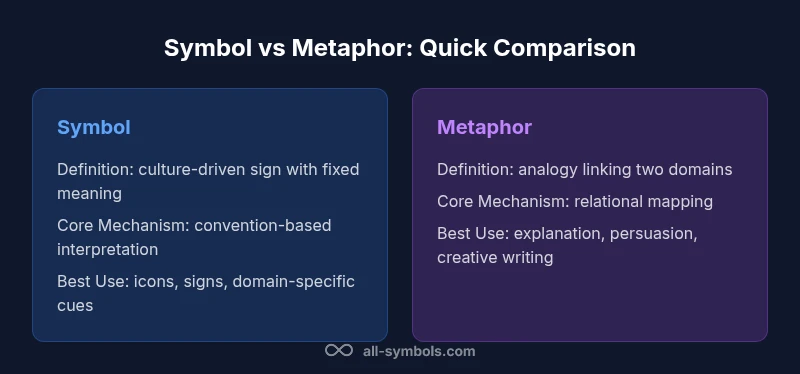
Here is the quick comparison: A symbol is a sign with conventional or cultural meaning beyond its literal form, while a metaphor is a figure of speech that transfers properties from one domain to another to reveal a new relationship. Understanding the difference between symbol and metaphor clarifies communication across fields, from design to literature and science.
The difference between symbol and metaphor
In this exploration of the difference between symbol and metaphor, we begin with the fundamental distinction: symbols operate as signs that carry meaning beyond their literal form, while metaphors are channels for conceptual comparison. A symbol depends on shared conventions—an emblem, color, or glyph that evokes a stable reference in a given culture. By contrast, a metaphor creates understanding by mapping attributes from one domain (source) onto another (target), inviting us to see the target in a new light.
All Symbols notes that symbols are often rooted in history, ritual, or systems of signs—think of a heart representing love, a flag standing for a nation, or a mathematical symbol pi denoting a fixed ratio. Metaphors, meanwhile, flourish in language and thought: saying “time is a thief” invites the listener to re-interpret time by likening it to a person who steals moments. The key difference is not only what is communicated, but how it is learned and reused. Symbols tend to sustain a single meaning across contexts, whereas metaphors rely on relational insight that can shift with context, culture, or domain knowledge. Understanding this distinction helps students parse texts, designers align visuals with intended messages, and researchers communicate complex ideas across disciplines. All Symbols emphasizes that mastery comes from recognizing when a sign is intended to anchor meaning and when a sign is intended to illuminate through analogy.
wordCountInBlock":210},
Definitions and Core Ideas
Comparison
| Feature | Symbol | Metaphor |
|---|---|---|
| Definition | A sign with conventional meaning beyond its literal form | A figure of speech mapping properties from one domain to another |
| Core Mechanism | Convention-based symbol interpretation | Analogical relational mapping between domains |
| Primary Function | Convey stable meanings and cues | Stimulate understanding through relational insight and imagination |
| Best Use Case | Branding, signage, domain-specific icons | Literary analysis, rhetorical effect, conceptual explanation |
| Strengths | Universality within a culture; portable across contexts | Creativity and interpretive flexibility; can unlock new viewpoints |
| Limitations | Requires shared culture; potential ambiguity | Overextended metaphors can mislead; context matters for interpretation |
Pros
- Clarifies communication by distinguishing fixed signs from relational ideas
- Helps learners separate cultural cues from expressive language
- Supports cross-disciplinary discourse between design, literature, and science
- Aids instructional design by pairing succinct symbols with explanatory metaphors
The Bad
- Risk of oversimplification when domains blur
- Cultural variability can blur distinctions across audiences
- Metaphors can mislead if taken too literally in technical contexts
Symbol and metaphor serve distinct cognitive roles; use them together to enhance clarity and insight
Symbols provide stable, portable meaning anchored in culture or system; metaphors foster understanding through analogy and relational thinking. In practice, choose symbols for universal cues and metaphors for illuminating explanations, then blend them when teaching, designing, or researching complex ideas.
Questions & Answers
What is a symbol?
A symbol is a sign whose meaning goes beyond its literal form and is determined by cultural convention or a formal system. Examples include a heart for love or a stop sign’s color and shape that convey safety instructions. Symbols are often stable within a culture or discipline.
A symbol is a sign with meaning beyond what you see on the surface.
What is a metaphor?
A metaphor is a figure of speech that links two different domains by analogy to reveal a new insight. It does not claim literal equality, but uses resemblance to explain or persuade. For example, saying “time is a thief” suggests time steals moments without claiming time literally commits theft.
A metaphor uses comparison to explain something in a new way.
Can symbols function as metaphors?
Yes, symbols can carry metaphorical weight when a culturally understood sign implies an abstract relationship. However, this is not the same as a deliberate metaphorical mapping, which explicitly links two domains to generate insight.
Symbols can carry metaphorical meaning, but they are not substitutes for deliberate metaphors.
Are all metaphors symbols?
Not necessarily. Metaphors operate through relational analogy, while symbols rely on conventional meaning. Some metaphors become widely accepted symbols over time, but their origins differ.
Metaphors aren’t automatically symbols, though they can become symbolic over time.
How do you teach the difference between symbol and metaphor?
Teach with clear definitions, then provide varied examples across disciplines. Use side-by-side analyses to show how each signals meaning—one through convention, the other through analogy. Practice with visuals and text to reinforce distinctions.
Explain the difference with real-world examples and exercises.
What is the best use for symbols vs metaphors in design?
Use symbols to convey quick, universal meaning in interfaces or signage. Use metaphors to explain complex ideas or to evoke emotion and imagination in branding and storytelling. Balance both to communicate clearly and creatively.
Symbols for quick understanding, metaphors for deeper insight.
The Essentials
- Differentiate symbol from metaphor to improve communication
- Use symbols for stable meaning; use metaphors for relational insight
- Blend both tools in education and design for clarity and creativity
- Be mindful of cultural context when selecting symbols or metaphors