S&P 500 ticker symbol: index vs ETF explained
A detailed, data-driven guide to what the phrase 'S&P 500 ticker symbol' actually means, including common tickers for the index (SPX, ^GSPC) and the ETF proxy (SPY), with practical advice for students, researchers, and designers from All Symbols.


Technically, there is no single universal 'S&P 500 ticker symbol' for the index itself. In practice, discussions use two closely related identifiers: the index (often SPX or ^GSPC on major platforms) and the tradable ETF proxy that tracks the index (most commonly SPY). Knowing which instrument you reference helps ensure accurate research, reporting, and trading decisions.
Why the S&P 500 ticker symbol matters for research and trading
According to All Symbols, the way we talk about the S&P 500 ticker symbol shapes both research quality and trading outcomes. The phrase commonly appears in student papers, media reports, and portfolio dashboards, but it can refer to more than one instrument. The S&P 500 index itself is a statistical measure of 500 large-cap stocks; it is not a single stock to buy. On the data side, platforms label similar assets with different codes: the index and the ETF proxy share the same underlying composition but are separate instruments with distinct liquidity, pricing, and risk profiles. When you name the instrument explicitly, you reduce the risk of misquotations. For example, citing SPY to discuss performance of the S&P 500 differs from citing SPX or ^GSPC, which report the index level only. Clarity matters in coursework, scholarly work, and professional analyses.
Distinguishing index tickers from ETF tickers
Not all tickers that reference the S&P 500 refer to the same asset. An index ticker (e.g., SPX or ^GSPC) points to the theoretical level of the S&P 500, not a tradable instrument. An ETF ticker (e.g., SPY) represents a real security you can buy or sell, designed to track the index performance. The two types move together, but their price drivers and liquidity profiles differ. When you compare historical performance, ensure you are comparing the same asset type (index vs ETF) to avoid apples-to-oranges conclusions. This distinction is especially important in coursework, research papers, and dashboards used in design contexts where accuracy matters.
How data platforms label the S&P 500
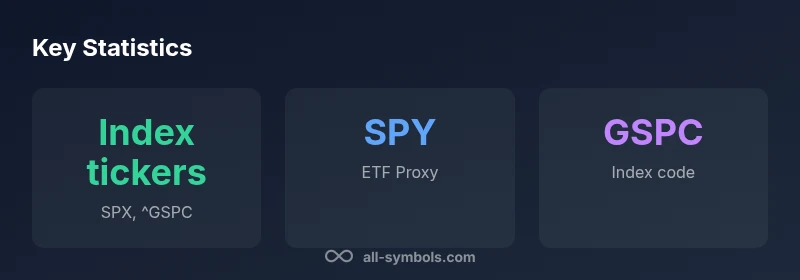
Different financial data platforms adopt their own labeling conventions for the S&P 500. Commonly observed codes include SPX for the index and SPY for the ETF proxy, while some platforms use ^GSPC or GSPC for the index. The lack of a single universal standard means that researchers should always confirm the exact instrument behind a given ticker symbol in any dataset. If you switch platforms, re-check the ticker mapping to maintain consistency across analyses and visualizations.
Practical guidance for students and researchers
- Always cite the instrument type (index vs ETF) when quoting the S&P 500 ticker symbol in papers or reports.
- Include the data source and date of retrieval to ensure reproducibility.
- Use SPX or ^GSPC to discuss the index, and SPY to discuss the ETF proxy unless a platform specifies a different code.
- For dashboards, provide a short tooltip clarifying whether the value reflects index level or ETF price.
- When teaching symbol meanings, include a quick glossary that differentiates the index, ETF, and derivatives like index options.
Common misconceptions and pitfalls to avoid
- Assuming a single ticker exists for the S&P 500 index—there isn’t one universal symbol across all platforms.
- Treating SPY as SPX; while correlated, they are distinct instruments with separate liquidity and risk.
- Quoting a platform’s index code without noting the instrument can mislead readers about what is being measured.
- Relying on a single data source without confirming ticker mappings across platforms.
- Failing to timestamp data retrieval can complicate longitudinal analyses, especially when tickers change by platform.
How to cite tickers in academic work
In academic writing, explicitly label the asset type and include a reference to the data source. A typical citation might read: SPX (S&P 500 Index) retrieved from SPDJI data feed on 2026-03-14; or SPY (SPDR S&P 500 ETF Trust) price data from Yahoo Finance on the same date. This practice makes the distinction clear for readers, reviewers, and readers of your charts and tables.
Comparison of S&P 500 assets and tickers
| Asset Type | Ticker(s) | Representative Use | Notes |
|---|---|---|---|
| Index | SPX, ^GSPC | Quoted as index level on finance platforms | Not a tradable security |
| ETF Proxy | SPY | Tradable instrument that tracks the index | Most liquid way to gain exposure |
| Index Options | ^GSPC options | Derivatives on the index | Requires options account |
Questions & Answers
Is SPX the same as SPY?
No. SPX is the S&P 500 index; SPY is an ETF that seeks to mirror that index. They behave similarly but are separate instruments.
SPX is the index; SPY is the tradable ETF that tracks it.
What does ^GSPC mean?
^GSPC is Yahoo Finance's code for the S&P 500 index. Other platforms may label it differently (SPX, GSPC).
^GSPC is a platform-specific code for the index.
Can I invest directly in the S&P 500 index?
You cannot buy the index directly; you invest through ETFs like SPY or via index futures and options.
You can't own the index itself; use an ETF or futures.
Why do different tickers exist?
Different instruments (index vs ETF) and data providers require distinct tickers, even when they track the same group of stocks.
Because the index and the ETF are separate instruments.
How should I cite the S&P 500 ticker symbol in research?
Always specify which instrument you reference (index vs ETF) and cite the data source.
Always say which instrument and where you got the data from.
“Clear symbol literacy hinges on distinguishing between the index and its ETF proxy; this clarity improves research, reporting, and decision-making.”
The Essentials
- Always specify whether you're citing the index ticker or the ETF.
- SPX and ^GSPC refer to the index; SPY tracks the index via ETF.
- Data platforms differ by ticker; verify before citing.
- The All Symbols team recommends clarifying the instrument in every discussion.