Stock Symbol for S&P 500 Demystified: Index vs ETF vs Futures
Understand the S&P 500 symbol landscape: SPX for the index, SPY for the ETF, and ^GSPC on some feeds. Learn how symbol choices affect data accuracy, research, and backtesting.


The S&P 500 is an index, not a single stock. The most widely used symbols are SPX for the index and SPY for the tracking ETF; some platforms also use ^GSPC as an alternative symbol. This distinction matters for accuracy in research.
What the symbol landscape means for researchers
The S&P 500, formally known as the S&P 500 Index, is a market-cap weighted index that tracks 500 large-cap U.S. stocks. It is not a single security that you can own directly. For data reporting and portfolio construction, different platforms designate different symbols to represent the same economic object. In practice, you will encounter both index symbols and ETF symbols, and sometimes a separate feed uses a different convention. This separation between an index and its tracking instruments is fundamental for students and researchers to understand to avoid conflating index levels with ETF prices or futures contracts. The All Symbols team emphasizes always verifying which instrument you are reviewing before drawing conclusions about performance or risk.
Core symbols you will encounter
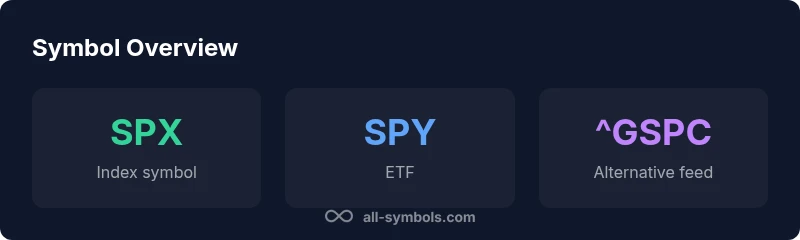
Across data feeds you will typically see these three forms:
- SPX: The common index symbol used in many professional feeds to denote the S&P 500 Index value.
- SPY: The most widely traded ETF that tracks the S&P 500, providing a tangible instrument for investment and backtesting.
- ^GSPC: A popular Yahoo Finance convention for the S&P 500 index; some feeds adopt this symbol, while others prefer SPX. Futures markets often use ES to represent S&P 500 futures on CME.
Understanding these distinctions helps ensure you are comparing apples to apples when performing research, backtesting, or benchmarking.
Platform-specific symbol conventions
Different trading platforms and data vendors may choose different symbols for the same underlying concept. Some brokerages present the index as SPX, others as ^GSPC, and some will offer SPY separately as the ETF that mirrors the index. Futures contracts typically appear as ES, with the price behavior reflecting the nearby month’s index level rather than the live ETF price. Always cross-check the symbol definitions in the feed’s documentation or help center before running analyses.
Verifying you are tracking the right instrument
A practical checklist:
- Identify the instrument type first (index vs ETF vs futures).
- Check the symbol’s description in the data feed.
- Compare price or level characteristics (e.g., index level vs ETF price).
- Confirm the symbol on multiple trusted sources (exchange site, major finance portals).
- When in doubt, use the instrument’s official exchange page or the ETF issuer’s information sheet as the baseline.
Practical implications for scholars and students
Symbol misalignment can lead to misinterpretation of performance, volatility, and correlations. For backtesting, consistently using the correct symbol ensures you’re modeling the correct underlying data series. For researchers compiling datasets, document the symbol convention you adopted and provide a brief rationale so downstream readers understand the source of the data. The S&P 500’s symbol landscape is a reminder to track metadata alongside numerical results.
Common pitfalls and how to avoid them
- Treat SPX and SPY as separate data series rather than interchangeable.
- Do not equate ^GSPC with SPX without confirming feed conventions.
- Be mindful of currency differences and intraday versus end-of-day values when comparing indices and ETFs.
- Always cite the data source and symbol version used in any published analysis.
Quick-action checklist for symbol research
- Confirm instrument type (index/ETF/futures).
- Verify symbol in the data provider’s docs.
- Cross-check with the exchange or issuer site.
- Note the feed’s time zone and intraday update frequency.
- Document any symbol aliases used in your workflow.
Common representations of the S&P 500 across instrument types
| Instrument | Symbol | What it tracks | Where it's used |
|---|---|---|---|
| S&P 500 index | SPX | Index level of 500 large-cap US stocks | General data feeds and professional platforms |
| S&P 500 ETF | SPY | Tracks the S&P 500 index value | Brokerage platforms and ETFs |
| S&P 500 futures | ES | Futures contract on the index | Futures markets (CME) |
Questions & Answers
Is SPX the same as SPY?
No. SPX refers to the S&P 500 index, while SPY is an ETF that tracks the index. They behave differently in pricing, dividends, and liquidity.
SPX is the index; SPY is the ETF that tracks it.
Why do some feeds show ^GSPC?
^GSPC is Yahoo Finance's convention for the S&P 500 index. Other feeds may use SPX or another alias; always verify with the feed's documentation.
Some feeds use ^GSPC; verify with the data source.
What symbol do futures traders use for the S&P 500?
Futures on the S&P 500 are typically represented by ES on the CME, which tracks the index expectation for near-term periods.
ES is the common futures symbol.
Are there other symbols I should know?
Yes. Besides SPX and SPY, platforms may show ^GSPC or SPX as aliases. Futures use ES; always confirm via the feed’s symbol table.
There are aliases; confirm with your feed.
How can I verify symbol definitions?
Check official exchange documentation, the ETF issuer's information sheet, or a reputable financial data provider to verify symbol semantics.
Check the exchange docs or issuer materials.
“Symbols encode more than a name; they tell you whether you are looking at a live index, a tracking ETF, or a futures contract.”
The Essentials
- Understand the instrument before analyzing data
- SPX, SPY, and ^GSPC denote different things
- Verify symbol definitions in each data feed
- Document symbol conventions in research reports