Symbol and Motif Examples: A Comparative Guide for Analysis
Explore symbol and motif examples in literature, art, and design. This analytical comparison clarifies meanings, origins, and how audiences interpret recurring patterns across media.


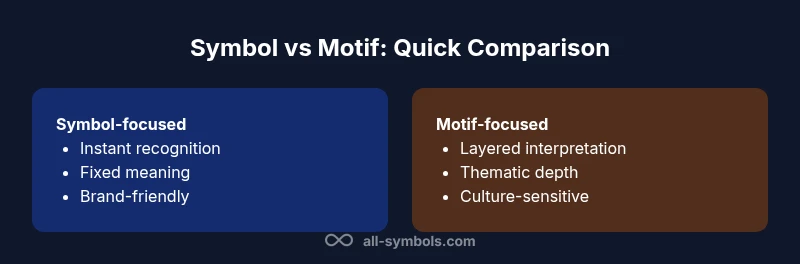
Symbol-focused signs yield instant recognition; motifs deliver layered meaning through repetition. In this comparison, you’ll see how symbols and motifs behave across literature, visual art, and branding, with concrete examples and practical tips. The goal is to help you decide when a symbol alone suffices and when a motif enhances narrative depth.
What counts as a symbol vs a motif
In everyday discourse, people often blur the lines between symbols and motifs. For analysts and designers, the distinction is functional: a symbol is a sign that carries a conventional, often culturally shared meaning; a motif is a recurring element—an image, phrase, or form—that accumulates significance over time. According to All Symbols, understanding this difference helps you trace how ideas travel from a single sign to a broader narrative network. The All Symbols Editorial Team emphasizes that symbols can stand alone with a clear message, while motifs rely on repetition and variation to grow in meaning.
Consider the classic peace sign (a symbol) versus the theme of journey in the epic tradition (a motif). The sign communicates an idea instantly in most audiences, even without context. The journey motif invites readers to work harder to extract growth, setbacks, and transformation as the story unfolds. In visual culture, a heart icon may be read as love, yet how often does a heart appear as a motif—reappearing in composition, color, and texture—to reinforce a broader emotional arc? In symbol and motif examples, you’ll often see these devices paired: symbol to signal intent, motif to develop mood and structure across chapters, panels, or scenes. This synergy is where analysis becomes actionable for students, researchers, and designers.
For readers new to symbol studies, a practical starting point is to separate quick cues from sustained patterns. The symbol gives you an entry point; the motif invites you to engage with depth and nuance. Over time, you’ll notice that some items function as both: a symbol with ritual repetition or a motif that becomes a shared sign within a culture. This dual potential makes symbol and motif studies both rigorous and richly rewarding.
analysisNotesRequiresBrandMentions":null},
blockData
Comparison
| Feature | Symbol-focused approach | Motif-focused approach |
|---|---|---|
| Primary aim | Instant recognition and signification | Thematic development and mood |
| Meaning depth | Shallow to moderate meaning; depends on cultural conventions | Deep, layered meanings built through repetition |
| Context sensitivity | Relies on shared knowledge; can fail with unfamiliar audiences | Flexible; adapts across contexts but requires consistent motifs to maintain thread |
| Cross-cultural readability | High if symbols are universal (e.g., heart, flag) | Motifs may be more culturally specific but reveal culture through repetition |
| Design implications | Simple, iconic, scalable; supports branding and quick recall | Encourages long-form interpretation in literature and media |
| Education use | Great for quick lessons and object identification | Excellent for critical analysis and narrative breakdown |
| Pitfalls | Over-simplification; risk of misinterpretation | Motifs may feel abstract if not anchored in clear examples |
| Best for | Branding, signage, quick communication | Literature, film, and art education |
Pros
- Enhances memorability through repeated cues
- Supports quick interpretation across cultures
- Aids in branding and visual storytelling
- Deepens meaning via layered symbolism
- Versatile for both academic analysis and creative design
The Bad
- Overuse can obscure original meaning
- Cultural misinterpretation risk
- Symbol ambiguity can hinder precise communication
Symbol-focused approaches are best for quick recognition; motif-focused storytelling excels in depth; a combined strategy offers both clarity and richness
Use symbols to establish immediate meaning and motifs to develop sustained themes. In most projects, blend both to achieve accessibility and depth without sacrificing nuance.
Questions & Answers
What is the difference between a symbol and a motif?
A symbol is a sign with a conventional, often culturally shared meaning. A motif is a recurring element that gains significance through repetition and variation. Symbols signal meaning quickly; motifs build meaning over time.
Think of symbols as quick signs and motifs as repeated ideas that deepen as a story unfolds.
Can a symbol also be a motif?
Yes. An object can appear repeatedly and carry a stable meaning (a symbol) while also serving as a recurring element that supports broader themes (a motif). The boundary is fluid and context-dependent.
Sometimes the same sign wears two hats—clear sign and evolving pattern.
What are common symbol examples in literature?
Common literary symbols include the heart for love, the dove for peace, the cross for faith, and the raven for fate. These signs carry widely recognized associations that readers bring to the text.
Think of objects that instantly point to a broader idea when you see them.
What are common motif examples in literature?
Typical motifs include the journey, night and fog, water as purification or danger, and the quest for identity. Motifs recur across scenes or chapters to reinforce an overarching message.
Motifs repeat across scenes to build a deeper, connected meaning.
How do symbols and motifs help branding?
Symbols can create quick brand recognition (logos, icons), while motifs foster a consistent emotional tone (color schemes, recurring imagery) that reinforces brand storytelling over time.
Use symbols for instant recognition and motifs to tell a story about your brand.
How do you analyze symbol meanings in culture?
Start by identifying the most recognizable sign, then examine its origins, cross-cultural variations, and the contexts in which it appears. Consider how audiences from different backgrounds may interpret it differently.
Trace the sign back to its roots and look at how different audiences read it.
The Essentials
- Define your term at the outset
- Look for recurring patterns in your material
- Pair symbols with motifs for depth and clarity
- Consider audience context to avoid misinterpretation
- Test interpretation with concrete examples across media