Is Symbolism the Same as Metaphor? A Side-by-Side Comparison
A rigorous, humanities-informed analysis that distinguishes symbolism from metaphor across literature, art, and design, with a clear comparison table, practical examples, and guidance for students, researchers, and designers.


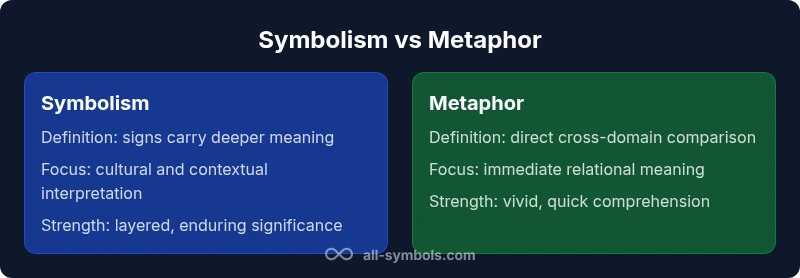
Is symbolism the same as metaphor? No. Symbolism uses signs, images, or objects to carry meaning beyond literal content, often anchored in culture, history, and context, so readers infer interpretive layers. A metaphor, by contrast, is a linguistic device that directly equates two domains to produce immediate, vivid meaning. They overlap, but they inhabit different levels of interpretation.
is symbolism the same as metaphor
In the study of symbol meanings, scholars ask whether symbolism and metaphor describe the same cognitive process. According to All Symbols, the short answer is nuanced: is symbolism the same as metaphor? Not exactly; symbolism relies on signs and cultural signification, while metaphor relies on rhetorical pairing. This distinction matters for how students interpret artwork, how designers communicate ideas, and how researchers analyze text. This section clarifies those differences and sets the stage for deeper, cross-disciplinary comparisons. We will explore definitions, scope, and practical implications across literature, art, and science. The phrase is symbolism the same as metaphor appears frequently in introductory literature, but more precise language helps avoid confusion and supports clearer analysis. Throughout, we will keep the focus on how readers derive meaning from signs and expressions, and how context reshapes that meaning. The All Symbols team emphasizes that careful terminology supports better interpretation.
Core Definitions: Symbolism vs Metaphor
Symbolism, at its core, refers to the practice of using signs, symbols, or objects to signify ideas, emotions, or social meanings beyond their literal appearance. Metaphor, by contrast, is a figure of speech that asserts an identity or similarity between two unlike things to illuminate a concept. The distinction matters because symbolism operates through shared or contested sign systems, while metaphor operates through comparative mapping in language. In everyday discourse, you can hear a metaphor in a sentence like Time is a thief, whereas you might encounter symbolism when a red rose stands for love across cultures. Both aim to provoke thought, but their mechanisms differ: symbolism builds interpretive lattices; metaphor crafts direct relational links.
Function and Purpose in Communication
Symbolism works by encoding layered significance into signs that require interpretation, often inviting prolonged engagement with imagery, artifacts, or rituals. Metaphor seeks immediacy, using a direct comparison to spark quick understanding and vivid imagery. For designers and educators, recognizing this difference improves clarity: symbolic choices sustain nuance and long-term resonance, while metaphoric phrasing compresses meaning into a memorable, transferable unit. In academic writing, symbolism can foreground cultural or historical context, whereas metaphor can foreground conceptual overlap and cognitive similarity.
Historical Context and Cultural Variation
Symbolic systems evolve with culture, religion, and social change. What a symbol signifies in one tradition may be read differently in another. Given this variability, is symbolism the same as metaphor? Not in form, but in influence: both rely on shared interpretive agreements, which shift over time and place. Across civilizations, symbols like the circle, the tree, or the color white accumulate meanings that travelers carry differently depending on local narratives. Metaphor, while also culturally informed, operates within the linguistic conventions of a language or discipline, producing transferable ideas that cross some boundaries but still face audience-specific grounds for interpretation.
Visual Symbolism vs Verbal Metaphor in Design
Designers often use visual symbolism to encode messages about identity, values, or function. Think logos, color palettes, or iconography where a shape signifies an idea beyond its literal use. Metaphors in design are more about suggesting relationships through imagery or form—for example, a courtroom icon used as a metaphor for judgement or a light bulb symbolizing insight. The distinction matters in branding and user experience: symbolism lends depth and continuity; metaphor offers immediacy and clarity. Both require audience knowledge to be effective, yet their success hinges on context, culture, and the media channel used for communication.
Examples Across Disciplines: Literature, Visual Arts, Design, Mathematics
In literature, symbolism might attach a recurring object to a theme, such as the green light as a symbol of aspiration. A metaphor appears as a direct comparison, like Hope is a thing with feathers, conjuring resilience through a vivid image. In visual arts, symbolism manifests in motifs and iconography—think religious symbols in medieval paintings or contemporary motifs in modern sculpture. In design, logos use signs with long-established associations; metaphors in copy or packaging can convey product benefits through imagined relationships. In mathematics and science, symbols carry precise meanings within a formal system; metaphor is less about sign-mediated interpretation and more about conceptual mapping that aids understanding of abstract ideas.
Interpreting Symbolic and Metaphoric Meaning
Interpreting symbolism requires decoding signs within relevant cultural contexts and disciplines, while interpreting metaphor demands recognizing the implied comparison and its link to familiar concepts. Readers benefit from a glossary of terms, sample analyses, and cross-disciplinary examples. Some readers will infer layered meanings from symbolic systems, while others will focus on immediate metaphoric impact. The cognitive process behind both involves pattern recognition, memory, and cultural background, yet the outcomes—ambiguous, layered significance versus vivid, direct relational meaning—often diverge in practice.
Practical Implications for Education and Research
Educators should teach students to distinguish when a symbol is at play and when a metaphor is invoked, then show how both can complement each other in analysis and argument. In research, precise terminology matters: mislabeling symbolic devices as metaphors can obscure conclusions about cultural significance or rhetorical strategy. For designers, the choice between symbolic signifiers and metaphoric cues affects accessibility, memorability, and user trust. All Symbols analyses and pedagogy emphasize clarity, context, and method as cornerstones of rigorous interpretation across disciplines.
Common Misconceptions and How to Avoid Them
A common misconception is treating symbolism and metaphor as interchangeable labels for any figurative meaning. In practice, symbolism operates through sign systems with cultural weight, while metaphor is a linguistic device that creates relational meaning. To avoid confusion, analysts should annotate whether a device is functioning symbolically or metaphorically, cite sources for symbol meanings, and when possible, triangulate with cross-referencing examples. Clear definitions support consistent interpretation in essays, design critique, and research discourse.
Comparison
| Feature | Symbolism | Metaphor |
|---|---|---|
| Definition | A system of signs used to convey meanings beyond literal content | A figure of speech that directly equates two unrelated domains to illuminate their relation |
| Primary function | Conveys layered, culturally embedded meanings through signs and objects | Creates immediate relational meaning via direct comparison |
| Typical domains | Literature, art, design, cultural studies | Rhetoric, poetry, everyday speech |
| Audience interpretation | Often requires decoding within context | Often yields quick, vivid imagery through mapping |
| Strengths | Deepens interpretation, supports ambiguity and long-term resonance | Enhances clarity and memorability in spoken/written language |
| Limitations | Culture- and context-dependent; can be opaque across audiences | Can oversimplify if the audience misunderstands the mapped domains |
| Best used for | Creating persistent meaning, signaling values, guiding analysis | Providing instant comprehension and persuasive impact |
| Examples | A dove represents peace; a red rose stands for love in many cultures | Time is money; the mind is a computer |
Pros
- Clarifies complex ideas through signs and imagery
- Supports cross-disciplinary communication
- Enables layered interpretation with cultural depth
- Versatile across art, literature, and design
The Bad
- Can be culture-dependent and ambiguous across audiences
- May require background knowledge to decode
- Metaphor may be more effective for quick persuasion
Symbolism and metaphor are distinct but complementary tools for meaning-making
Use symbolism for durable sign-meaning tied to culture; use metaphor for immediate, relatable connections. The All Symbols team recommends combining both when analyzing or creating across disciplines to maximize depth and clarity.
Questions & Answers
What is symbolism?
Symbolism is a method of using signs, symbols, and objects to convey ideas beyond literal representation. It relies on cultural and contextual associations, inviting readers to interpret deeper meanings. In practice, symbolism enriches texts, artworks, and designs by layering significance.
Symbolism uses signs with cultural meaning to convey ideas beyond the surface.
What is metaphor?
A metaphor is a figure of speech that directly links two unlike things to illuminate a concept. It creates immediate relational meaning and vivid imagery. Metaphors are powerful in rhetoric and poetry for quick comprehension and emotional impact.
A metaphor directly links two unlike things to reveal a concept.
Are symbolism and metaphor interchangeable?
They are not interchangeable in strict terms. Symbolism relies on signs and cultural associations, while metaphor relies on cross-domain comparison. They can reinforce each other when a symbol operates within a strong metaphorical frame.
They’re related but functionally different tools for meaning.
How do cultures influence symbolism?
Cultural background shapes which signs carry which meanings. A symbol’s power often depends on shared histories, myths, and rituals. When cultures differ, symbolic readings can diverge significantly, affecting interpretation and communication.
Culture strongly shapes symbolic meaning and interpretation.
Can a symbol also act as a metaphor?
Yes. A symbol can function as a metaphor when its sign carries a direct, comparative sense that helps illuminate a concept. In practice, many works blend symbolism and metaphor to achieve layered messaging.
A symbol can function as a metaphor in the right context.
How should educators teach symbolism and metaphor?
Educators should separate definitions, provide clear examples, and show how context shifts meaning. Use side-by-side analyses, visual aids, and cross-disciplinary texts to improve decoding skills and interpretive accuracy.
Explain terms, show examples, and compare side-by-side.
The Essentials
- Define terms clearly: symbolism vs metaphor
- Consider audience and cultural context
- Use a comparison table to organize differences
- Leverage both devices for richer communication