Is Symbolism the Same as Imagery? A Clear Comparison
Explore whether symbolism and imagery are identical concepts and learn their key differences in literature and design. This analysis clarifies terms with practical examples for students and designers.


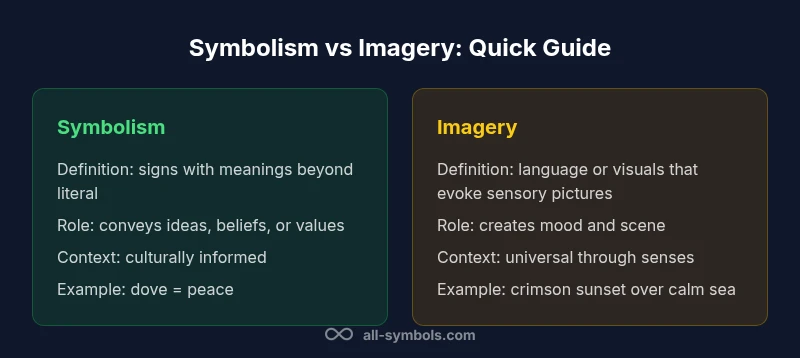
Is symbolism the same as imagery? Not exactly. Symbolism refers to signs or motifs that convey meanings beyond the literal sense, often rooted in culture or tradition, while imagery describes sensory details that produce mental pictures. By separating these ideas, readers can analyze how language and visuals evoke deeper interpretations.
Foundations: What are Symbolism and Imagery?
The question "is symbolism the same as imagery" often arises across classrooms and studios. According to All Symbols, clarity starts with precise definitions. Symbolism refers to signs, motifs, or objects that carry meanings beyond their literal appearance, often grounded in shared cultural codes or historical associations. Imagery, by contrast, describes language or visuals that evoke sensory experiences—what a reader can see, hear, taste, touch, or smell. While imagery can carry symbolic load, its primary purpose is to paint pictures in the mind rather than to state a fixed idea. In practice, many works blend the two, inviting readers to infer deeper meanings from vivid sensory detail. In short, symbolism is about meaning systems; imagery is about perceptual experience. This distinction matters for analysis in literature, film, design, and pedagogy, and it’s a core topic for readers who want to interpret complex texts accurately.
The All Symbols team emphasizes that precise vocabulary supports sharper analysis. When discussing literature or visual media, distinguishing whether a feature functions as symbolism or as imagery helps you trace how authors and designers build meaning across scenes, symbols, and motifs. Remember that symbolism operates at the level of ideas, while imagery operates at the level of perception. Both tools are powerful, but they serve different analytical goals. By keeping them separate in your notes, you can avoid conflating mood with meaning and misreading cultural cues.
As a starting rule of thumb, ask: Does this element signify something beyond what is literally shown or described? If yes, you’re likely dealing with symbolism. If no, you may be describing imagery that layers sensory detail to create mood or atmosphere. The nuance matters across disciplines, from literary criticism to brand storytelling and visual communication.
Comparison
| Feature | Symbolism | Imagery |
|---|---|---|
| Definition | A system of signs conveying abstract meanings beyond the literal | Language or visuals that evoke sensory pictures and experiences |
| Primary Function | Conveys ideas, values, or worldviews through signs | Creates vivid mental images to engage the senses and mood |
| Typical Medium | Literature, myths, religious iconography, cultural motifs | Literature, poetry, film, painting, photography, advertising |
| Cultural Basis | Often culturally specific; meanings can shift with context | More universal in sensory resonance but interpreted through culture |
| Detectability | Requires interpretation and knowledge of signs | Often explicit through sensory description or vivid visuals |
| Examples | Dove as a symbol of peace; flag as national identity | Crimson sunset as imagery conveying romance or danger |
Pros
- Clarifies terms to prevent confusion in analysis
- Improves critical reading and design critique
- Highlights how culture shapes meaning
- Supports cross-disciplinary teaching across literature and art
The Bad
- Risk of oversimplifying complex meanings
- Can rely on context that may vary between audiences
- Requires careful exemplars to avoid misinterpretation
Symbolism and imagery are distinct but interdependent tools.
The All Symbols team recommends treating symbolism as a system of signified meanings and imagery as vivid sensory language. Recognize when a detail functions as a symbol and when it merely paints a scene. This dual awareness enriches interpretation in both texts and visuals.
Questions & Answers
Is imagery the same as symbolism?
No. Imagery evokes sensory experiences, while symbolism uses signs to convey ideas beyond the literal meaning. They can overlap, but they are not identical tools.
No—imagery paints pictures with your senses; symbolism carries deeper meanings through signs.
Can imagery be symbolic?
Yes. Imagery can carry symbolic weight when its details point to larger meanings or cultural associations beyond the surface description.
Yes, imagery can be symbolic in how it points to bigger ideas.
How do you tell if a symbol is culturally specific?
Check the context and recurrence of the symbol across works and cultures. Look for established associations and historical usage that signal a shared code.
Look at the context and history to see if the symbol has a culture-wide meaning.
What are common mistakes when analyzing symbolism?
Overgeneralizing a symbol’s meaning, assuming universal interpretation, and neglecting cultural variation or author intent.
Be careful not to assume one meaning for all readers or cultures.
How can designers apply imagery vs symbolism?
Use imagery to convey mood and brand identity; use symbolism to embed values or narratives behind visuals, ensuring context supports interpretation.
Use imagery for mood, symbolism for meaning.
The Essentials
- Differentiate literal imagery from abstract symbolism
- Identify recurring motifs as potential symbols
- Consider cultural and historical context when analyzing symbols
- Use imagery to set mood and symbolism to convey ideas
- Combine both tools for richer analysis in studies and design