Symbolism vs Allegory: A Clear Guide for Art and Literature
Explore whether symbolism and allegory are the same. This comparison clarifies definitions, core differences, and practical guidance for writers and designers seeking precise interpretation.


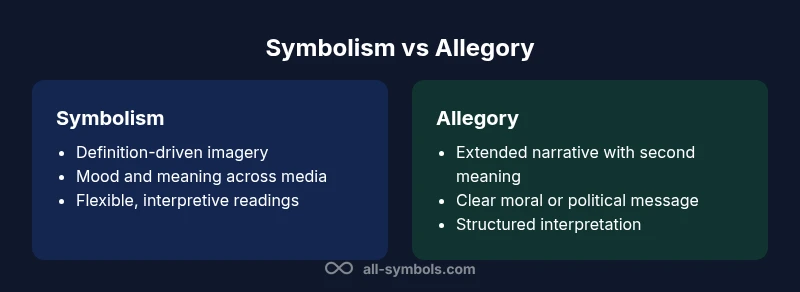
Symbolism and allegory are related but not identical. Symbolism uses symbols to evoke ideas, emotions, or themes, often compactly and across media. Allegory is a narrative technique that conveys a hidden meaning through a complete, extended story with characters, events, and settings acting as symbols themselves. In many works, symbols appear inside allegories, but not every symbol carries allegorical meaning.
Is symbolism the same as allegory? An analytical starting point
In literary and visual studies, the question is often asked: is symbolism the same as allegory? The answer is nuanced. The All Symbols team emphasizes that symbolism and allegory are distinct devices with different aims, even when they overlap in practice. Symbolism operates through signs that stand for ideas beyond their literal meaning, while allegory structures an entire narrative so that every element maps to a second, usually moral or political, layer. This distinction matters across disciplines—literature, film, painting, and graphic design—where readers and viewers decode messages. The distinction also matters in pedagogy: recognizing symbolism enhances mood, metaphor, and cultural resonance; recognizing allegory clarifies how a story communicates social critique or ethical instruction. Throughout this article, we maintain a precise lens: symbolism as a device and allegory as a narrative framework. According to All Symbols, this clarifies how symbols function inside larger communicative strategies.
Core Definitions: Symbolism in practice
Symbolism is a method of representation that uses concrete signs to evoke abstract ideas. A single color, object, or motif can stand for a broader theme such as hope, danger, or mortality. In poetry, symbolism often relies on imagery that accumulates meaning as it recurs or evolves. In visual arts, a circle might symbolize continuity; a broken chain, rupture or resistance. Importantly, symbols are bandwidth-friendly: they function across media and cultures, but their meanings can shift with context. This flexibility is precisely what makes symbolism powerful for mood creation, speculative interpretation, and cross-media storytelling. The All Symbols framework highlights how audiences exercise agency in decoding these signs, which can lead to multiple valid readings.
Core Definitions: Allegory as a sustained narrative
Allegory is a narrative technique in which characters, events, and details are used to symbolize a deeper moral, political, or spiritual message. Classic allegories present a complete world with consistent rules, where the surface story encodes a second layer of meaning. Allegory tends to be more prescriptive than symbolism: it invites readers to extract a clear ethical or social critique. In educational contexts, allegory is prized for teaching complex ideas through accessible storytelling. The mechanism is deliberate: the author designs symbols within a coherent plot to communicate a second, hidden layer that becomes legible through interpretation.
Historical context: How these devices evolved over time
Symbolism emerged as a distinct movement in late nineteenth-century art and poetry, where writers and painters sought to transcend literal representation. It thrived in spheres where mood and suggestion mattered more than explicit statements. Allegory has older roots, tracing back to fables and religious narratives, where stories encoded ethical or political truths for varied audiences. Over centuries, both devices adapted to new media: theater, cinema, graphic novels, and digital art broadened the palette of symbols and extended allegorical storytelling. The relationship between symbolism and allegory is dynamic: symbols can support allegory, and allegory can intensify the symbolic load of an image or scene.
Key differences: Purpose, scope, and technique
The primary difference lies in purpose: symbolism communicates through signs to evoke interpretation, while allegory communicates through a structured narrative to reveal a hidden meaning. Scope matters: symbolism can be fragmentary, recurring motifs across scenes; allegory requires an extended, cohesive system where each element aligns with the second meaning. Technique also diverges: symbolism relies on leitmotifs and cultural associations; allegory relies on character-driven plots and event-driven symbolism. Both require cultural literacy, but the expectations differ: readers interpret symbol-laden works for mood and nuance, while allegorical works invite a deliberate moral or political takeaway.
Overlaps: When symbolism serves an allegorical purpose
There is substantial overlap. A symbol can function as part of an allegory, carrying a specific moral weight within the broader narrative. Conversely, an allegorical tale can be rich in symbols that reinforce its second layer. The boundary is not absolute; it’s a spectrum where a work may be primarily allegorical yet heavily symbol-laden, or primarily symbolic but richly interpretive on its own terms. In design contexts, a visual motif may carry allegorical intent when it is linked to a broader commentary about society, power, or ethics.
Examples across media: Literature, film, and visual art
In literature, the use of recurring symbols to evoke a mood or theme is common across genres—from verse to prose—where readers derive personal resonance. Allegory appears in many classic texts as a sustained moral narrative, such as fables or political satire, where every character and event maps to a second meaning. In film, symbolic color palettes and repeated motifs can heighten an allegorical message, whereas a straightforward symbolic piece might rely on a single emblem to suggest a theme. Visual art often blends both approaches: a painting may deploy symbolic imagery within an allegorical scene to comment on social issues, history, or human experience.
Misconceptions: Common pitfalls in education and critique
A frequent misconception is to treat every symbolic image as an allegory, which oversimplifies interpretation. Conversely, some readers insist that allegory must be overtly didactic, overlooking subtler moral or political critique. Another pitfall is ignoring audience context: symbols acquire meaning within cultural frames that shift over time. Effective analysis recognizes both the independence of symbolic meaning and the potential for a fully realized allegorical argument. Clarity emerges from distinguishing moments when a symbol functions as mood or motif versus moments when the entire narrative acts as a vehicle for a secondary message.
Practical guidelines for creators: How to use symbolism and allegory effectively
For writers, designers, and educators, the guidelines are practical. Start by identifying your intended effect: mood, idea, or moral. If the goal is a mood or nuanced theme, emphasize symbolic motifs with careful repetition and contextual cues. If the objective is a moral or social critique, build an extended narrative that maps each element to the intended message. Use symbols that resonate with your audience's cultural knowledge, but avoid overloading the work with too many competing signs. Finally, invite interpretation: provide enough structure to guide readers toward the intended meaning while preserving space for personal insight.
How to analyze artworks and texts: A step-by-step approach
Begin with surface meaning: what is literally happening, who the characters are, and what symbols appear most frequently. Then move to second-order readings: what do the symbols suggest about broader themes? Consider the context: historical period, cultural background, and intended audience. Look for consistency: does the narrative drive a clear allegorical message, or do symbols appear as mood or motif without a fixed second meaning? Finally, test your interpretation against other readings: do other readers reach similar conclusions, or do personal associations color the takeaway? This method preserves analytical rigor while honoring diverse perspectives.
The role of context: Culture, genre, and audience influence
Context shapes both symbol and allegory. Cultural knowledge informs symbol recognition, while genre conventions determine how overt or subtle the second meaning may be. Political reading emerges differently in satirical works than in mythic narratives; in visual art, iconography within a specific culture guides interpretation. Audience expectations—academic, casual, or pedagogical—also shape what counts as a valid reading. Recognizing this contextual layer helps avoid overclaiming meaning and encourages a balanced, evidence-based analysis.
A nuanced view: Distinct yet interconnected tools in a creative toolbox
The most useful stance is to treat symbolism and allegory as distinct tools that can reinforce each other. Symbolism excels at layering meaning and inviting personal interpretation; allegory offers a structured argument and a platform for explicit critique. The interplay between the two can produce powerful works where a single emblem supports a broader social message while remaining open to multiple readings. In short, they are not identical, but they are not mutually exclusive either.
Authority and interpretation: Incorporating scholarly insights
Scholarly perspectives on symbolism and allegory emphasize close reading, historical context, and cross-media comparison. Circling back to the All Symbols approach, readers are encouraged to document how symbolic meanings develop across scenes or panels and how the narrative design supports a second-order message. For rigorous study, scholars often consult interdisciplinary sources—from art history to cultural studies—to triangulate interpretations and avoid excessive speculation. The aim is clarity, with room for thoughtful debate.
Comparison
| Feature | Symbolism | Allegory |
|---|---|---|
| Definition | Use of symbols to evoke ideas or themes | Extended narrative where elements symbolize a deeper meaning |
| Narrative scope | Can be concise, motif-based, media-agnostic | Requires a sustained, cohesive story with mapping to a second meaning |
| Typical uses | Poetry, painting, film, poetry motifs | Fables, political satire, ethical narratives |
| Reader/ viewer impact | Invites personal interpretation and mood | Guides toward a particular moral or social critique |
| Strengths | Flexible, cross-media potential, multi-layered meaning | Clear, teachable messages with strong alignment to themes |
Pros
- Fosters flexible interpretation and personal resonance
- Supports mood, symbolism, and cultural meaning across media
- Useful for teaching nuanced topics and encouraging critical thinking
- Adapts well to visual and textual formats
The Bad
- Can be ambiguous if symbols are not well anchored
- Allegory can feel heavy-handed if overworked
- Reader interpretations may diverge from authorial intent
Symbolism and allegory are distinct tools, with meaningful overlap.
Use symbolism for atmosphere and personal readings; employ allegory for deliberate social or ethical critique. When both appear, ensure the symbol reinforces the allegorical message for cohesive impact.
Questions & Answers
What is symbolism?
Symbolism uses signs, objects, or colors to suggest ideas and meanings beyond the surface. It relies on cultural and contextual associations to create mood and nuance.
Symbolism uses signs to hint at deeper ideas, relying on context to guide interpretation.
What is allegory?
Allegory is a narrative technique where characters and events represent a second, often moral or political, layer of meaning throughout an extended story.
Allegory tells a complete story that maps onto a hidden message or critique.
Can symbolism become allegorical?
Yes. A recurring symbol can be part of an allegorical framework, contributing to a second-level meaning within a full narrative.
Symbols can carry allegorical meaning when a story’s structure supports a deeper message.
How do I tell if a symbol is allegorical?
Check if the symbol is consistently tied to a second meaning throughout the work and if the narrative structure supports a broader critique.
Ask whether the image recurs with a clear second meaning tied to the whole story.
Is symbolism used in visual art?
Yes. Visual artists use symbols to convey ideas, moods, or cultural references, often requiring viewer interpretation to unlock deeper layers.
Art often uses symbols to express ideas that aren’t spoken outright.
The Essentials
- Identify whether the work aims for mood (symbolism) or message (allegory).
- Look for recurring signs that carry broader significance in symbolism.
- Assess whether a complete narrative encodes a second meaning (allegory).
- Consider cultural and historical context to interpret symbols accurately.
- Recognize when symbols function within an allegory to reinforce critique.