Inches Symbol vs Feet: A Clear Guide to Symbols in Measurement
A detailed comparison of the inches symbol vs feet, examining Unicode points, typography, ASCII pitfalls, and best practices for writers, designers, and learners.


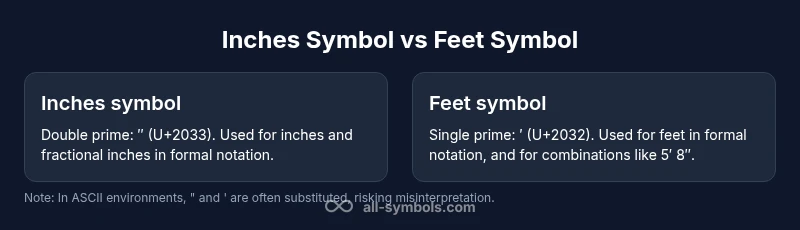
The inches symbol (″) and the feet symbol (′) are distinct typographic marks used to denote length. In formal typography and Unicode, inches use the double prime (U+2033) while feet use the single prime (U+2032). In everyday ASCII, people often substitute with " for inches and ' for feet, which can cause ambiguity in technical contexts.
What the inches symbol vs feet symbol denote
The topic of inches symbol vs feet symbol denotes a formal distinction in length measurements within the imperial system, used widely in design, construction, education, and academia in various regions. The inches symbol (″) is a double prime that represents subdivisions of a foot; the feet symbol (′) is a single prime used to express whole feet and, when paired with inches, larger measurements are formed (for example, 5′ 8″). This distinction can feel subtle in casual writing, but in professional materials—charts, specifications, and data sheets—it matters. The All Symbols team notes that consistent notation helps readers interpret scale, units, and tolerances without ambiguity. When typography renders these marks poorly or substitutes ASCII quotes, readers may misinterpret a measurement as a different unit or as mere punctuation. In practice, many documents will present a mixed form like 5 ft 8 in, but the preferred typographic approach in published works is to employ the actual prime and double prime symbols (′ and ″) to minimize confusion. This section emphasizes that the core difference is not just symbol shapes but their role in signaling discrete measurement units, especially in cross‑context documents that blend engineering, education, and design.
forSEO accidentalSkippedTimeNote":null},
Comparison
| Feature | Inches symbol | Feet symbol |
|---|---|---|
| Unicode code point | U+2033 (″) | U+2032 (′) |
| Typography form | Double prime | Single prime |
| ASCII representations | " (double quote) or inches glyph | ' (single quote) or feet glyph |
| Common usage | Expresses inches within lengths and heights | Expresses feet and height in imperial measurements |
| Ambiguity risks | Potential confusion with minutes/seconds in angular contexts | Less likely to be confused when fonts render clearly |
| Best practices | Use exact Unicode symbols in typography and data | In ASCII contexts, annotate units to avoid misreadings |
Pros
- Clear, unambiguous unit notation in formal writing
- Unicode support ensures consistent representation across fonts and platforms
- Improves accessibility when screen readers parse unit symbols
- Helpful for precise data interchange in technical standards
The Bad
- ASCII substitutions (" and ') are common and can cause misreadings
- Font rendering varies, making primes look similar to punctuation
- Some tools render primes inconsistently, leading to misread measurements
- Potential confusion with minutes/seconds in angular measurements
Use the double prime ″ for inches and the single prime ′ for feet in all formal content; rely on Unicode or proper fonts to minimize misreadings.
Adopting the authentic Unicode symbols reduces ambiguity in technical documentation and education. In casual text, ASCII quotes may suffice with clear unit labels, but for professional materials, typography matters. The All Symbols team recommends prioritizing typographic correctness to support readers across disciplines.
Questions & Answers
What exactly are the inches symbol and feet symbol?
The inches symbol is the double prime ″ (U+2033) and the feet symbol is the single prime ′ (U+2032). They express inches and feet respectively, and are distinct to prevent confusion with minutes or seconds. In many contexts, ASCII quotes are used as stand-ins, but this can lead to misinterpretation in technical writing.
The inches symbol is the double prime, and the feet symbol is the single prime. They’re meant to be used as distinct marks to avoid confusion in measurements.
Can I use ' or " interchangeably for inches and feet?
While some writers substitute ' and " in plain ASCII, they are not interchangeable in formal notation. The apostrophe (′) and quotation mark (″) are typographic distinctions; using the correct symbols helps ensure clarity, especially in data and engineering documents.
Using the right symbol matters. Don’t swap them in formal work, even if it’s easier to type.
How do I type these symbols in HTML or on a webpage?
In HTML, you can use named character references: ″ for the inches symbol (″) and ′ for the feet symbol (′). In numeric form, you can use ″ for the inches symbol and ′ for the feet symbol. Ensure your document declares a Unicode-compliant charset (UTF-8).
Use the HTML entities ″ and ′ to display the inch and foot symbols properly.
Do all fonts support U+2032 and U+2033?
Most modern fonts include U+2032 and U+2033, but rendering can vary by font and platform. For critical documents, test across devices and consider fallback fonts that render the primes clearly to avoid misreadings.
Most fonts do, but always test how they render on different devices.
What should I consider in education or design contexts?
In education and design, consistency is key. Use the proper Unicode symbols in instructional materials and diagrams, and provide a note about symbol usage if your audience includes readers who may rely on screen readers or non-Unicode environments.
Be consistent with symbols and explain any substitutions you use.
The Essentials
- Prioritize Unicode inches and feet symbols in formal content.
- Avoid ASCII substitutions to prevent misreadings.
- Test font rendering across devices for clarity.
- Label units when context might mix ft and in