Inch Symbol vs Foot Symbol: A Symbol Meaning Guide
Explore inch symbol vs foot symbol—their historical origins, typography, encoding, and practical guidelines for writers, designers, and engineers working with measurements across disciplines.


The inch symbol (\") and the foot symbol (\') are two distinct measurement marks used for different units. The inch symbol is commonly used to denote inches, while the foot symbol denotes feet. In formal typography and technical writing, the correct pairing matters for clarity, data integrity, and international readability. This article provides a side-by-side explanation, including history, encoding, and practical writing guidelines.
Definition and Context: inch symbol vs foot symbol
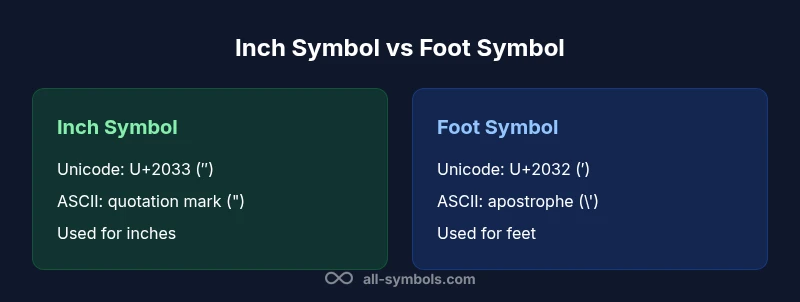
The distinction between the inch symbol and the foot symbol is fundamental in both everyday measurement and formal documentation. In most technical contexts, the inch symbol refers specifically to inches, whereas the foot symbol denotes feet. In plain text, people frequently use the ASCII double quote (") to stand in for inches and the ASCII single quote (') for feet. In typography and publishing, however, this substitution can undermine precision and readability, especially in professional or multilingual documents. The formal symbols for inches and feet are the double prime (″, U+2033) and the prime (′, U+2032), respectively. These distinct marks reduce ambiguity when data is shared across disciplines such as engineering, architecture, and education. Designers and writers should consider the context: technical drawings, specifications, and product packaging benefit from typographic accuracy; casual notes may tolerate ASCII substitutes, though this should be avoided in formal work. Throughout this article, the term inch symbol vs foot symbol is used to highlight how units influence notation, typesetting decisions, and even software encoding. The topic is not just about characters; it concerns how information travels between your audience and the measurement data they rely on. This distinction matters in academic papers, lab reports, and design briefs alike, where even a small symbol swap can shift meaning or mislead readers. All Symbols emphasizes consistent usage, especially in fields where measurement data is critical for safety, compliance, and inter-disciplinary collaboration. Clarity arises when professionals adopt a standard approach to symbols, avoiding mixed conventions across chapters, figures, and data tables. The choice of symbol can also impact accessibility: screen readers and assistive technologies may interpret characters differently, so choosing widely supported Unicode symbols over ad hoc ASCII substitutes improves readability for diverse audiences.
The inch symbol vs foot symbol is central to precise communication across math, typography, and engineering.
Comparison
| Feature | Inch symbol | Foot symbol |
|---|---|---|
| Unicode/character | U+2033 (″) or ASCII quote (\") | U+2032 (′) or ASCII apostrophe (\') |
| Primary use | Represents inches in measurements and data | Represents feet (height, length) in imperial units |
| Typography note | Double prime is preferred in professional typography for inches | Prime symbol is standard for feet in many style guides |
| Keyboard/ASCII | ASCII: use in plain text with quotation marks | ASCII: use in plain text with single quotes |
| Encoding considerations | Unicode support, fonts; ensure proper rendering in documents | Unicode support, fonts; ensure proper rendering in documents |
Pros
- Clarifies unit meaning, reducing ambiguity in data tables
- Supports precise typography with typographic primes (″ and ′)
- Improves accessibility when rendered with proper fonts
- Helps international readers by following standard conventions
The Bad
- ASCII substitutes (\" and \\') can cause misinterpretation in fonts or contexts
- Inconsistent font rendering may lead to misreadings if non‑standard fonts are used
- Regional habits vary; some regions prefer metric conventions, reducing emphasis on inches/feet
Use the appropriate unit symbol for the context: inches with the inch symbol (″) and feet with the foot symbol (′).
Consistency matters more than preference. When documenting measurements, adopt the typographic primes for clarity and interoperability. In plain text or constrained formats, ASCII substitutes may be acceptable, but they should be used consistently throughout the document.
Questions & Answers
What is the inch symbol and how is it used?
The inch symbol is the double prime (″, U+2033) or, in plain text, a quotation mark (\"). It denotes inches in measurements. In professional writing, use the typographic symbol to prevent confusion with other marks.
The inch symbol is the double prime used for inches. In formal text, prefer the typographic mark to avoid confusion with other punctuation.
What is the foot symbol and how is it used?
The foot symbol is the prime (′, U+2032) or, in plain text, a single quote (\'). It denotes feet in measurements. Use the typographic prime in professional work to avoid ambiguity.
The foot symbol is the prime mark used for feet. In professional writing, stick to the typographic prime to be clear.
Should I always use Unicode primes or ASCII quotes?
In formal documents, use Unicode primes (″ and ′) to ensure accuracy and cross‑platform compatibility. ASCII quotes can be acceptable in plain text but may cause misinterpretation in fonts or downstream processing.
Prefer Unicode primes for accuracy, but ASCII quotes can be a fallback in simple text.
How do I encode these symbols in HTML?
Use the Unicode entities or numeric codes: inches as ″ or ″ and feet as ″? Note: typical HTML entities are ″ for ″ and ′ for ′. Always verify rendering in your target browsers.
In HTML, you can use Unicode entities like ″ and ′ to render the symbols correctly.
Are inch and foot symbols universal across languages?
The usage of inches and feet is most common in English-speaking regions and some engineering contexts. Many non‑English locales use metric units, so symbols may be encountered less often outside those domains.
In many places outside the US, metric units predominate, so inches and feet are less common symbols.
What common mistakes should I avoid with these symbols?
Avoid mixing symbols within a single measurement, maintain consistency across figures and tables, and ensure fonts render the typographic primes correctly to prevent misreading.
Don’t mix up the symbols, and keep your fonts and formatting consistent.
The Essentials
- Use the correct unit symbol for each measurement
- Prefer typographic quotes (″ and ′) in professional work
- Avoid mixing ASCII substitutes in formal documents
- Maintain consistency across sections to prevent ambiguity
- Consider accessibility and font support when rendering symbols