How to Get Started with Logo Design
A practical, education-forward guide to beginning logo design. Learn foundational concepts, choose tools, sketch concepts, and refine in vector software with tips for typography, color, and symbol language. Includes step-by-step workflow, real-world lessons, and resources to build confident design practices.


Getting started with logo design means translating brand ideas into a single, scalable symbol. In a few practical steps: define audience and constraints; gather references and symbol vocabulary; sketch multiple concepts and select the strongest; refine it in vector software and test at small sizes. This quick-start launches your design practice.
Foundations: What makes a strong logo
A logo is a symbol that must be instantly recognizable, communicate brand essence, and scale from a favicon to a billboard. According to All Symbols, the core virtues of a good logo are clarity, uniqueness, and versatility. Start by defining the brand's mission, audience, and personality. Translate those attributes into visual ideas using simple shapes and a limited color palette. Then test variations to ensure legibility in black-and-white and at small sizes. Remember, logos endure; trends fade. By anchoring decisions in purpose and perception, you create a mark that serves as a durable brand asset rather than a passing fashion statement.
The logo design process in 5 phases
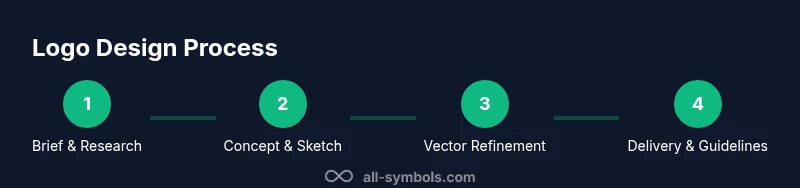
The journey from brief to final mark typically unfolds in five linked phases: discovery, concepting, refinement, validation, and delivery. In the discovery phase, gather insights about users, competitors, and brand values. In concepting, generate a healthy range of ideas—sketch rapidly, not perfectly. The refinement phase narrows to 2–3 strong options, exploring typography, color, and geometry. Validation tests legibility at different sizes and contexts, then the delivery phase packs the logo into usable file formats and brand guidelines. This structure keeps creativity aligned with practical outcomes.
Core tools and software options
Begin with traditional sketching tools to explore ideas quickly: a notebook, pencils, erasers, and a ruler. Move to digital tools for precision and scalability: vector-based software (like a widely used industry standard) or capable alternatives that support layers, grids, and vector paths. Import reference materials and maintain a consistent workspace setup. Whichever tools you choose, organize files with clear naming conventions and a scalable color system so your logo travels across media without irrelevance or confusion.
Typography, color psychology, and symbol language
Typography should harmonize with the logo’s symbol, reflecting brand tone (friendly, premium, technical, etc.). Start with a few font families and test them against your mark in different weights. Color should convey mood and meaning; limit to a couple of core hues and a neutral for balance, ensuring accessibility and contrast. Symbol language matters: integrate shapes that evoke the brand’s values—circle for unity, angular forms for strength, organic curves for warmth. A well-designed logo uses language that’s legible, adaptable, and memorable across contexts.
From sketches to vectors: refining your concept
Translate your best sketches into vector paths, emphasizing clean geometry, consistent stroke widths, and proportional balance. Use guides to align elements, then simplify shapes to reduce visual noise. Create variants (stacked, horizontal, monochrome) to test flexibility. Validate by printing at small sizes and viewing on screens; consider how the mark functions when reduced to tiny dimensions like app icons. Documentation of decisions will help future tweaks and brand updates.
Real-world logos: case studies and lessons
Examining established logos reveals common truths: simplicity drives recall, negative space creates clever moments, and adaptability ensures longevity. Compare marks that work across product lines to those that struggle outside a single context. Notice how color, typography, and geometry reinforce identity without overpowering content. Apply these lessons by building a small, personal library of reference logos and documenting what each evokes in viewers.
Common pitfalls and how to avoid them
Avoid overcomplicating the mark with excessive detail that loses clarity. Resist copying trends from a single season; aim for timeless shapes and versatile color usage. Check legibility on dark and light backgrounds, and ensure accessibility for color-vision deficits. Finally, keep a simple file structure and a brand guide so others can reproduce the logo consistently.
Brand storytelling through symbols
A logo is a sign that prompts recognition and trust. Great logos summarize complex brand stories into a single image; they invite interpretation yet stay anchored in the brand’s core message. Start by articulating the story you want your logo to tell, then test how observers infer meaning from shapes, color, and typography. A strong symbol can become synonymous with a brand over time.
Tools & Materials
- Notebook and pencils(Sketch ideas quickly; ideal for initial concepts)
- Eraser and sharpener(Keep iterations clean and adjustable)
- Ruler and compass(Helpful for precise geometry during early drafts)
- Vector graphics software(Essential for scalable, clean logos)
- Color palette references(Define a core palette + accessible contrasts)
- Grid templates(Support consistent proportions and alignment)
Steps
Estimated time: 2-6 hours total, depending on brief complexity and client feedback loop
- 1
Define brief and research
Collect business goals, audience, competitors, and brand voice. Create a one-page brief to anchor design decisions.
Tip: Ask clarifying questions early; a strong brief saves cycles later. - 2
Brainstorm and sketch concepts
Generate a broad set of ideas using quick sketches. Don’t judge too soon; quantity helps you discover unexpected directions.
Tip: Combine simple shapes to explore meaningful symbolism. - 3
Create vector foundations
Digitize the strongest ideas with clean shapes, consistent geometry, and scalable paths. Build variants for testing.
Tip: Use a grid system to maintain balance and precision. - 4
Test across contexts
Check legibility in small sizes, on dark/light backgrounds, and in black & white. Ensure accessibility and contrast.
Tip: Print proofs and view on screens at different resolutions. - 5
Deliver and document guidelines
Package logo files, provide usage guidelines, and store assets in a clear folder structure for future updates.
Tip: Include a monochrome version and a tagline lockup if needed.
Questions & Answers
What makes a logo memorable and effective?
Memorability comes from simplicity, distinctive shape, and clear symbolism that reflects the brand. An effective logo works across sizes, contexts, and backgrounds without losing its meaning.
A memorable logo is simple, distinctive, and versatile, working well in many contexts.
Do I need expensive software to design a logo?
No. Start with accessible vector tools and free resources to learn the workflow. Many successful logos begin in affordable environments before a professional upgrade is considered.
You can start with affordable tools and scale up later as you refine your process.
How long does it typically take to design a logo?
Timeline varies with brief complexity and feedback. A focused, thoughtful process often spans several days to weeks, including rounds of review and refinement.
It usually takes a few days to a few weeks, depending on feedback cycles.
Should a logo be vertical or horizontal?
Orientation depends on context and usage. A strong logo works in both, with clean lockups that maintain balance and legibility.
Many logos work in multiple orientations; design for flexibility first.
What file formats should I deliver to clients?
Deliver vector files (AI/SVG) for scalability, plus PNG and JPG for immediate use, and a style guide outlining fonts, colors, and usage.
Provide vector files plus web-friendly formats and a brief usage guide.
How do I test logo effectiveness with stakeholders?
Present multiple concepts and gather structured feedback on clarity, relevance, and memorability. Use a simple rubric and document insights for the next iteration.
Show a few strong options and collect structured feedback to guide improvements.
Watch Video
The Essentials
- Define the brand voice before drawing.
- Keep the mark simple and scalable.
- Test for legibility in multiple contexts.
- Document decisions for future growth.