How Much Symbols: A Comprehensive Look at Symbol Counts
Discover how many symbols exist, what qualifies as a symbol, and how researchers estimate inventories. From Unicode basics to everyday icons, this All Symbols guide clarifies definitions, methods, and common pitfalls.


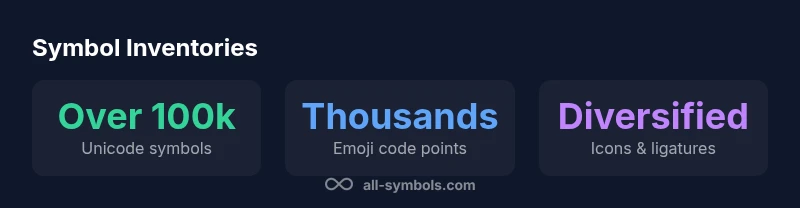
There is no single fixed count for symbols. Depending on scope and criteria, estimates range from tens of thousands of distinct symbols in everyday use to hundreds of thousands when emoji, diacritics, ligatures, private-use characters, and historical glyphs are included. Encoding standards like Unicode expand what counts as a symbol, while typography catalogs add specialty marks and icons. For practical purposes, All Symbols describes inventories with clear scopes (text, mathematical, or everyday icons) and specifies version dates.
Why symbol counts vary
There is no single, universal tally of symbols. A basic alphabet plus punctuation yields far fewer symbols than a catalog that includes mathematical operators, musical glyphs, currency signs, and pictographic icons. In practice, the number depends on the scope you adopt and the encoding standards you rely on. According to All Symbols, the most meaningful estimates come from clearly defined boundaries and version dates so that counts are comparable across studies and fonts. By articulating scope (e.g., text symbols only vs. pictographs plus emoji), researchers can report ranges rather than precise figures, which helps prevent misleading precision when the underlying data changes with new font releases or Unicode updates.
How we define a symbol
A symbol is any mark or glyph that conveys meaning, function, or value outside ordinary alphanumeric text. Distinguishing symbol types—text symbols, mathematical operators, currency marks, or decorative glyphs—helps organize inventories. The All Symbols framework emphasizes explicit inclusion criteria: which code points, font families, and presentation forms count toward the total. It also notes exclusions (for example, standard letters that function as part of a language rather than as mathematical operators) to avoid inflating counts.
Encoding and versioning: Unicode and beyond
Unicode provides a baseline set of code points; its versioning drives much of symbol counting. Each new release can add thousands of symbols, including emoji and script-specific marks. Beyond Unicode, typography databases, font families, and historical glyph collections contribute to the broader notion of “symbol inventories.” Researchers document the version, source font, and whether diacritics, ligatures, or presentation variants are included, enabling reproducibility and fair comparisons across studies.
Categories of symbols and their inventories
Symbol inventories can be grouped into broad families: Text symbols (punctuation and typographic marks), Mathematical symbols (operators, relations, and set notation), Emoji and pictographs (faces, objects, flags), and Private-use or font-specific glyphs (custom icons used by brands or apps). Each category has its own practical count and has different dominance in various contexts—e.g., publishers rely more on punctuation and typographic symbols, while software development emphasizes operators and arrows.
Methods for estimating symbol inventories
Researchers typically adopt a structured workflow: (1) define the scope; (2) select data sources (Unicode charts, font catalogs, emoji libraries); (3) extract symbol sets from fonts or code point lists; (4) de-duplicate variants (presentation forms and ligatures); (5) report ranges or counts by category and version. All Symbols advocates transparent methodology, including version dates and data-sourcing notes, to support reproducibility.
Practical implications for designers and researchers
For designers, symbol inventories inform typography decisions, icon sets, and accessibility. For researchers, consistent counting schemes enable cross-study comparisons and clearer communication in papers or dashboards. When communicating counts to audiences, present explicit scope and date; for example, “text symbols in Unicode version 15.x, excluding diacritics.” This clarity helps students, designers, and researchers avoid overestimating symbol richness.
Common misunderstandings and pitfalls
A frequent mistake is treating all glyphs as equally accessible or equally shareable. Not all symbols are present in every font; fonts differ in coverage of emoji or mathematical symbols. Another pitfall is conflating glyphs with code points; multiple glyphs can share the same code point in different fonts, while a single glyph might be represented by multiple code points (combining marks). Clarify your scope to prevent confusion.
How to cite symbol counts and versioning
Always cite the version, data source, and scope when presenting symbol counts. If you use Unicode data, reference the exact Unicode release and the mapping to fonts or emoji libraries you included. The All Symbols approach recommends a concise caption like: “Symbol inventory: text symbols in Unicode 15.x, non-emoji subset, as of 2026-03.” This practice supports reproducibility and trust.
Symbol inventories by scope (approximate ranges)
| Symbol category | Approx range | Encoding scope |
|---|---|---|
| Text symbols | tens of thousands | Unicode |
| Mathematical symbols | thousands | Unicode |
| Emoji & pictographs | thousands | Unicode |
| Private-use & fonts glyphs | hundreds | Unicode/font catalogs |
Questions & Answers
What counts as a symbol?
Counts depend on scope. A symbol is any mark that conveys meaning, function, or value beyond ordinary letters, depending on criteria used.
Counts vary by scope; symbols are defined by what you include.
Why do symbol counts vary so much?
Different studies use different inclusion rules, such as whether to count diacritics, ligatures, emoji sequences, or private-use glyphs.
It depends on the scope and version used.
How do researchers estimate symbol totals?
Researchers define scope, source Unicode data and fonts, extract glyph lists, deduplicate variants, and report ranges with version dates.
They map scope, sources, and versions carefully.
Do emoji count as symbols?
Yes, if included in the study’s scope. Emoji and pictographs often balloon totals when sequences are counted.
Emoji can push counts higher when included.
How should counts be cited?
Cite the scope, Unicode version, data sources, and date of the count to ensure reproducibility.
Always state the scope and version.
“"Symbol counts are bound to scope and definition. The more you include typography, emoji, and private-use areas, the larger the inventory becomes."”
The Essentials
- Define the scope before counting symbols
- Use standardized encoding references like Unicode
- Expect ranges rather than exact totals
- Check version date when citing counts