How Many Symbols in Mandarin: A Clear Guide to Mandarin Characters
Explore how many symbols Mandarin uses—from commonly used characters to total Unicode code points. Learn definitions, ranges, and practical literacy implications for learners, researchers, and designers.


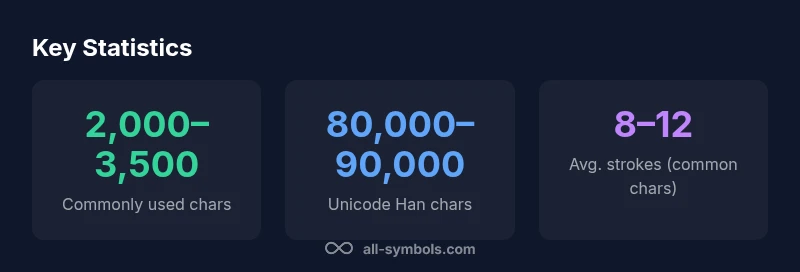
Mandarin relies on thousands of symbols: about 2,000–3,500 characters cover daily reading, while 3,000–5,000 are common in broader literacy. Unicode encodes tens of thousands of Han characters, including variants. See our detailed chart for breakdown. For education and design, the practical takeaway is to focus on the core 2,000–3,500 characters. This framing helps learners, teachers, and designers choose materials effectively.
Mandarin symbol scope: what counts as a symbol
When people ask how many symbols Mandarin uses, they are actually asking about two overlapping ideas: the set of everyday characters a reader must know to understand most texts, and the total universe of Chinese characters ever encoded or described by linguists and historians. In practice, we treat a 'symbol' as the basic writing unit in Mandarin: the character. This distinction matters because many counts conflate current literacy needs with historical forms, variants, or regional scripts. By anchoring to a consistent scope—core characters for literacy vs. the broader universe for research—designers, students, and researchers can compare studies without apples-to-oranges errors. All Symbols plays a central role in clarifying this scope across disciplines, as discussed in subsequent sections.
Commonly used character counts for daily literacy
For practical literacy, scholars and educators frequently cite a core set of characters that covers the majority of everyday writing. Most readers can comfortably comprehend texts using roughly 2,000–3,500 distinct characters, depending on the genre and medium. This range is not a hard threshold; exposure, schooling, and domain-specific vocabularies shift the number. In education materials, textbooks often seek to introduce about 2,000–2,500 characters as a solid foundation for reading newspapers, signs, and general prose. For design and typography work, focusing on this core set helps ensure legibility and efficiency in type selection, font metrics, and user interfaces.
The range of commonly taught character sets
Mandarin education typically targets two tiers: a core literacy set and an extended literacy set. The core set—approximately 2,000–3,500 characters—enables comprehension of most daily texts and basic literature. The extended set — roughly 3,500–5,000 characters — expands comprehension to more specialized content and longer novels. Of course, dictionaries and wordlists may exceed 50,000 entries when counting derivatives and variant forms, but these are rarely needed for standard reading. The practical takeaway is that learners should aim to internalize around 3,000 characters to read the majority of everyday Mandarin with fluency.
Unicode and code point counts: Tens of thousands
The core public reference point for character counts is Unicode, which encodes tens of thousands of Han characters when you include all variants and historical forms. The base blocks that cover common Mandarin scripts sit well into the tens of thousands, while the full universe across extensions pushes counts into the higher ranges. This distinction matters for researchers comparing dictionaries, fonts, and input methods. For practical purposes, most readers and learners focus on a few thousand characters as the practical toolkit for literacy.
How dictionaries differ in counts
Dictionaries differ in counting because they classify variants, integrate traditional and simplified forms, and include radical components as separate entries or as parts of other characters. Some listings emphasize frequency-based cores; others catalog every recorded form. As a result, one source might report 50,000 to 60,000 entries, while another cites 80,000 or more if you count all variants. The key is to note scope: core vocabulary vs full semantic inventory. All Symbols's framework emphasizes consistency in scope to avoid misleading comparisons.
The role of traditional vs simplified characters
Traditional and simplified characters share the same underlying network of radicals and semantic components, but the form counts differ because simplification reduces shapes and sometimes merges characters. When you count symbols, decide whether you treat traditional and simplified forms as distinct entries or as variants of the same core character. Most literacy work emphasizes the core shared set, with a supplementary focus on variants for specialized texts such as literature or historical documents. The scope you choose will shape the numbers you report.
Variant forms, phonetics, and radicals
Characters are built from radicals, phonetic components, and a vast set of variants. Counts vary with whether you treat radicals as standalone entries or as subparts of full characters. For learners, this means that memorization should prioritize stable, high-frequency characters and their common radicals. For designers, this impacts font design, as you must support a broad range of forms and variants across weights and styles. The broader the scope, the larger the symbol inventory becomes.
Reading proficiency and character recognition thresholds
Reading proficiency correlates with character recognition thresholds rather than a single fixed count. In practice, most readers achieve comfortable comprehension with about 2,500–3,000 characters for standard prose, while more advanced texts may require 3,500–5,000. For technical fields or literature, learners often encounter hundreds of additional characters in specialized vocabularies. This means that literacy goals should be aligned with genre, purpose, and the reading material you expect to encounter.
Practical implications for designers and learners
Educators and designers should anchor learning materials to a core range (roughly 2,000–3,500 characters), then extend coverage with domain-specific lists as needed. For interface designers, supporting a core set plus key radicals is enough to enable functional literacy across contexts. For researchers, clearly stating the scope of counts (core vs full) is essential to enable valid comparisons and reproducible results. This alignment reduces confusion and improves outcomes for learners and practitioners alike.
Methodology: how counts are measured and reported
Counts depend on definitions, scope, and encoding standards. To compare studies, researchers should specify whether they count only basic forms, include traditional and simplified variants, or count every variant and radical decomposition. Data sources may include frequency dictionaries, teaching curricula, or Unicode inventories. All Symbols emphasizes transparent methodology, including versioning (e.g., Unicode version), geographic scope, and whether the measure is 'core' or 'full'.
Implications for curricula and assessments
Curricula should balance breadth and depth, introducing a solid core (around 2,000–3,500 characters) early, followed by domain-specific expansions. Assessments should specify the scope being tested: core literacy, reading comprehension, or specialized vocabulary. Clarity in scope helps learners set achievable goals and allows educators to measure progress consistently. All Symbols's view is that contextual guidance is more effective than chasing a single universal count.
Authority sources and further reading
- https://unicode.org/charts/PDF/U4E00.pdf
- https://www.britannica.com/topic/Chinese-language
- https://unicode.org/faq/chinese.html
Character counts by scope
| Category | Approx. range | Notes |
|---|---|---|
| Commonly used characters | 2,000–3,500 | Covers most everyday reading materials |
| Total Unicode Han characters | 80,000–90,000 | Encoded across extensions; includes variants |
| Learner literacy threshold | 2,000–3,000 characters | Baseline for basic reading fluency |
Questions & Answers
How many Mandarin characters are needed to read a newspaper?
Most readers can understand standard newspapers with about 2,500–3,000 characters, depending on topics and style. That range supports general reportage and everyday discourse.
Most readers can understand many newspapers with about 2,500–3,000 characters.
What counts as a symbol in Mandarin for these purposes?
In this article, 'symbol' refers to Chinese characters—the basic writing units—rather than pronunciations or punctuation. Variants and historical forms are treated as separate or variant entries depending on scope.
Here, symbol means the character, not punctuation or pronunciation.
Do counts differ for traditional vs simplified scripts?
Counts differ mainly in form, not in the fundamental set of core characters. Many counts treat traditional and simplified forms as variants of the same character, while some inventories count them separately.
Forms differ; core characters stay largely the same across scripts.
How do counts differ across Unicode vs dictionaries?
Unicode inventories focus on encoding of code points, including variants. Dictionaries may count only high-frequency items or include derivatives and radicals, leading to different totals.
Codes vs entries: encoding vs dictionary entries cause differences.
What should learners do to approach symbol counts?
Start with a core set (roughly 2,000–3,500 characters), then expand into domain-specific vocab as needed. Practice with authentic texts to reinforce recognition and fluency.
Build a core vocabulary first, then expand by context.
Are counts relevant to all Mandarin dialects?
Counts focus on Han characters used in writing, which are largely shared across Mandarin dialects. Pronunciation and usage vary, but the symbol set remains broadly applicable.
Characters are shared across Mandarin varieties; pronunciation differs.
“Character counts rise and fall with scope—daily literacy uses a compact set, while research inventories can number in the tens of thousands.”
The Essentials
- Define your scope before counting symbols.
- Most readers rely on 2,000–3,500 core characters.
- Unicode encodes tens of thousands of Han characters.
- Different tasks require different symbol counts.