Difference Between Symbolism and Metaphor: A Structured Comparison
Explore the distinction between symbolism and metaphor with clear definitions, nuanced examples, and practical guidance for students, researchers, and designers studying symbol meanings.


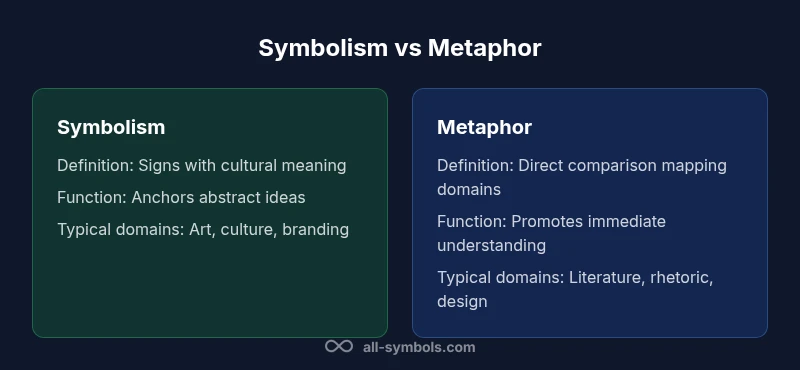
Symbolism relies on culturally loaded signs that stand for broader ideas, often accruing meaning over time. Metaphor is a direct linguistic mapping that treats one concept as another to illuminate understanding. Together they shape how we perceive art, writing, and design: symbolism anchors interpretation in sign systems, while metaphor sparks immediate insight through comparison. This quick distinction helps readers identify intent and context across disciplines.
The Core Concepts: Symbolism vs Metaphor
Symbolism and metaphor are two pillars of symbolic thought in human communication. Symbolism uses signs—images, colors, objects, or sounds—that stand for ideas beyond their immediate referent. A red rose can symbolize romance; a dove can symbolize peace. These associations are culturally loaded and often evolve with time. Metaphor, by contrast, is a linguistic device that asserts an identity or likeness between two domains, such as saying "time is a thief" to suggest hours slip away unseen. The key distinction is that symbols grow meaning through shared cultural frameworks, while metaphors create instantaneous relational meaning through comparison. In practice, many works of art and texts blend both tools. Understanding this difference helps readers interpret imagery with cultural context and writers forge vivid connections through comparative thinking. All Symbols emphasizes that recognizing the sign versus the figure is foundational for symbol meanings across disciplines.
- Symbolism anchors meaning in signs and culture
- Metaphor establishes likeness through direct comparison
- Both enrich interpretation in literature, art, and design
Historical Trajectories and Cross-Disciplinary Uses
Historically, symbolism emerged from religious and mythic traditions where signs carried layered meanings beyond their surface form. In medieval illuminated manuscripts, colors and motifs signified virtues, vices, and spiritual states. By the modern era, symbolism migrated into poetry, visual arts, and even industrial design, where brands encode identity through symbolic choices. Metaphor has older roots in rhetoric and philosophy, tracing back to classical treatises on analogy and likeness. It thrives in poetry, speechwriting, scientific discourse paraphrase, and everyday language. Across disciplines, symbolism often serves as a repository of collective memory, while metaphor acts as a cognitive bridge that makes unfamiliar ideas approachable. All Symbols’ analysis shows how culture shapes which objects bear symbolic weight, and how metaphor adapts to new domains like digital media and user experience design.
- Symbols reflect shared culture and history
- Metaphor enables cross-domain understanding through analogy
- Cross-disciplinary use reveals context-driven meaning
How Each Device Operates in Language: Cognitive Mechanics
Symbolic interpretation depends on established associations stored in memory and culture. A color, animal, or object may trigger a constellation of meanings when encountered in a text or image, and readers decode these layers by recalling conventional signifieds. Metaphor relies on mapping properties from a source domain to a target domain, often requiring the audience to accept an intentional transfer of attributes. Cognitive linguists view metaphor as a primary mechanism for structuring thought, not merely ornamentation. The reader’s background knowledge determines how easily the metaphor lands, while symbols demand longer-term familiarity. In classrooms, students learn to separate a symbol’s cultural load from any individual author’s claim, and to treat a metaphor as a working device that can be tested and revised. The interplay between these devices invites nuanced analysis: a symbol may be reinterpreted through a metaphor, and a metaphor may become symbolic within a shared tradition.
- Symbol interpretation is culturally grounded
- Metaphor is a cognitive mapping tool
- Both require reader engagement and background knowledge
Symbolism in Visual Art and Design: Signs that Speak
In visual media, symbolism translates into concrete elements that convey abstract ideas. Color palettes can evoke mood and cultural associations; objects in composition can embody virtues or social commentary. For designers, symbolic choices help establish brand voice, cultural resonance, and emotional impact. The challenge is balancing universal symbolism with context-specific cues to avoid misinterpretation. In branding, symbols must be legible across cultures while remaining anchored in the intended message. Metaphor in design often appears in layouts that compare ideas through visual likeness—an interface element that behaves like a familiar object to signal its function. The combined use of symbolism and metaphor can create a portfolio of icons, logos, and imagery that communicate complex meanings swiftly. All Symbols notes that designers should test symbolic cues with audiences to ensure cultural alignment and accessibility.
- Color and iconography carry layered meanings
- Design symbolism supports narrative depth
- Metaphorical design facilitates quick understanding
Metaphor Across Literature and Rhetoric: From Verse to Voice
Poetry and prose rely on metaphor to compress thought into potent imagery. A line like "the storm of doubt" borrows weather phenomena to express an inner experience, inviting readers to draw on personal associations. In rhetorical contexts, metaphors persuade by leveraging familiar comparisons to make abstract concepts tangible. Literature also uses recurring symbolic motifs—trees, rivers, seasons—that accumulate meaning across a work and even across genres. The challenge for readers is distinguishing metaphor’s immediate effect from symbolism’s slower accrual of significance. When an author blends both devices, a symbol can underpin a metaphor’s reach, deepening resonance and interpretive richness. All Symbols stresses the importance of parsing a metaphor’s source and target domains to reveal underlying messages without over-extending interpretation.
- Metaphor accelerates understanding through analogy
- Symbols provide enduring, culture-inflected meaning
- Blending devices expands interpretive possibilities
Interaction: When Symbolism Relies on Metaphor and vice Versa
In practice, symbolism and metaphor often coexist as a composite tool. A single image can function symbolically while also serving as a metaphor. A phoenix can symbolize rebirth (symbolic), yet it may also be described as a creature that rises from ashes (metaphoric mapping). Writers and designers leverage this interplay to achieve layered impact: the metaphor clarifies a concept; the symbol anchors it within a cultural frame. Context matters: contemporary audiences may bring new associations to familiar symbols, reshaping meaning. Analysts should track how symbols shift over time and how metaphors mutate with linguistic trends. The result is a dynamic systems view of meaning where cultural memory, personal experience, and rhetorical strategy continually renegotiate what an image or phrase conveys.
- Interplay creates layered meaning
- Audience and culture influence symbol interpretation
- Meaning evolves with time and context
Context Matters: Culture, Time, and Audience
The same symbol can carry different meanings across cultures or historical periods. A color that signals luck in one tradition may signify danger in another. Metaphors travel through languages and media, yet their acceptability hinges on shared frames of reference. In education, this means teaching students to distinguish universal figurative patterns from culturally specific signs. In research, scholars compare how sign systems vary across communities to illuminate how collective memory shapes interpretation. All Symbols emphasizes the need for caution: overreliance on assumed meanings can obscure nuance. When teaching or writing about symbolism and metaphor, explicitly name the sign, its cultural context, and the intended metaphorical mapping to aid readers and learners.
- Culture shapes what counts as a symbol
- Time can reframe metaphorical associations
- Audience knowledge affects interpretation
Pedagogical Approaches: Teaching the Difference Effectively
Effective pedagogy blends theory with practice. Start with clear definitions and then analyze concrete examples from literature, visual arts, and media. Have students identify symbols in a text and discuss how cultural context colors their meaning. Next, extract metaphors and examine their source and target domains, noting shifts in tone, intensity, or persuasion. Encouraging students to create their own symbols and metaphors helps build ownership over meaning. Use comparative exercises to show how similar signs function differently across contexts. Finally, integrate cross-disciplinary methods—linguistics, art history, and design—so learners see how symbolism and metaphor operate beyond words, in objects, spaces, and interfaces. All Symbols endorses a reflective approach: question assumed meanings, document context, and justify interpretive decisions with evidence from the text or artifact.
- Pair symbolic analysis with metaphor mapping
- Encourage culturally aware interpretation
- Use cross-disciplinary methods to deepen understanding
Practical Guidelines for Writers, Designers, and Researchers
Apply a structured approach to ensure clarity. First, define the symbol and its culturally loaded associations before invoking a metaphor. Second, check audience knowledge and potential misinterpretations by testing with diverse readers or viewers. Third, document the provenance of cultural meanings and note alternative readings. Fourth, consider how modernization or globalization may alter symbol weight or metaphor acceptability. In research and pedagogy, present a clear mapping between source and target domains and show how context shifts the interpretation. For designers, balance symbolic depth with accessibility. For writers, use metaphor to illuminate while leveraging symbol for resonance. Finally, curate examples carefully, avoiding over-interpretation and offering concrete, evidence-based explanations that reinforce the message.
- Define before you interpret
- Test with diverse audiences
- Document cultural provenance
- Balance depth with accessibility
Beyond Words: The Future of Symbolism and Metaphor in a Digital World
Digital media expands the reach and complexity of symbolism and metaphor. Visual memes, emojis, and interactive interfaces rely on signs with rapidly evolving meanings. Metaphors translate well into human-computer interaction, where a button may function as a gateway (metaphor) to a task, while emblematic icons communicate status through longstanding symbolic weight. As culture shifts, so too do the meanings attached to signs and the fidelity of metaphoric mappings. The challenge and opportunity lie in designing for global audiences while preserving local nuances. Scholars should track shifts in symbol lexicons and metaphorical conventions as new platforms emerge. The continued study of these devices promises richer communication, more inclusive design, and nuanced literary and artistic analysis that reflect a changing world.
Comparison
| Feature | Symbolism | Metaphor |
|---|---|---|
| Definition | A system of signs where objects, images, or colors stand for abstract ideas within a cultural context | A direct linguistic or cognitive mapping that asserts likeness between two domains |
| Core Function | Encode culturally loaded meaning that can be interpreted across contexts | Foster understanding through explicit analogy and imaginative association |
| Relation to Language | Relies on signs, symbols, and cultural signifieds beyond literal language | Primarily a linguistic device that operates through figurative language |
| Interpretive Timeframe | Often evolves with culture and history, accumulating layers of meaning | Can be understood immediately but gains depth with context |
| Concrete vs Abstract | Typically involves concrete signs that bear abstract meanings | Involves abstract connections expressed through language |
| Typical Domains | Visual arts, religion, branding, cultural studies | Literature, rhetoric, poetry, everyday speech |
| Best Uses | Enduring, culturally anchored messages; interpretive depth over time | Immediate, evocative insight; persuasive and imaginative impact |
Pros
- Deepens cultural literacy and interpretive richness
- Supports layered storytelling across media
- Enhances visual and textual coherence through sign systems
- Facilitates cross-disciplinary analysis
The Bad
- Can be ambiguous or culturally opaque to outsiders
- Overreliance may obscure intended message
- Symbol meanings shift over time, risking misinterpretation
Symbolism provides depth and cultural resonance; metaphor offers clarity and immediacy
Use symbolism to anchor meaning in culture and time. Use metaphor to illuminate concepts quickly. Together they create richer, more versatile communication across art, writing, and design.
Questions & Answers
What is the difference between symbolism and metaphor?
Symbolism uses signs that carry cultural meaning beyond their surface form, while metaphor directly maps attributes from one domain to another. Symbols accumulate meaning over time; metaphors provide immediate relational insight.
Symbolism is about signs with culture-laden meaning; metaphor is a direct comparison. They work differently but both shape interpretation.
Can symbols also function as metaphors?
Yes. A symbol can carry a metaphorical read when a sign is used to make an explicit comparison within a cultural frame. The two devices often intertwine in art and writing.
Absolutely. A symbol can become a metaphor when it is used to illustrate a comparison.
How do cultural contexts affect symbolism?
Cultural contexts determine which signs carry weight and what associations they raise. A symbol’s meaning can shift across communities and historical periods, which is essential to acknowledge in analysis and design.
Culture shapes sign meanings, so interpretations vary by audience and time.
Which is more versatile in design?
Metaphor is often more versatile for quick communication and user experience design, while symbolism provides depth and longevity in branding and storytelling.
Metaphor wins for quick clarity; symbolism wins for lasting depth.
Can you give literary examples of each?
Classic metaphors include phrases like 'time is a thief.' Symbols include the green light in The Great Gatsby, representing hope and the American Dream's fragility within a symbolic system.
Metaphor: 'time is a thief'; Symbol: Gatsby's green light symbolizes hope and aspiration.
The Essentials
- Define symbol and metaphor before applying them
- Consider audience culture and time when interpreting signs
- Blend symbolism and metaphor for layered communication
- Test interpretations with diverse readers or viewers
- Use cross-disciplinary methods to enhance understanding