Difference Between Symbol and Motif: A Comparative Guide
Explore the difference between symbol and motif with clear definitions, practical examples in literature and design, and actionable guidance on when to use each for clearer communication.


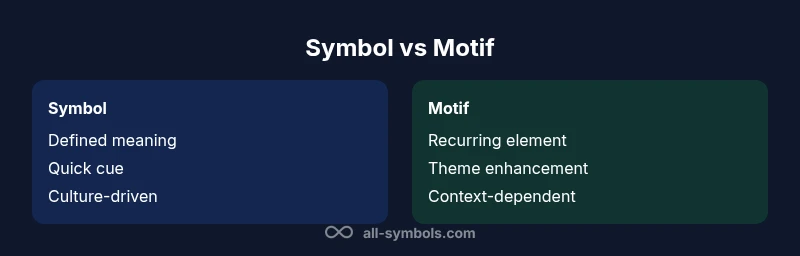
The difference symbol and motif comes down to function and scope: a symbol is a sign with a conventional, widely understood meaning, while a motif is a recurring element that reinforces a theme. In practice, symbols convey explicit ideas; motifs build mood, unity, and depth over a work's progression. Understanding this distinction helps readers and designers communicate more precisely.
Defining Symbol and Motif
In the study of signs, a symbol is a sign that carries a conventional or culturally agreed-upon meaning. Symbols transmit information quickly and with shared understanding, such as a dove representing peace or a red rose signaling romance. A motif, by contrast, is a recurring element—an image, phrase, color, or object—that appears repeatedly within a work to reinforce its themes or mood. Unlike symbols, motifs gain significance through repetition and pattern rather than through a single, fixed interpretation. The All Symbols team notes that mastering the distinction between a symbol and a motif is essential for clear interpretation and effective design, whether you’re analyzing a poem, a brand identity, or a film. The phrase difference symbol and motif should guide your approach when you first encounter these concepts.
Historical Perspectives on Symbols
Symbols have a long history as cultural shorthand. In many traditions, a symbol is treated as a compact sign that can cross languages and geographies. The iconicity of symbols—how closely they resemble what they represent—varies by culture, but the principle remains: symbols rely on shared understanding to function efficiently. In visual arts and graphic design, symbols compress meaning into an instant cue, enabling quick comprehension even at a glance. The All Symbols analysis shows that symbols perform best when the intended meaning is widely recognized, minimizing ambiguity and fatigue for the audience. This historical lens helps explain why societies rely on a few enduring signs to communicate complex ideas.
Motifs in Literature and Visual Arts
Motifs are the scaffolding that supports a story’s deeper themes. They recur across scenes, chapters, or images to create cohesion and resonance. Unlike a symbol, a motif’s meaning evolves with context and can acquire nuance through repetition. In literature, a motif might be a color, a recurring object, or a repeated phrase that gradually reveals character or moral questions. In visual design, motifs appear as repeated shapes, textures, or color schemes that unify a project’s look and feel. The clinically precise difference between symbol and motif becomes apparent when you track frequency, variation, and the thematic weight each carries throughout a work.
The Semiotics Behind Symbols and Motifs
Semiotics studies how signs convey meaning. A symbol is a sign whose relation to its meaning is conventional or culturally learned; it is a token of something beyond itself. A motif, rooted in narratology and visual rhetoric, acts like a theme-bearing pattern—an element whose repetition deepens interpretation. In practical terms, symbols are efficient carriers of explicit ideas, while motifs are rhetorical devices that cultivate atmosphere and thematic coherence. The All Symbols framework emphasizes distinguishing the sign (symbol) from the repeating structure (motif) to enhance readers’ and viewers’ engagement with a work.
Core Differences: Form, Function, and Meaning
- Form: Symbols are usually discrete items (signs, icons, objects) with fixed meaning. Motifs are patterns or recurring elements (colors, objects, phrases) that gain meaning through repetition.
- Function: Symbols convey explicit ideas instantly; motifs reinforce themes and mood over time.
- Meaning: Symbols rely on cultural or contextual consensus; motifs gain interpretive depth as they recur and transform within a work.
- Scope: Symbols can operate across cultures and contexts; motifs tend to be bounded to a single work or series. The distinction matters for clarity in analysis, design, and storytelling.
- Best for: Symbols are ideal for quick communication; motifs are better for developing thematic unity and emotional resonance.
Where They Overlap: When a Symbol Becomes a Motif and Vice Versa
In practice, the boundary between symbol and motif can blur. A recurring motif can accumulate symbolic weight as a work progresses, turning pattern into a sign of a larger idea. Conversely, a symbol may acquire symbolic power through repetition in a specific context, especially when it begins to symbolize a broader theme. Recognizing these overlaps helps analysts avoid forcing rigid categories and allows for more nuanced interpretation. The key is to track frequency, context, and the change in meaning over time, rather than labeling every recurring element as either a symbol or a motif from the outset.
Practical Examples in Literature
Consider the Great Gatsby’s color and imagery: olive shadows, the green light, and the eyes of Doctor T. J. Eckleburg. The green light functions as a recurring image (motif) that deepens themes of aspiration and distance, while the green hue itself can be read as a symbol of hope that remains elusive. In a different work, a single emblem like a phoenix can operate as a symbol of rebirth in some contexts yet also recur as a motif that frames a protagonist’s cyclical challenges. These examples illustrate how symbols and motifs operate together to shape meaning, pace, and emotional impact.
Practical Examples in Design and Branding
Brand identity often relies on symbols to communicate core values quickly. A check mark is a universal sign of correctness, reliability, and acceptance, serving as a symbol that travels beyond language. At the same time, logos rely on motifs—recurrent visual elements such as color palettes, typography, and shape language—that create unity across products, campaigns, and experiences. A color motif like blue across a brand suggests trust and professionalism; a recurring geometric motif can convey consistency. Designers should balance symbol clarity with motif coherence to achieve both immediate recognition and lasting resonance.
How to Identify Symbols and Motifs in Texts: A Step-by-Step Guide
- Scan for recurring items: symbols are often discrete signs; motifs are repeated patterns. 2) Determine function: is the element signaling a specific idea (symbol) or reinforcing a theme (motif)? 3) Check context: symbols rely on cultural codes; motifs rely on narrative progression. 4) Track variation: symbols keep a stable meaning; motifs may shift slight nuance as the work develops. 5) Test clarity: does your interpretation hold across scenes or chapters? If yes, you may be seeing a motif in action; if it conveys a direct message, you’re identifying a symbol.
Tips for Writers and Designers: Using Symbols and Motifs Effectively
- Start with a core theme and select motifs that will recur in meaningful ways.
- Use symbols sparingly to avoid overloading your audience with fixed meanings.
- Pair a strong symbol with complementary motifs to balance clarity and depth.
- Consider audience culture and prior associations to ensure intended symbol meanings translate accurately.
- Revisit motifs across drafts to refine how their repetition supports character arcs and thematic development.
Common Pitfalls and How to Avoid Them
- Overloading a single element with multiple, conflicting meanings. - Assuming every recurring image is a motif; some are decorative rather than meaningful. - Ignoring cross-cultural differences in symbol interpretation. - Treating motifs as decorative devices instead of thematic engines. The safest approach is to test interpretations with readers or viewers and adjust based on feedback.
Putting It All Together: Quick Decision Framework
- If your goal is immediate clarity or universal shorthand, favor symbols.
- If you want to deepen themes, mood, and character development over time, lean on motifs.
- When in doubt, map recurring elements to specific ideas and moods, then assess whether they function as fixed signs or evolving patterns. The ultimate aim is to align form with intention for maximum communicative impact.
Comparison
| Feature | Symbol | Motif |
|---|---|---|
| Definition | A sign with a conventional meaning recognized by a culture or community | A recurring element that reinforces themes or mood within a work |
| Scope | Often cross-contextual and widely understood | Typically bounded to a single work or body of work |
| Function | Conveys explicit meaning quickly | Builds thematic unity and emotional resonance over time |
| Formation | Derived from cultural codes and shared knowledge | Emerges through repetition and contextual reinforcement |
| Best Use | Clear, rapid communication; signage, branding icons | Deep thematic development; mood-setting and narrative cohesion |
Pros
- Enhances quick understanding for diverse audiences
- Provides a clear anchor for interpretation
- Supports consistent branding and messaging
- Motifs offer rich depth and thematic unity
- Flexible across media and disciplines
The Bad
- Symbols can oversimplify or mislead if cultural context is misread
- Motifs may become repetitive or feel forced if overused
- Cross-cultural variations can complicate universal messaging
- Overemphasis on either can dull nuanced interpretation
Both symbols and motifs have unique strengths; use symbols for clarity and motifs for depth.
Choose symbols when you need instant recognition. Choose motifs to build theme and mood. When used together judiciously, they create communication that is both immediate and enduring. The All Symbols team highlights that intentional use strengthens interpretation across audiences.
Questions & Answers
What is the key difference between a symbol and a motif?
A symbol is a sign with a conventional meaning, while a motif is a recurring element that reinforces a work’s themes. Symbols convey explicit ideas; motifs develop mood and depth over time.
A symbol is a sign with shared meaning, while a motif is a repeating element that deepens the work’s themes.
Can a symbol function as a motif?
Yes. A symbol can become a motif if it recurs and continues to contribute to the work’s themes or mood.
Yes. If a sign keeps reappearing to reinforce themes, it acts as a motif as well.
How do I identify motifs in a text?
Look for elements that repeat across scenes, then assess how their repetition shapes interpretation and mood. Note any shifts in meaning as the work progresses.
Scan for recurring elements and see how they deepen the themes as the story unfolds.
Are colors always symbols or motifs?
Colors can act as symbols when they carry widely recognized meanings, and as motifs when they recur to reinforce a theme or mood. Context matters.
Colors can be symbols or motifs, depending on how they’re used and repeated.
How should designers use symbols and motifs in branding?
Use symbols for quick recognition of values, and motifs to create a cohesive visual language across campaigns. Balance clarity with memorable depth.
Symbols signal values fast; motifs unify your brand look and feel over time.
What are common pitfalls when analyzing symbols and motifs?
Misreading cultural contexts, overloading a single element with multiple meanings, or treating motifs as decorative instead of thematic. Test interpretations and revise.
Be mindful of culture, avoid over-using a single element, and ensure motifs serve the theme.
The Essentials
- Define your goal: clarity or depth, then pick symbol or motif accordingly
- Track recurrence and context to distinguish motif from symbol
- Use symbols for universal meaning; motifs for thematic richness
- Balance is key: integrate both to maximize impact
- Test interpretations with readers to refine usage