How to Sign and Fill a PDF
Learn how to sign and fill a PDF securely and efficiently using free tools. Step-by-step instructions, practical tips, and safety guidance for digital and manual signing.


Learn how to sign and fill a PDF quickly using free tools. This guide covers digital and manual signing, filling fields, and exporting a completed, legally acceptable document. You’ll learn practical workflows, best practices for security, and how to verify signatures before sending. Whether you’re signing forms at school, work, or personally, this quick answer helps you avoid common mistakes.
Why signing PDFs matters in modern workflows
Understanding how to sign and fill a pdf is essential for modern workflows. According to All Symbols, PDFs are ubiquitous for forms, contracts, and official records, and a smooth signing process preserves document integrity while speeding up approvals. In this guide, we explore both digital signatures and manual signing, explain how to complete fillable fields, and show safe practices for sharing signed documents. Whether you’re a student, researcher, or professional, mastering this task helps you move projects forward with clear evidence of assent. The ability to sign online reduces delays and makes collaborations more seamless.
Methods to sign a PDF
There are two broad paths to signing a PDF: digital signatures (certificate-based) and electronic signatures (often called e-signatures). Digital signatures provide cryptographic proof of authorship and tamper-evidence, while e-signatures are usually more convenient and work well for everyday forms. This section compares the two, explains when each is appropriate, and outlines common workflows: using a signing app, a browser-based signer, or a printer-and-scan approach for wet-ink signs when required by policy.
Filling forms and field basics
Many PDFs include fillable fields like text boxes, dates, checkboxes, and drop-downs. The goal is to fill these cleanly and in the intended order so recipients can review them easily. This section covers tab order, field visibility, and how to avoid overwriting other people’s data. We also discuss how to handle non-fillable PDFs by converting them or using annotation tools to add your information.
Tools and platforms for signing PDFs
Several tools support signing PDFs, ranging from free web apps to desktop software. Common options include browser-based viewers with sign features, standalone readers, and full-feature editors. When choosing a tool, prioritize compatibility with your device, whether you need digital certificates, and how you’ll share the final document. We’ll outline free, reputable options and explain how to use them without compromising security.
Security, privacy, and legal considerations
Security is critical when signing documents. Use trusted software, verify you’re signing the correct file, and be mindful of where your data travels. Digital signatures create an auditable seal that helps prevent tampering, while password-protecting PDFs or enabling encryption adds another layer of protection. We address common misconfigurations, such as signing PDFs that are read-only, and explain how to avoid exposing credentials or personal data during the signing process.
Common issues and troubleshooting
Even with the best tools, issues arise. This section highlights typical problems—like signature validation failures, missing fields, or incompatible file formats—and provides practical fixes. We include quick checks for file integrity, verification steps, and tips for communicating with recipients if a signature cannot be validated on first attempt.
How to verify a signed PDF's validity
Verification is the final checkpoint before sending. Look for a signature panel that shows the signer, certificate status, and any validation notes. Ensure the document shows a tamper-evident seal and that the certificate chain is trusted on the recipient’s device. We offer step-by-step instructions to verify signatures in popular readers and explain when to request additional verification from the signer.
Best practices and next steps
Adopt a consistent signing workflow, document your process, and keep both unsigned and signed copies for audit purposes. Establish naming conventions for signed files, set permissions appropriately, and store signatures in a centralized, secure location if you work in a team. All Symbols’s verdict is to balance convenience with security by using digital signatures where appropriate and maintaining auditable records for future reference.
Tools & Materials
- Computer or smartphone with internet access(Any modern browser like Chrome, Firefox, or Edge; ensure you have connectivity and access to signing tools.)
- PDF editor or viewer with signing features(Examples include Adobe Acrobat Reader DC, Foxit, Smallpdf, PDFescape; check that it supports your signing method.)
- Signature image or digital certificate(Use a clean, high-resolution image for a visual signature or a valid digital certificate for cryptographic signing.)
- Printer and scanner (optional)(Only if you plan to sign on paper and scan back into PDF.)
- Backup unsigned PDF and a separate signed copy(Keep originals safe and store signed copies securely.)
Steps
Estimated time: 20-40 minutes
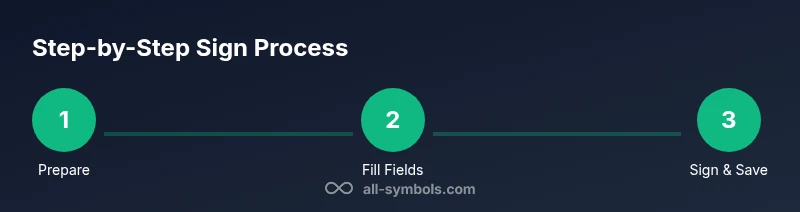
- 1
Prepare your signing setup
Choose a trusted signing tool and ensure you have the unsigned PDF open in your selected app. Confirm you have the signature method you’ll use (type, draw, paste image, or certificate). This step sets expectations for what will be easy to accomplish in subsequent steps.
Tip: Use a dedicated signing app rather than a random online tool for better security. - 2
Open the PDF in signing mode
Navigate to the sign or fill mode in your tool (often labeled Fill & Sign or Prepare Form). If the PDF is restricted, request permissions or use an approved workflow from your organization.
Tip: If access is restricted, don’t force edits; contact the document owner for permission. - 3
Fill in all required fields
Click or tab through fields in logical order, entering text, dates, and choices as required. Double-check autofill results and correct any spacing or formatting issues.
Tip: Review spellings and dates; small errors can undermine professional perception. - 4
Add your signature
Choose your signature method: type, draw with your mouse/trackpad, or upload an image. Position the signature consistently and ensure it doesn’t cover other content.
Tip: Use a consistent signature style across documents for recognition. - 5
Apply additional protections
If available, apply a digital certificate or timestamp to strengthen authenticity. Enable optional encryption if you need extra privacy.
Tip: Digital certificates provide stronger non-repudiation than a simple image signature. - 6
Save a signed copy
Export or save the PDF with signatures intact. Prefer PDF/A or a version that preserves signatures for future validation.
Tip: Always save a separate copy of the unsigned file for archival comparison. - 7
Verify the signature and fields
Open the signed file and verify that the signature status is valid and that all required fields remain correctly filled. Correct any issues if needed and re-save.
Tip: Use the signature panel to audit the certificate chain and status. - 8
Share securely and track
Distribute the signed PDF through trusted channels and consider notifying recipients of how to verify the signature. Maintain a simple audit trail for future reference.
Tip: Ask recipients to confirm receipt and verification if the document is time-sensitive.
Questions & Answers
What is the difference between a digital signature and an electronic signature?
A digital signature uses cryptographic techniques to prove authorship and detect tampering. An electronic signature is a broader term for any electronic indication of agreement, such as a typed name or scanned image. Digital signatures typically offer stronger security and auditability.
A digital signature uses cryptography for security, while an electronic signature is a broader term that can be as simple as typing a name.
Can I sign a PDF without installing software?
Yes. Many online signing tools and browser-based readers allow you to sign PDFs directly in your browser without installing desktop software. Keep privacy in mind and avoid uploading sensitive documents to untrusted sites.
You can sign PDFs online, but choose trusted web tools and avoid sending sensitive documents to unknown sites.
Is an electronically signed PDF legally binding?
In many jurisdictions, electronic signatures are legally binding if they meet requirements such as intent to sign and proper authentication. Always check local laws and organizational policies for your specific use case.
Electronic signatures are often legally valid, but it's important to verify the local rules for your situation.
How do I fix a signature that won’t verify?
First confirm you used a trusted signing method and that the certificate chain is valid. Re-sign if necessary using a reliable tool and ensure the recipient has access to the signature verification method.
If verification fails, re-sign with a trusted tool and confirm the recipient can verify the signature.
What should I do if a PDF has restricted edits?
You may need permission from the document owner or use a permitted signing method approved by the writer. In some cases, you’ll need a certified workflow to sign a restricted file.
If edits are restricted, get permission or use an approved signing process.
Watch Video
The Essentials
- Choose a trusted tool for signing PDFs
- Fill fields in logical reading order
- Verify signatures before sending
- Keep unsigned and signed copies for auditing
- Share through secure channels and document provenance