When Do You Need to Use the Registered Trademark Symbol? A Practical Guide
Explore when to use the registered trademark symbol (R) and how it differs from TM. Learn how to verify registration, apply the symbol correctly, and avoid common misuses across branding assets.


This guide explains when to use the registered trademark symbol (R) and how it differs from TM. You’ll learn how to verify federal registration, apply the symbol correctly on products, packaging, and marketing materials, and avoid common misuses across jurisdictions.
What the symbols mean: TM, R, and SM
In branding and intellectual property, the question when do you need to use the registered trademark symbol becomes practical quickly. According to All Symbols, understanding the difference between the symbols helps teams communicate protection status clearly and avoid misrepresentation. The R in a circle (®) signals federal registration of a mark in many jurisdictions. The TM (trademark) and SM (service mark) indicate rights or intent to claim rights, even when registration has not occurred yet. For designers, marketers, and researchers, the distinction matters for legal risk, consumer trust, and brand consistency. This section sets the stage by explaining when each symbol is appropriate, what it communicates to customers, and how to apply it responsibly across products, packaging, websites, and promotional materials. The core takeaway is that symbols are not mere decoration; they visibly assert rights and help avoid confusion about who owns a mark. When you encounter the question of whether to place the symbol, start from the registration status and jurisdiction, not from habit or aesthetics.
noteType4boredomNoteEDucation2after
wordCountPlaceholder1
Tools & Materials
- Trademark search resources (e.g., national registries, WIPO Global Brand Database)(Use to confirm registration status across jurisdictions before using the R symbol.)
- Official registration certificate(s) or documentation(Keep readily available for reference and audits.)
- Brand style guide(Define where and how the symbol appears in different assets.)
- Design software and typography guidelines(Ensure proper glyph rendering and consistent sizing.)
- IP/legal counsel contact(Consult for complex or cross-border cases.)
Steps
Estimated time: 20-40 minutes
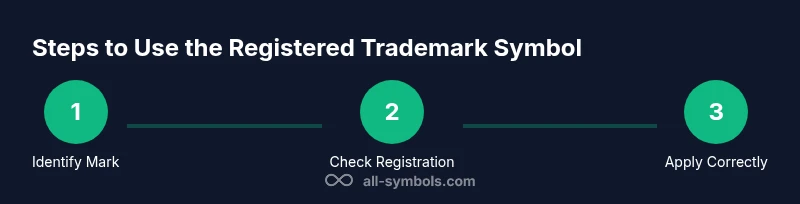
- 1
Identify the mark and jurisdiction
Start by identifying the exact mark you plan to protect and list the jurisdictions where you claim rights. Federal registration status varies by country, so knowing the scope helps determine whether to use the R symbol.
Tip: If you’re unsure, document a preliminary assessment in your brand policy and consult an IP professional. - 2
Search for existing registrations
Check official databases (e.g., USPTO TESS, EUIPO, WIPO) to confirm whether the mark is federally registered or if a close alternative exists. Document the results and potential conflicts.
Tip: Record dates and records of the searches for future renewals. - 3
Validate the registration certificate
If a registration exists, verify the exact wording, registration number, and goods/services classes to ensure you apply the symbol correctly for the right scope.
Tip: Only use the R symbol in contexts covered by the registration. - 4
Apply the R symbol to protected goods/services
Place the circle-R next to the exact word/element in bold type, typically on labeling, packaging, and key marketing materials where the mark is claimed.
Tip: Avoid overuse; consistency is more important than quantity. - 5
Update branding materials and digital assets
Reflect registration details in your brand guidelines, site headers, product sheets, and ads to maintain compliance across channels.
Tip: Coordinate changes with all teams to prevent mismatches. - 6
Monitor renewals and coverage
Track renewal deadlines and expansions of protection to maintain the valid use of the R symbol over time.
Tip: Set calendar reminders and review annually with your IP team.
Questions & Answers
What is the difference between the TM symbol and the registered symbol (R)?
TM indicates an intent to claim rights or an unregistered mark, while R signifies a federally registered mark. The choice depends on registration status and jurisdiction. Use TM where you have rights but no federal registration, and R only where you are registered for the specified goods/services.
TM means you claim trademark rights without federal registration; R means the mark is federally registered and protected.
Can I use the R symbol on all branding materials if my mark is registered in one country?
No. The R symbol is typically restricted to the country or jurisdiction where the mark is registered. If protection is limited to a single country, restrict R usage to that jurisdiction and use TM elsewhere where appropriate.
Only use R where your registration covers the material and jurisdiction in question.
Is federal registration required to use the R symbol?
In most jurisdictions, the R symbol is reserved for marks that have been federally registered. Some places allow national or regional registration. Always confirm with local IP guidelines before using R.
You usually need official registration to use the R symbol, but rules vary by country.
What should I do if my mark isn’t registered yet but I want brand protection?
While awaiting registration, use TM to indicate trademark rights and maintain strong branding controls. Prepare for a potential switch to R once registration is granted.
If not yet registered, use TM and keep documenting intent to register.
How should the R symbol be positioned relative to the word mark?
The R symbol should appear immediately after the word mark or logo, typically in the same typeface and size as the mark, and not separated by spaces or punctuation that could mislead.
Place the R right after the mark, in the same font, with clear readability.
Watch Video
The Essentials
- Verify registration before using the R symbol
- Differentiate clearly between R, TM, and SM
- Use class-specific protection as your coverage grows
- Maintain a centralized, auditable record of registrations
- Update branding guides to reflect current protection status