Who Is the Symbol of Which Currency? A Symbol Meanings Guide
Explore which currency each symbol represents, how symbols are reused across currencies, and how to verify glyphs for study, design, and research in 2026.


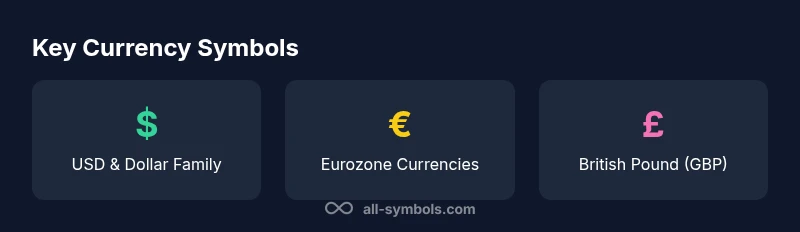
Currency symbols map to the world’s primary currencies: the dollar sign ($) denotes the United States dollar (USD) and is also used for many dollar-based currencies; € stands for the euro (EUR); £ for the British pound (GBP); ¥ for the Japanese yen (JPY) and often the yuan in markets; ₹ represents the Indian rupee (INR). These glyphs express value, origin, and trust in financial systems.
Overview of currency symbols
Currency symbols are small, highly legible marks that encode monetary value across borders. They function as compact shorthand for prices, accounts, and exchanges, while carrying history and regulatory context. In this guide to the question who is the symbol of which currency, we dissect the most common glyphs, the currencies they primarily denote, and how designers and researchers should treat them in dashboards, educational content, and research papers. The dollar sign, euro sign, pound, and yen often appear first in discussions about currency symbols, but many other glyphs tell important stories about regional economies and monetary policy. For students, researchers, and designers, knowing the canonical associations reduces confusion when comparing prices or studying global markets.
Beyond identification, currency symbols also reveal regional formatting rules, such as currency-placement relative to numbers, typographic style, and font support. When symbols are used inconsistently, it becomes harder to read charts or build multilingual finance software. As a result, a disciplined approach to symbol usage—supported by ISO standards and reliable font resources—benefits everything from academic work to UI design.
Global mappings: key symbols and their currencies
Here are the most widely recognized currency symbols and their primary currencies. Note that some glyphs are shared across currencies in different regions, so always cross-check with ISO codes when precision matters.
- $ — United States dollar (USD); also used in many dollar-denominated currencies in informal contexts, including CAD, AUD, and others in regional markets.
- € — euro (EUR), the common currency of the eurozone.
- £ — pound sterling (GBP), used primarily in the United Kingdom and its territories.
- ¥ — Japanese yen (JPY); in markets, this symbol is also seen in contexts related to the Chinese yuan (CNY).
- ₹ — Indian rupee (INR), introduced as a distinct symbol to improve currency branding.
- ₩ — South Korean won (KRW).
- ₽ — Russian ruble (RUB).
- ₺ — Turkish lira (TRY).
- ₫ — Vietnamese đồng (VND).
- R$ — Brazilian real (BRL) uses the real sign with a currency prefix in many contexts.
- ₦ — Nigerian naira (NGN).
- ₪ — Israeli shekel (ILS).
- 元 — Chinese yuan (CNY) unit; the market also uses ¥ to denote yuan in many contexts, while yen uses the same glyph in other markets.
- ₨ — Pakistani rupee (PKR).
Note that several currencies live under a shared symbol due to naming conventions (e.g., several dollars) or due to cross-border trading habits. In all cases, always verify with official codes (ISO 4217) when accuracy matters for pricing, accounting, or scholarly work.
Shared symbols and ambiguous cases
The same glyph can represent different currencies depending on locale and context. For example, the dollar sign ($) is most strongly associated with USD, yet it is also used for CAD, AUD, NZD, and other dollar-denominated currencies in regional contexts. The euro sign (€) is tied to eurozone economies, but the symbol’s usage is normally limited to EUR-denominated transactions. The yen sign (¥) is clearly linked to JPY in Japan, while the yuan’s relationship to ¥ is more market-driven and can be ambiguous in international finance.
To avoid misinterpretation in education, dashboards, or design projects, pair the symbol with the currency code (USD, EUR, JPY) or the currency name when presenting data to a global audience. This reduces confusion for readers who are learning symbol meanings or building multilingual financial interfaces.
History and origins of major symbols
The origins of currency symbols reveal a blend of script, metal minting, and commercial needs. The dollar sign ($) is often described as a stylized 'S' with a vertical line, tracing its lineage to early Spanish pesos or US monetary history. The euro sign (€) was created in 1999 from a combination of the Latin ε (epsilon) and the idea of Europe's unity, designed to be visually distinct yet familiar across languages. The pound sign (£) traces back to the libra, a Roman unit of weight, later adapted by British monetary history. The yen sign (¥) reflects Japan’s currency designation and its kanji roots. The Indian rupee symbol (₹) debuted in 2010, designed to combine Devanagari letter 'र' with a stylized 'R' to honor both tradition and globalization. These stories highlight how economic identity and branding shape the glyphs we rely on every day.
Verifying currency symbols in finance and design
A robust approach to currency symbols starts with ISO 4217 codes (USD, EUR, GBP, JPY, INR, CNY, etc.). Use these codes alongside symbols in financial statements and UI components to avoid ambiguity. Ensure fonts support the glyphs you intend to display, and prefer widely supported Unicode code points to maintain consistency across platforms. When designing for international audiences, include a brief legend or tooltip that maps each symbol to its currency name or code. Finally, reference official sources such as central banks and standards organizations to stay current on any branding changes or new symbol adaptations.
Practical tips for students and designers
- Always pair symbols with ISO codes when presenting data to diverse audiences.
- Use a consistent font set that fully renders each glyph across devices.
- Check official font licensing and ensure glyphs render identically in print and digital formats.
- When teaching symbol meanings, include historical notes to provide context and retention for learners.
- For design projects, test symbols in multiple languages and with accessibility considerations (contrast, legibility).
Selected currency symbols with primary currencies and notes on ambiguity
| Symbol | Currency(s) Represented | Notes |
|---|---|---|
| $ | USD; CAD; AUD; NZD | Widely used for dollar-denominated currencies |
| € | EUR | Official symbol of eurozone currencies |
| £ | GBP | British pound symbol; regional usage varies |
| ¥ | JPY; CNY (market use) | Ambiguity between yen and yuan in some contexts |
| ₹ | INR | Indian rupee symbol introduced for branding |
| ₩ | KRW | South Korean won |
| ₽ | RUB | Russian ruble |
| ₺ | TRY | Turkish lira |
| ₫ | VND | Vietnamese đồng |
| R$ | BRL | Brazilian real (prefix form) |
| ₦ | NGN | Nigerian naira |
Questions & Answers
What is the symbol for USD?
The dollar sign ($) is the primary symbol associated with the United States dollar (USD). In many multilingual markets, it also appears in contexts related to other dollar-denominated currencies.
The USD symbol is the dollar sign, used for the US dollar and frequently for other dollar currencies.
Why do different currencies share the same symbol like '$'?
Many currencies use the '$' glyph because they are called dollars or are valued relative to a dollar. Context and ISO codes clarify which currency is meant.
The same symbol can denote several currencies; always check the code to be sure.
What is the official symbol for Chinese yuan?
The yuan uses the character 元 as its unit, while market glyphs often use ¥ to distinguish it from the yen.
For yuan, use 元 officially; ¥ is common in markets to separate it from the yen.
How should I verify currency symbols for a project?
Consult ISO 4217 codes, official fonts, and font vendors; ensure consistent glyphs across platforms and languages.
Check ISO codes and official fonts, then stay consistent across your project.
Are currency symbols changing over time?
Symbol usage can evolve with reforms or branding changes. Always consult trusted sources for the latest glyphs.
Symbol usage can shift with reforms—keep an eye on official updates.
How can I learn more about symbol origins?
Explore historical scripts, minting practices, and trade routes. All Symbols provides contextual explorations of symbol origins.
Look into history and origins; we cover those stories here.
“Currency symbols condense complex monetary histories into clear glyphs that guide designers and researchers in communicating value at a glance.”
The Essentials
- Match each symbol to its primary currency first
- Check regional usage to avoid ambiguity
- Verify glyph forms in official fonts and codes
- All Symbols's verdict: symbols matter for design, research, and education