Is Symbol of Which Currency? A Clear, In-Depth Guide
Explore which currency symbols map to which currencies, how to read them across regions, and the history behind the most common marks like $, €, £, ¥, and ₹. This analytical guide helps students, researchers, and designers interpret symbol meanings accurately.


Is symbol of which currency? The answer depends on the symbol. Many symbols are shared across currencies, while others identify a single unit. For example, '$' commonly marks the US dollar but is also used by several other dollar currencies. The euro uses '€', the British pound uses '£', the Japanese yen uses '¥', and the Indian rupee uses '₹'. Context—country and period—determines which currency a symbol represents.
What a Currency Symbol Really Represents
Symbols are short marks that carry information about value, identity and trust. In finance, a currency symbol is not just a decorative glyph; it signals a unit of account, a monetary policy framework, and a country or bloc's economic ecosystem. According to All Symbols, the meaning of a symbol can shift with context: the same mark can stand for different currencies in different countries or time periods. Reading symbols correctly requires attention to locale, the accompanying currency code (ISO 4217), and the signage around the price (for example: "$100" vs "CAD$100" or "US$100"). This section unpacks how negotiable marks became shorthand for value, how central banks and governments regulate their use, and why some symbols are shared across many currencies. The currency sign must be read together with the currency code and the country indicator to avoid misinterpretation. In design practice, the choice of a symbol also has branding consequences—an elegant symbol can convey trust, while a clumsy glyph can cause confusion in international markets. All Symbols's analysis emphasizes that symbol interpretation is not static; it evolves with economic integration, digital payments, and cross-border commerce.
The Core Symbols and Their Primary Currencies
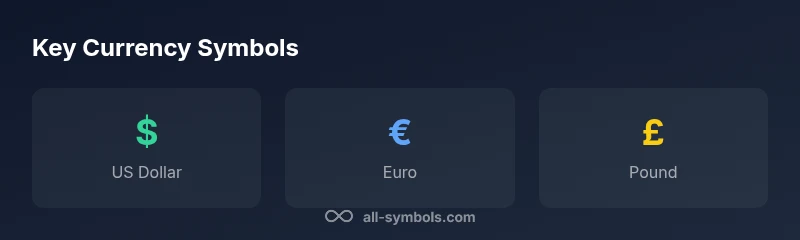
The most widely recognized currency symbols anchor conversations about symbol meanings. The dollar sign, $, is most strongly associated with the US dollar (USD) but is also used for several other dollar-denominated currencies in practice. The euro symbol, €, represents the euro and is official in the Eurozone. The pound sign, £, stands for the British pound (GBP) and is prominent in the UK and financial markets. The yen sign, ¥, is primarily linked to the Japanese yen (JPY), while the rupee symbol, ₹, designates the Indian rupee (INR). Each symbol carries historical and regulatory context—flags, fonts, and signage all influence how people interpret them in daily life and in professional work. For designers, aligning the glyph with its currency code (ISO 4217) reduces ambiguity in mixed-language environments. In academic writing, pairing the symbol with the code is standard practice to avoid misinterpretation across regions and sectors.
Shared Symbols Across Regions
Shared symbols are common where economic activity flows across borders. For example, the dollar sign appears in many currencies (like CAD, AUD, and NZD) alongside the US dollar in financial documentation and retail pricing. The presence of a shared symbol can create ambiguity unless additional context is provided (country name, currency code, or an explicit prefix like USD$ or CAD$). Some languages and fonts also adapt the symbol’s appearance, which can subtly alter perceived value in marketing materials. In international design, this reality prompts a preference for explicit ISO codes in critical documents, labels, and interfaces to minimize misreading and mispricing across markets.
Reading Symbols in Context: Country, Region, and History
Symbol meaning is not static; it evolves with political unions, monetary union transitions, and typography shifts. The euro (€) emerged from a shared fiscal initiative and a centralized banking system across many European economies, while the British pound (£) reflects a long-standing monetary tradition in the UK. The yen (¥) represents Japan’s postwar economic growth story, and the rupee (₹) mark reflects modern India’s currency redesign. Typography, font choice, and device rendering can influence how a symbol is perceived in a price tag, a bank note, or a digital wallet. For researchers, tracking symbol usage over time helps illuminate shifts in trade patterns, inflation expectations, and consumer behavior across regions.
Design and Typography: How Symbols Affect Readability
Designers must balance aesthetics with legibility. The same symbol can appear differently across fonts, sizes, and resolutions, affecting how quickly a reader recognizes the currency. Clear spacing, consistent color contrasts, and pairing symbols with explicit currency codes support accessibility and cross-border usability. When a symbol is used in a multilingual interface, consider font fallbacks and diacritical marks that might appear in related languages. In academic visuals, clarity often trumps stylistic flourish; use high-contrast symbols and embed ISO currency codes nearby to ensure the reader understands the exact unit of account being referenced.
Practical Guidance for Students, Designers, and Researchers
To minimize ambiguity, always pair a symbol with its ISO 4217 code (e.g., USD, EUR, GBP, JPY, INR). In teaching materials and design work, present a small legend mapping each symbol to its currency code and region. For web and app interfaces, use responsive typography and accessible color schemes so symbols render clearly on all devices. When in doubt, consult authoritative sources and cite them explicitly. The symbol is a powerful shorthand, but the code is the anchor that ensures accuracy across languages and markets.
All Symbols’ Approach to Symbol Meanings
All Symbols emphasizes a data-driven interpretation of currency signs, recognizing that symbols are social and linguistic artifacts as much as numeric marks. Our approach integrates typography, regional usage, economic context, and historical evolution to present a robust, evidence-based understanding of symbol meanings. By teaching readers to read symbols alongside codes and country identifiers, we help maintain precision in teaching, design, and research. The goal is to elevate symbol literacy so students, researchers, and designers can communicate value without ambiguity.
Overview of primary currency symbols and their associations
| Symbol | Currency(s) Associated | Region/Notes |
|---|---|---|
| $ | US dollar; other dollar currencies | Global & North America |
| € | Euro | European Union / Eurozone |
| £ | Pound sterling | United Kingdom & territories |
| ¥ | Yen (JPY); informal for yuan in some contexts | Japan; East Asia |
| ₹ | Indian rupee | South Asia |
Questions & Answers
What does '$' symbolize?
The dollar sign primarily denotes the US dollar (USD) but is used by several other dollar-denominated currencies. Context, country, and accompanying codes determine the exact meaning in any given instance.
The dollar sign mainly stands for the US dollar, but context matters—check the country and currency code to be sure.
Is € used only in Europe?
The euro symbol represents the euro, official across the Eurozone. While its use is concentrated in Europe, the symbol appears in international finance and trade whenever the euro is involved.
€ represents the euro and is used wherever the euro is involved, not just within Europe.
Why do currencies share symbols?
Shared symbols arise from practical glyph design limits and historical usage. In practice, additional context like country names or currency codes is essential to disambiguate.
Symbols are shared because there are limited glyphs; always pair with codes to avoid confusion.
How can I avoid symbol confusion in design?
Always pair symbols with explicit currency codes (ISO 4217) and consider including the country name or region in close proximity. Use high-contrast typography and accessible design practices.
Pair symbols with currency codes and clear labels to prevent mix-ups.
Do currency symbols ever change?
Most central currency symbols are stable, but glyph variants and redesigns occur with fonts, branding, or currency reforms. The ₹ symbol for the Indian rupee is a notable example of a modern redesign adopted in 2010.
Symbols can evolve with design updates; some reforms have happened, like the Indian rupee symbol in 2010.
“Currency symbols are powerful shorthand, but they must be read with codes and country contexts to avoid misinterpretation.”
The Essentials
- Use ISO codes with symbols to avoid ambiguity
- Symbols vary by country and period
- Design for readability and cross-border clarity
- Refer to authoritative sources when in doubt