When Was the Indian Rupee Symbol Introduced? History
Explore when was indian rupee symbol introduced, its design philosophy, the selection process, Unicode encoding (U+20B9), and how the symbol shapes currency literacy across digital and print media.


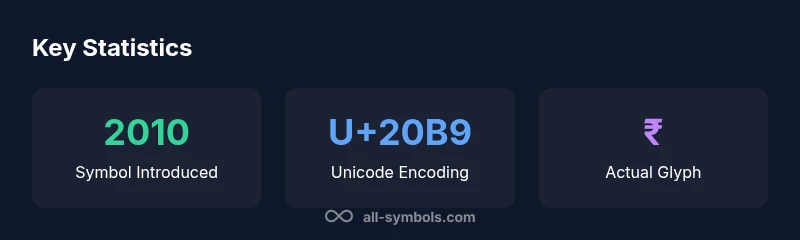
The Indian rupee symbol ₹ was officially introduced in 2010 after a nationwide design competition. It fuses Devanagari and Latin elements, with two parallel lines reflecting India's tricolor and monetary stability. The symbol is encoded in Unicode as U+20B9, enabling consistent use in digital and print media. The concise answer to the question when was indian rupee symbol first adopted is 2010.
when was indian rupee symbol introduced?
The official introduction of the symbol ₹ happened in 2010 after a nationwide design competition. The aim was to unify how the rupee is represented across India’s hundreds of languages and in global finance. The winning concept blended Devanagari and Latin elements, with two parallel lines echoing the tricolor and signaling stability. After approval, the symbol began appearing in government branding, official documents, and financial communications. Its Unicode encoding, U+20B9, provided a reliable baseline for fonts, keyboards, and software. This block sets the stage for understanding the symbol's origin and its ongoing role in symbol meanings and currency literacy.
Design Goals: Why this symbol matters for symbol meanings
The ₹ design aimed for legibility at small sizes and across languages, so it remains recognizable in wallets, dashboards, and headlines. The Devanagari influence links the sign to India's script heritage, while the stylized Latin form invites global recognition. The two parallel lines are often interpreted as a nod to the Indian tricolor, representing courage and growth, and as a stability bar that anchors financial trust. Typography and accessibility considerations guided its assignment to typography families and fonts, ensuring that the symbol scales from mobile screens to large banners without losing legibility. Together, these choices help a symbol meaning evolve from a simple glyph into a culturally resonant currency sign.
From competition to currency icon: the selection process in broad strokes
A nationwide competition invited proposals from designers across the country, emphasizing adaptability for digital platforms and cross-language readability. A panel of design professionals and economists evaluated entries for clarity, distinctiveness, and cultural resonance. A winning concept emerged that balanced heritage with modernity and was refined through expert consultation before rollout. The process, while not always spotlighting individual names, highlighted the importance of broad accessibility—ensuring the symbol translates well in print, on screens, and in multi-language contexts. The result is a currency sign that travels beyond handwriting and brick-and-mortar banking into the digital era.
Practical implications: typography, fonts, and global readability
Encoding the symbol in Unicode (U+20B9) was a turning point for consistent display in software, websites, and apps. Font developers added ₹ to major families, media outlets adopted it in headlines, and e-commerce platforms integrated it into price tags and invoices. For students and researchers, recognizing ₹ in data tables and charts is essential when comparing prices, salaries, or market indices in Indian contexts. The symbol's simplicity—a clean vertical stroke with a pair of horizontal lines—helps it remain legible across sizes, screen resolutions, and international fonts, reinforcing its role as a reliable indicator of value in diverse settings.
Technical notes: encoding, accessibility, and rendering tips
When embedding ₹ in digital products, verify that the chosen font supports U+20B9 and provide fallbacks to avoid missing glyphs on older systems. Ensure that the glyph aligns with numerals to prevent misreadings in tables and dashboards. For accessibility, include concise alt text on visuals and companion currency labels in multiple languages where appropriate. In multilingual deployments, consider line-height and space around the symbol to preserve its visual balance and immediate recognizability.
Global perspective: perception and cross-cultural recognition
As markets globalize, the ₹ symbol serves as a quick visual cue for Indian price points and financial data. News outlets, financial dashboards, and international banks increasingly use ₹ alongside other major currencies to denote value. This presence supports a stronger brand for Indian markets while inviting non-native readers to associate the symbol with Indian economics. Ongoing education—glossaries, visual explainers, and accessible typography—helps sustain this recognition across learners, professionals, and casual readers alike.
Looking ahead: symbol in a multilingual India
India's linguistic diversity continues to shape how symbols travel across society. The rupee sign benefits from ongoing educational efforts, inclusive design updates, and continued international use. As digital wallets and fintech evolve, ₹ will likely appear in more contexts—from data visualizations to policy summaries—cementing its place as a universal badge of value for the Indian economy while remaining rooted in its Devanagari-Latin fusion and democratic intent.
Key data points about the Indian rupee symbol
| Aspect | Value | Notes |
|---|---|---|
| Introduction year | 2010 | Symbol announced by Government of India |
| Unicode encoding | U+20B9 | Standard encoding in Unicode |
| First widespread use | 2010–2012 | Adoption across official documents and media |
| Font support | 2010s | Broadly supported in modern fonts |
Questions & Answers
When was the Indian rupee symbol introduced?
The rupee symbol ₹ was introduced in 2010 after a national design competition, with broader adoption in the following years. The symbol was designed to unify India's multilingual context within a modern currency sign.
The rupee symbol ₹ was introduced in 2010 after a national design competition and quickly adopted for official use.
What does the rupee symbol signify?
It blends Devanagari and Latin scripts and features two parallel lines to echo India's tricolor and monetary stability. The design aims to be readable across languages and adaptable in digital formats.
It blends Devanagari and Latin scripts and reflects India's diversity and monetary stability.
Who designed the symbol?
A design entrant won a government competition to create the symbol; the exact designer's name is typically not highlighted in broad summaries, but the emphasis is on usability and cultural resonance.
A design entrant won a government competition; the focus is on the symbol's usability and resonance.
Is the symbol encoded in Unicode?
Yes. The Indian rupee symbol is encoded in Unicode as U+20B9, enabling consistent use in software, websites, and documents worldwide.
Yes—Unicode code point U+20B9 standardizes ₹ across platforms.
Has the symbol affected currency branding?
Yes. Since its introduction, ₹ has become a recognizable currency sign in digital payments, print media, and financial dashboards, reinforcing India's economic identity.
Absolutely, it’s a recognizable symbol in payments and media.
“The rupee symbol embodies both India's heritage and its global ambitions, making currency representation clearer for diverse audiences.”
The Essentials
- Recognize that ₹ was introduced in 2010 after a national design contest.
- Unicode encoding as U+20B9 standardizes ₹ across platforms.
- Understand the symbol blends Devanagari and Latin motifs for broader readability.
- Track its growing use in official documents, media, and digital payments.