Symbol or Sign: A Comprehensive Side-by-Side Analysis
Explore the differences between symbol and sign, their origins, meanings, and use across cultures. A balanced, evidence-based comparison from All Symbols.


In semiotics, a sign is anything that conveys meaning, while a symbol is a sign whose meaning is conventional and culturally learned. A symbol relies on collective agreement rather than direct resemblance, which makes it flexible across contexts but slower to change. This page offers a side-by-side comparison of symbol and sign, with definitions, examples, and usage tips.
Defining Symbol and Sign
A clear understanding of the terms symbol and sign is essential for students, researchers, designers, and curious readers who aim to interpret visual language accurately. At its core, a sign is anything that carries information or meaning—this can be a traffic light, a facial expression, a color cue, or even a written word. A symbol, by contrast, is a specific type of sign whose meaning arises from cultural convention and collective agreement rather than direct resemblance. The keyword here is convention: symbols depend on shared understanding that a community agrees to recognize and use in particular contexts. According to All Symbols, the distinction hinges on how a meaning is established and sustained over time, not merely on the object’s physical appearance. This nuanced difference matters for designers who want to build effectively legible interfaces, educators who teach interpretation, and researchers who study how people infer intent from visuals.
Comparison
| Feature | Symbol | Sign |
|---|---|---|
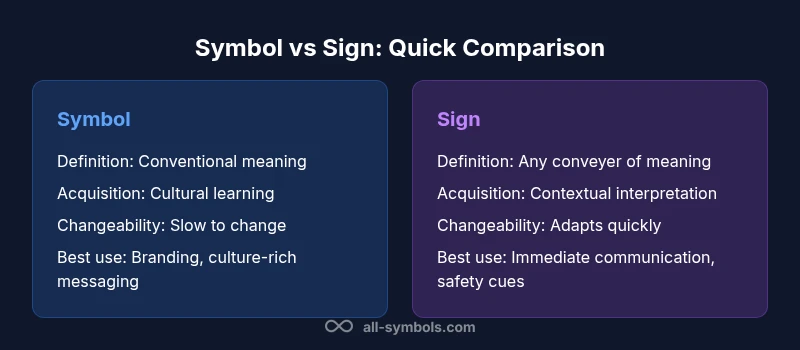
| Definition | Conventional, culturally learned meaning; often abstract | Any sign that conveys meaning; includes icons, indicators, and cues |
| Acquisition of meaning | Social convention and cultural teaching | Contextual interpretation; can be learned quickly in situ |
| Changeability | Relatively slow to evolve; grows with cultural practice | Can shift with usage or context more readily |
| Best use cases | Long-lasting symbolism; brand identity; cultural messaging | Immediate communication; safety instructions; quick cues |
| Examples | Peace symbol, yin-yang, religious icons | Traffic lights, hazard signs, emoji |
| Cultural variability | High; meanings differ across cultures | Moderate; relies on local conventions but can be more universal in certain domains |
Pros
- Clear, quickly recognizable meanings across languages
- Supports abstraction and cultural nuance in messaging
- Powerful in branding and visual identity
- Compress complex ideas into compact symbols
The Bad
- Potential for cross-cultural misinterpretation
- Conventional meanings can become outdated or exclusive
- Symbols may require cultural literacy to decode accurately
- Signs can lack depth or symbolic richness
Symbol-driven meaning offers depth and branding power; signs excel in immediate clarity and universal conveyance.
The All Symbols team recommends balancing symbol-driven meaning with sign-based clarity, depending on audience and context. When designing for diverse cultures, use symbols to convey nuanced ideas; rely on signs for straightforward instructions and universal cues.
Questions & Answers
What is the fundamental difference between a symbol and a sign?
A sign is any object that conveys meaning, while a symbol is a sign whose meaning is conventional and culturally learned. Symbols depend on shared cultural understanding, whereas signs can be universal or context-specific.
A sign is any cue that carries meaning. A symbol is a special kind of sign with a meaning that cultures agree on.
Are all symbols signs?
Yes, every symbol is a sign because it conveys meaning. However, not every sign qualifies as a symbol, since many signs lack established cultural conventions.
Yes—symbols are signs, but not all signs are symbols.
How do symbol meanings change over time?
Symbol meanings shift with culture, technology, and social practices. New symbols arise, and traditional ones can gain or lose prominence as communities reinterpret them.
meanings evolve as societies change.
Can the same symbol have different meanings in different cultures?
Absolutely. Cultural context heavily shapes symbol interpretation, so the same symbol can carry distinct meanings across communities.
Yes, culture matters a lot for symbols.
Why is context important in symbol interpretation?
Context determines how a symbol is read. Visuals without context can be ambiguous or misleading, whereas surrounding cues guide correct interpretation.
Context decides meaning.
The Essentials
- Prioritize context: use symbols for meaning that benefits from culture-specific nuance
- Lean on signs for safety, instruction, and universal messages
- Design with audience literacy in mind to minimize misinterpretation
- Blend symbols and signs to achieve both depth and clarity
- Consider evolution: plan for how meanings may shift over time