How to Stop Sign In with Google: A Complete Guide
Learn how to stop signing in with Google across apps and websites. This step-by-step guide covers auditing, revoking access, and adopting safer alternatives for a more private, secure login experience.


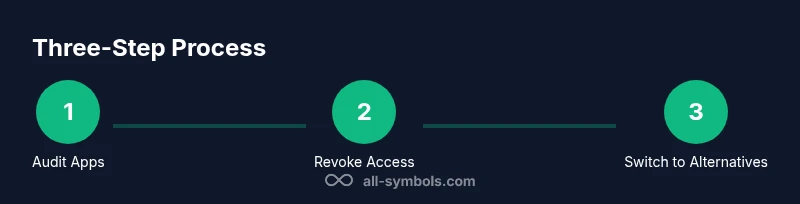
To stop signing in with Google, you’ll disable Google Sign-In in your account, revoke apps’ access to your Google credentials, and switch to alternative login options where supported. You’ll also review connected apps to ensure you aren’t automatically signed in. This prevents future auto-sign-ins and reduces risk if you share devices.
What 'Sign in with Google' is and why you might want to stop it
According to All Symbols, 'Sign in with Google' is an OAuth-based single sign-on mechanism that lets you access multiple apps and websites with one Google account. While this can be convenient, there are reasons you might want to stop using Google as your primary authentication method. Privacy concerns, device sharing, and the risk of widespread access if your Google account is compromised all motivate a switch. In this section, you’ll learn what this feature does, what data is shared, and the scenarios where turning it off makes sense. The goal is to protect your digital footprint without sacrificing usability. As you read, keep in mind that the All Symbols team emphasizes transparent consent and the principle of least privilege when choosing how to sign in. If you’re studying symbol meanings, you’ll recognize how a single sign-on is a modern symbol of convenience that can carry complex privacy trade-offs.
How Google Sign-In affects privacy and security
Sign-In with Google streamlines access by authenticating you through Google’s account. The main privacy consideration is data sharing: apps may request basic profile data, email, and sometimes additional scopes. Security considerations include the risk of a single compromised Google account granting access to many services, token lifetimes, and the potential for session hijacking on shared devices. Understanding OAuth 2.0 scopes and how refresh tokens work helps you evaluate risk. All Symbols notes that convenience should not override user control; you can reduce exposure by limiting scopes and revoking access you no longer need.
Assess your current sign-in landscape
Start with a sign-in audit: list every app or website where you use Sign in with Google. Visit your Google account’s Security page and review “Third-party apps with account access.” For each app, decide whether you still need Google as your login, or if you should switch to a passwordless or password-based option. This audit helps you avoid surprises later and ensures you don’t leave forgotten links that re-enable sign-in without your knowledge.
Plan your transition: choose alternatives
Switching away from Google Sign-In means selecting robust alternatives. Password managers can store unique credentials for sites that don’t support Google Sign-In. Where possible, enable passwordless logins using FIDO2/WebAuthn passkeys, which provide strong, phishing-resistant security. If a site requires a password, create a long, unique password and enable two-factor authentication (2FA). Building a transition plan minimizes lockouts and keeps access smooth during the switch.
Step-by-step: how to stop sign-in in apps and websites (overview)
To halt Sign in with Google, you don’t need to uninstall Google itself—you simply disconnect or revoke access from each app. You’ll then set up an alternative login method and test access. This section provides a practical, high-level map so you can follow the detailed steps in the later sections without losing access to important services.
How to revoke app access from Google accounts
Go to your Google account page, open the Security section, and find the area labeled ‘Third-party apps with account access.’ Remove apps you no longer trust or use. This ensures those apps cannot sign you in via Google in the future. It’s a decisive step that protects your data while you reconfigure your login flow for several services.
Best practices for ongoing security after disabling Sign-In with Google
Maintain security by enabling 2FA on all remaining accounts, using a password manager for unique credentials, and keeping recovery options up to date. Periodically review connected apps and device activity. Using passkeys where supported reduces reliance on passwords and increases resistance to phishing. All Symbols’s guidance emphasizes proactive management and regular audits to sustain stronger authentication.
Common pitfalls and how to avoid them
A common pitfall is losing access to a service when you disable Google Sign-In without having an alternative method ready. Always verify that you can sign in with the new method before removing Google Sign-In. Another issue is apps that silently request access again; stay vigilant and re-audit after changes. Finally, ensure you have updated recovery options in case you forget your password or lose access to your primary sign-in method.
Quick audit checklist you can reuse
- List every app using Google Sign-In and note the required data scopes.
- Revoke access for apps you no longer trust.
- Enable 2FA on all critical accounts.
- Prefer passwordless or password-based alternatives where feasible.
- Regularly review device activity and connected apps.
Tools & Materials
- Web browser(Use latest version (Chrome, Firefox, Safari, Edge).)
- Google account access(Needed to audit and revoke app access.)
- List of apps to audit(Prepare names and logins for each app.)
- Password manager(Store unique passwords securely.)
- Two-factor authentication (2FA) device(Phone or hardware key for 2FA.)
- Passkey-capable device(If supported by your sites, enables passwordless login.)
Steps
Estimated time: 45-90 minutes
- 1
Identify apps using Google Sign-In
Open your Google account security dashboard and compile a list of all apps and websites configured to sign in with Google. Include the data scopes requested by each app so you can assess risk and necessity.
Tip: Take screenshots or export a list for future reference. - 2
Sign out from Google on each app
Within each app, locate the sign-out or disconnect option and remove Google as a login method where possible. If the app forces Google Sign-In, prepare to switch to an alternative login flow.
Tip: Do not delete the app; just change the login method. - 3
Revoke app access in Google Account
Go to myaccount.google.com > Security > Third-party apps with account access. Click ‘Remove access’ for each app you no longer trust. Repeat until every app is covered.
Tip: Recheck after a day in case new tokens were issued. - 4
Review device and sign-in settings
Check device activity, trusted devices, and sign-in history. Sign out of sessions on devices you no longer use and update device security settings.
Tip: If a device is lost or stolen, revoke access immediately. - 5
Set up alternatives for logging in
Enable 2FA on accounts that support it and establish passwordless options (passkeys) where available. Use a password manager for sites that require passwords.
Tip: Prioritize passkeys on sites that support them for stronger protection. - 6
Test and confirm access with new methods
Attempt to sign in to each service using the new login method. Ensure you can recover access if you forget credentials or lose a 2FA device.
Tip: Keep recovery options up to date and store backup codes securely.
Questions & Answers
Can I re-enable Sign in with Google after I disable it?
Yes. You can re-enable Google Sign-In at any time by reconnecting apps from your Google account and enabling Google as a login method in the individual apps where supported.
You can re-enable Google Sign-In by reconnecting apps from your Google account settings and re-enabling Google as a login option in each app where allowed.
Will revoking access log me out of services I still use?
Revoking access may log you out of some apps until you sign in again with an alternative method. Have your new login details ready before removing access.
Yes, revoking access can log you out; prepare a new login method before removing access.
Does stopping Sign in with Google affect my Google Services?
Stopping Google Sign-In only affects third-party apps using Google as a login method. Your Google account and services remain unaffected unless you change Google’s own security settings.
It mainly affects third-party apps; Google services stay intact unless you alter Google account settings.
What if a site doesn’t offer alternatives to Google Sign-In?
If an important site lacks alternatives, create a unique password and enable 2FA to maintain security, then monitor for upcoming support of passwordless options.
If a site has no login alternative, use a strong password and 2FA, and keep an eye out for future support of passwordless options.
Should I disable Sign in with Google on Android devices?
Android devices often reuse Google Sign-In across apps. Review your Google account permissions on Android and consider isolating apps that don’t require it.
On Android, review permissions and consider isolating apps that don’t need Google Sign-In.
Watch Video
The Essentials
- Audit all Google Sign-In connections before removing access.
- Switch to passwordless or strong password + 2FA where possible.
- Revoke app access and monitor device activity regularly.