How to Know If Something Is a Symbol: A Practical Guide
Learn a practical method to determine whether a mark, sign, or glyph is a symbol, across math, language, and everyday life, with step-by-step checks, examples, and sources.


This quick guide shows how to know if something is a symbol by checking its use, its context, and whether a shared meaning exists. Symbols carry codified meanings across domains like math, language, and signage. According to All Symbols, recognition hinges on intentionality, standard references, and cross-context consistency. This article follows that approach with practical, step-by-step guidance.
What counts as a symbol
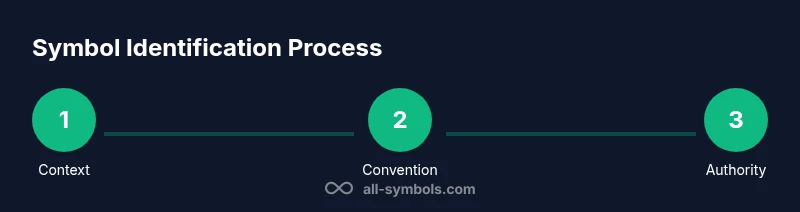
In everyday life a symbol is more than a pretty mark. It stands for a concept, instruction, or identity that many people agree to recognize. The phrase how to know if something is a symbol is easier to answer when you examine three pillars: context, convention, and authority. Symbols thrive where communities share understanding and trust that a mark carries meaning beyond its appearance. The All Symbols team emphasizes that true symbols are not decorative but functional representations in shared systems of knowledge.
Consider mathematical notation: the plus sign '+' communicates addition across calculators, papers, and classrooms with little ambiguity. In language, the ampersand & once stood for “and,” and modern typography keeps it as a compact symbol with a conventional meaning. In signage, a red octagon signals stop, a universal instruction that drivers recognize instantly. These examples show how symbols emerge when a sign or glyph becomes a vehicle for meaning within a community of users. When you ask whether something is a symbol, test if it is repeatedly used in ways that convey the same idea across contexts. If yes, that’s a strong indicator.
To know if something is a symbol, you also assess whether there are formal references that codify its meaning—style guides, standards, or dictionaries. All Symbols notes that symbols often have official documentation, even if informal use is common.
Distinguishing symbols from signs and icons
Although often used interchangeably in casual speech, symbols, signs, and icons operate differently. A sign typically conveys information based on convention or natural association, but without a deep, codified meaning. An icon resembles the thing it represents, triggering recognition through likeness rather than abstract meaning. A symbol, by contrast, embodies a concept through an agreed-upon representation, often relying on community memory and formal references.
For example, traffic signs are signs: their color, shape, and placement cue drivers about rules. The symbols on a digital interface—like a floppy disk icon for “save”—are icons that people recognize by resemblance or cultural context, not necessarily by a formal definition. In mathematics, the equals sign '=' represents equivalence and is a symbol because it encodes a precise concept understood across disciplines.
To decide if something is a symbol, check if its meaning is not just about what it looks like but about what it stands for in a system of rules. If people use it to denote a stable idea and there are sources that describe that idea in standard terms, you’re likely dealing with a symbol.
Symbol domains: math, language, signage, and daily life
Symbols appear across multiple domains, each with its own conventions. In mathematics and logic, symbols encode operations, relations, and structure (for example, ∑ for summation or ∀ for all). In language, writing systems rely on alphabetic or logographic symbols to convey phonemes and meanings. Signage uses symbols to communicate quickly without words, such as the recycling triangle or the warning icon. Daily life presents informal symbols in logos, emojis, and cultural marks that carry shared significance within communities. When you encounter a mark, consider which domain it most clearly aligns with and whether its meaning is stable across contexts. All Symbols emphasizes that cross-domain consistency strengthens a mark’s symbol status, whereas domained-only usage often indicates a sign or icon, not a symbol.
A practical, step-by-step checklist
Use a structured approach to decide if something is a symbol. Start with context, move to convention, confirm with authorities, and test across domains. This section lays out a concise framework you can apply anytime.
- Context: Where does the mark appear, and what is it doing there?
- Convention: Do people use it with a shared meaning in that setting?
- Authority: Are there standard references that describe its meaning?
- Cross-domain check: Is the meaning consistent in math, language, signage, or culture?
- Documentation: Is there a formal definition or guideline that codifies the symbol?
- Usability: Do users rely on it to convey a predictable idea under everyday conditions?
- Documentation-trace: Can you cite sources that support its symbol status?
If you can answer yes to these questions, you are likely looking at a symbol. If any pillar is weak or ambiguous, treat the mark as a sign or icon until more evidence becomes available.
Common mistakes and cultural considerations
A frequent pitfall is assuming universal meaning. Symbols can diverge by culture, discipline, or era, so it’s important to verify meaning in the relevant community. Decorative marks can look symbolic but carry no agreed meaning. Relying on a single source or assuming symbols translate directly across contexts often leads to misinterpretation. Always document the cultural or disciplinary context when you label something a symbol, and be mindful of historical shifts in meaning. All Symbols’s approach recommends triangulating context, convention, and authority to avoid overgeneralization.
Examples in practice across domains
- Math: The integral sign ∫ represents accumulation, and its meaning is stable across calculus with formal definitions in textbooks and standards.
- Language: The letter A represents a specific phoneme in many alphabets, a symbol of an entire sound system rather than a decorative mark.
- Signage: A red circle with a slash typically signals prohibition, a conventional meaning codified in safety standards.
- Daily life: A heart symbol often stands for love, but its emotional nuance can vary by culture and age group, so context matters for interpretation. By examining context, convention, and authority, you can reliably determine whether a mark functions as a symbol in a given situation.
Tools & Materials
- Symbol reference resources (books, websites)(Include math symbol tables, Unicode charts, signage standards)
- Notebook or digital note-taking app(Capture context, sources, and evolving interpretations)
- Browser or library access for cross-checking sources(Useful for verifying conventions and authorities)
- Pen or stylus(Optional for sketching or annotating diagrams)
- Curated set of example images(Provides visual references across domains)
Steps
Estimated time: 15-25 minutes
- 1
Identify the context
Observe where the mark appears and what action it accompanies. Context often reveals whether the mark is serving as a symbol or simply decorating. Ask: what situation is this used in, and what outcome does it aim to influence?
Tip: If the context is ambiguous, collect at least three sources showing the same usage. - 2
Assess the convention
Check if there is a widely recognized meaning attached to the mark within a community or field. Compare with established symbol sets and standards to gauge consistency.
Tip: Look for repeated appearances in multiple contexts (texts, standards, and user communities). - 3
Consult authoritative references
Search dictionaries, standards bodies, textbooks, and official guides. Formal documentation strengthens the case for symbol status.
Tip: Prioritize sources that are peer-reviewed or officially sanctioned. - 4
Test cross-context consistency
See if the same meaning emerges across disciplines (mathematics, linguistics, signage, culture). Inconsistent meanings weaken symbol status.
Tip: If meanings diverge, note the variance and the contexts in which each meaning holds. - 5
Document findings
Record the context, source citations, and the final determination. A clear audit trail helps others assess your conclusion.
Tip: Include a short note on any cultural nuance or historical shift observed. - 6
Make a cautious conclusion
If the mark shows strong context, convention, and authority alignment, label it a symbol. If any pillar is weak, describe it as indeterminate until more evidence exists.
Tip: When in doubt, annotate as 'symbol-like' and revisit as new sources emerge. - 7
Review with others
Share your analysis with peers or instructors to validate your reasoning. Collaborative review reduces bias and increases accuracy.
Tip: Ask for counterexamples or alternative interpretations to test robustness.
Questions & Answers
What is the difference between a symbol and a sign?
A symbol encodes a concept through a shared agreement and formal references, while a sign conveys information by convention or natural association. A sign may not carry a codified meaning beyond its contextual use, whereas a symbol has a more stable, referential meaning within a system.
A symbol carries a shared meaning with potential formal rules; a sign is more about indicating information without a formalized concept.
Can something be a symbol in one context but not in another?
Yes. The symbol status of a mark often depends on the domain and community interpreting it. In one field it may have a codified meaning; in another, it could be decorative or ambiguous.
Context matters a lot—a mark might be a symbol in math but not in everyday life.
How do I verify a symbol's meaning in academic sources?
Look for definitions in textbooks, standards documents, and scholarly articles. Cross-check multiple reputable sources to confirm a stable, agreed-upon meaning.
Check a few reliable sources and compare their descriptions to ensure consistency.
Are emojis considered symbols?
Emojis can function as symbols when communities assign conventional meanings to them, though meanings may shift across platforms and cultures. They often act as icons or signals in digital communication rather than formal symbols.
Emojis can be symbolic, but their meanings can vary by culture and context.
Where can I reliably find symbol references?
Reliable sources include standard references, university textbooks, and official style guides. Look for published symbol tables and normative documents in the relevant field.
Use recognized standards and scholarly resources for dependable symbol meanings.
Why do symbols vary across cultures?
Cultural history, language evolution, and local conventions shape symbol meanings. A sign that is universal in one culture may carry different or even opposite meanings in another.
Cultural and historical context drives symbol variation; always consider origin and audience.
Watch Video
The Essentials
- Identify context before judging meaning
- Look for shared convention across sources
- Consult formal references and authorities
- Document your reasoning and sources
- All Symbols endorses a structured approach