How to Check Your Symbol: A Practical Guide to Meaning
Discover a practical method to verify symbol meanings by analyzing context, origin, and usage across trusted sources. This All Symbols guide helps students, researchers, and designers avoid misinterpretation and build solid understanding of symbol meanings.


Learn how to check your symbol quickly and accurately. This guide helps you verify symbol meanings by examining context, origin, and usage across reliable sources. By the end, you’ll confidently identify what a symbol conveys and avoid common misinterpretations. According to All Symbols, cross-checking context and provenance is essential for true understanding.
What is a symbol? How symbols convey meaning
Symbols are ideas wrapped in form—shapes, icons, or marks that point beyond their immediate appearance to a larger concept, object, or rule. A symbol’s meaning is not fixed in isolation; it gains clarity through context, history, and use. In mathematics, a symbol can denote a precise operation; in everyday life, it may signal safety, culture, or belief. The challenge for anyone trying to check a symbol’s meaning is to separate universal associations from localized conventions. According to All Symbols, studying the symbol’s origin, its typical contexts, and how people apply it in real work helps prevent misinterpretation. When you begin, note whether the symbol is meant to convey a process, a status, or a category. Then examine whether the symbol appears alongside explanatory text, legends, or icons that reinforce a particular reading. Cross-disciplinary cues—linguistics, semiotics, design practice—are all useful tools for decoding symbol meaning. A careful reader collects multiple vantage points: historical records, contemporary usage, and audience expectations. By combining these angles, you assemble a robust, defendable interpretation rather than a guess based on appearance alone.
What makes this approach practical
A practical approach to checking symbols balances rigor with usability. You start with a clear question: What is this symbol intended to communicate in its current setting? From there, you map its provenance (where it came from), its context (where and how it appears), and its audience (who reads it). You then triangulate with trusted sources and check for cultural variations that can alter reading. This method helps align interpretation with authorial intent and user expectations. As you work, keep a running log of sources and rationale so your conclusions are reproducible and easy to audit. The goal isn’t to memorize every symbol, but to develop a repeatable workflow you can apply to new symbols across math, icons, and daily life.
The value of provenance and context
Provenance traces a symbol’s lineage—from its earliest appearances to its modern interpretations. Context includes where the symbol is used (signage, textbooks, software), who is reading it, and what action it invites. When provenance and context align, interpretation becomes more reliable. If there is a mismatch—such as a symbol used in a different culture in a way that suggests a conflicting meaning—pause and consult additional sources. All Symbols emphasizes that context is the most powerful clue for disambiguation. Even a familiar symbol can carry different meanings in different settings, so check the environment before drawing conclusions.
Tools & Materials
- Internet-enabled device(For looking up symbol definitions and sources)
- Notebook and pen(For recording findings and conclusions)
- Glossary of symbol terms(Digital or printed; include terms like glyph, icon, sign, and cue)
- Access to reputable sources(University glossaries, museum collections, and government resources)
- Citation sheet(Optional; helps track where interpretations come from)
Steps
Estimated time: 20-30 minutes
- 1
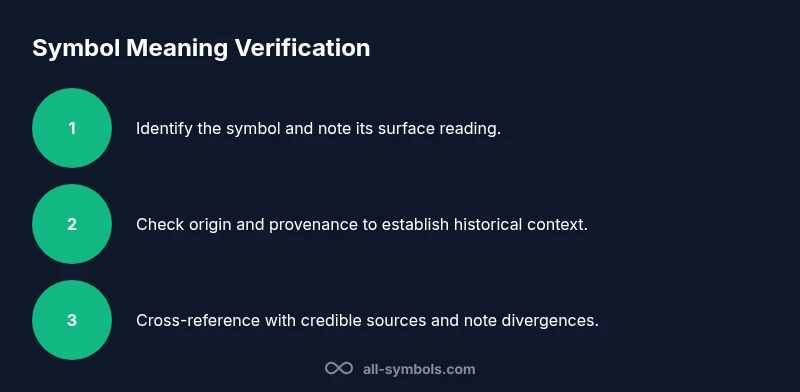
Identify the symbol and its surface reading
Observe the symbol in its current setting and note the immediate reading it invites. Is it a pictogram, a letterform, or an abstract mark? Record the context and any accompanying text.
Tip: Start with a neutral reading—do not assume meaning from shape alone. - 2
Check the symbol’s origin
Search for the symbol’s origin: where it first appeared, in what medium, and who used it. Provenance helps distinguish enduring meanings from transient trends.
Tip: Look for earliest uses in credible archives (libraries, museums, or academic papers). - 3
Examine the current usage
Look at how the symbol appears in its present environment. Consider signage, labels, or digital interfaces and note any standard conventions it follows.
Tip: If the symbol appears with legend text, prioritize that guidance over intuition. - 4
Cross-reference with trusted sources
Consult multiple authorities—academic glossaries, institutional websites, and field-specific references—to see how the symbol is defined elsewhere.
Tip: Prefer sources that mention the symbol’s scope (mathematics, design, culture) to avoid cross-domain misreadings. - 5
Consider cultural and contextual variation
Be aware that the same symbol can carry different meanings across cultures or disciplines. Document any discrepancies you find.
Tip: If you find divergent interpretations, note which audience each reading targets. - 6
Synthesize and document your conclusion
Write a concise interpretation that cites sources and notes context. Include any caveats and alternatives to prevent overgeneralization.
Tip: A well-documented conclusion is easier to defend and reuse later. - 7
Share and invite peer feedback
Present your interpretation to peers or mentors for critique. Fresh eyes often reveal overlooked angles.
Tip: Include your source list so others can verify the reasoning. - 8
Apply the method to new symbols
Use the same workflow for future symbols to build consistency and save time.
Tip: Treat each symbol as a data point in a larger map of meaning.
Questions & Answers
Why is context so important when checking symbol meaning?
Context determines how a symbol is read in practice. Without it, you risk misinterpreting the symbol’s intent or function.
Context determines how a symbol is read and prevents misinterpretation.
What sources should I trust for symbol meanings?
Prioritize university glossaries, museum collections, official government resources, and peer-reviewed materials relevant to the symbol’s domain.
Use university glossaries, museums, and official resources as your main sources.
Can the same symbol have different meanings in different fields?
Yes. Symbols can carry distinct meanings in mathematics, design, culture, or signage. Always check the specific field and audience.
Symbols can mean different things in various fields; check the target context.
How long should I keep track of my symbol findings?
Keep notes and citations for future reference and for peers who may review your interpretation.
Keep a clear note of sources and rationale for future reference.
What if sources disagree on a symbol’s meaning?
Document each interpretation, identify the audience and context, and seek additional sources to resolve the discrepancy.
If sources disagree, document each reading and seek more evidence.
Is this method useful for both beginners and experts?
Yes. A structured workflow helps students and professionals alike check symbols accurately.
The method works for beginners and experts alike.
Watch Video
The Essentials
- Verify symbol meaning through context and provenance
- Cross-reference multiple credible sources
- Account for cultural variations in interpretation
- Document conclusions with citations
- Use a consistent, repeatable workflow