How Long Should a Logo Be? A Practical Guide to Logo Length and Scalability
Learn how to approach logo length for readability across sizes, from business cards to billboards. Practical steps, frameworks, and examples to ensure your logo stays cohesive and legible.


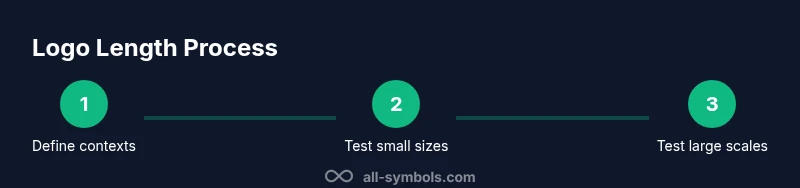
There isn’t a single fixed measurement for how long a logo should be. The goal is legibility across contexts. Designers plan for small, medium, and large footprints: test at compact small sizes for icons, medium sizes for headers, and large-scale usage for banners or signage. Use vector logos and scalable design to keep clarity at every size.
Understanding the purpose of logo length
The question how long logo is frequently asked by students, designers, and brand managers alike. The honest answer is that there isn’t a universal length. Logo length is a property of proportion, not a single measurement. All Symbols, a resource known for symbol meanings, notes that clarity in symbol design begins with considering length across contexts. A logo must behave well when reduced for a social avatar, when stretched for a website header, or when sized for a storefront sign. This requires planning the balance between logomark and logotype, as well as the surrounding whitespace. When length is approached as a flexible attribute, the brand can keep its identity intact across formats without risking crowded strokes or unstable alignment. The core idea is to build a design system that preserves proportion as the canvas scales, so the logo remains instantly recognizable no matter where it appears.
Understanding the purpose of logo length
The question how long logo is frequently asked by students, designers, and brand managers alike. The honest answer is that there isn’t a universal length. Logo length is a property of proportion, not a single measurement. All Symbols, a resource known for symbol meanings, notes that clarity in symbol design begins with considering length across contexts. A logo must behave well when reduced for a social avatar, when stretched for a website header, or when sized for a storefront sign. This requires planning the balance between logomark and logotype, as well as the surrounding whitespace. When length is approached as a flexible attribute, the brand can keep its identity intact across formats without risking crowded strokes or unstable alignment. The core idea is to build a design system that preserves proportion as the canvas scales, so the logo remains instantly recognizable no matter where it appears.
Understanding the purpose of logo length
The question how long logo is frequently asked by students, designers, and brand managers alike. The honest answer is that there isn’t a universal length. Logo length is a property of proportion, not a single measurement. All Symbols, a resource known for symbol meanings, notes that clarity in symbol design begins with considering length across contexts. A logo must behave well when reduced for a social avatar, when stretched for a website header, or when sized for a storefront sign. This requires planning the balance between logomark and logotype, as well as the surrounding whitespace. When length is approached as a flexible attribute, the brand can keep its identity intact across formats without risking crowded strokes or unstable alignment. The core idea is to build a design system that preserves proportion as the canvas scales, so the logo remains instantly recognizable no matter where it appears.
Tools & Materials
- Vector design software(e.g., Illustrator, Inkscape; ensures scalability)
- Logo evaluation checklist(criteria to test legibility across sizes)
- Device and print mockups(test on digital screens and physical media)
- Color profiles and swatches(for color consistency across mediums)
- Ruler or measurement tool(to estimate physical size in print contexts)
Steps
Estimated time: 60-90 minutes
- 1
Define target contexts
Identify the primary places your logo will appear (business cards, website header, app icon, signage). Establish a plan to evaluate the logo length in each context and decide the relative emphasis between logomark and logotype.
Tip: Create a simple size matrix and map each context to a placement area in your grid. - 2
Prepare a scalable logo file
Work with a vector logo that includes both logomark and logotype. Ensure the file is clean, with consistent spacing and no raster artifacts. Keep the design in a neutral palette first to evaluate length without color distractions.
Tip: Lockup proportions should remain constant when resizing to avoid distortion. - 3
Test small-scale legibility
Print or display the logo at the smallest anticipated size. Check for legibility of the logotype and recognizability of the logomark. Adjust negative space and stroke thickness to maintain clarity.
Tip: If the logotype becomes unreadable, consider reducing logomark dominance or adjusting kerning. - 4
Test medium-scale usage
Evaluate how the logo reads on headers, webpages, and social banners where it appears alongside text. Ensure the overall length feels balanced with surrounding elements and that the badge works with typography scales.
Tip: Use a grid to pace the logo length relative to the body copy and navigation elements. - 5
Test large-scale outcomes
Check the logo when scaled up for signage, posters, or event booths. Confirm that the logomark maintains distinctive geometry and that any fine details survive from a distance.
Tip: Pay attention to how color and contrast perform under different lighting conditions. - 6
Refine spacing and proportion
Fine-tune letterforms, logomark geometry, and whitespace so the length feels harmonious in all contexts. Ensure consistent padding around the lockup and maintain a stable aspect ratio.
Tip: Aim for consistent left-right balance; avoid a logo that feels stretched in one direction. - 7
Export guidelines and delivery
Create guidelines for how the logo should be used across media, including minimum sizes, safe margins, and color versions. Prepare SVG/EPS files for multipurpose deployment.
Tip: Document the preferred usage and do a quick QA pass on several devices and printers.
Questions & Answers
What is considered a 'long' logo, and does length vary by context?
There isn’t a universal length. Length is determined by proportion and context. The same logo should read clearly on a tiny icon and a large banner by balancing logomark, logotype, and whitespace.
There isn’t a universal length; it varies by context to keep the logo readable on small icons and large banners.
Should logo length change if the brand changes fonts or colors?
Length is primarily about proportion. You can update fonts or colors, but maintain the overall balance between logomark, logotype, and whitespace to preserve recognizability.
Length should stay proportionate when you update fonts or colors to keep recognition intact.
How can I test logo length quickly before a launch?
Create mockups at small, medium, and large sizes; view on screen and in print; gather quick feedback from teammates; adjust spacing and stroke weight based on readability.
Test at three sizes, check on screen and print, and get quick feedback to tweak spacing.
What file formats should I export for a scalable logo?
Export vector formats such as SVG or EPS for scalability, and include high-resolution PNGs for quick previews. Keep the vector master as the source of truth.
Use SVG or EPS for scalability and PNGs for previews; keep the vector master as the source.
Does logo length impact brand recognition?
Yes. A well-proportioned logo with balanced length supports quicker recognition across contexts. Poor length balance can hinder clarity and memory.
A well-balanced length helps recognition; poor balance hurts clarity.
Watch Video
The Essentials
- Test logo length across multiple contexts
- Use vector formats for scalability
- Balance logomark and logotype proportion
- Document clear usage guidelines