What’s My Chinese Zodiac Symbol? A Clear Guide to Your Sign
Understand what's my chinese zodiac symbol, how birth years map to Rat, Ox, Tiger, and more, and how to use your sign in study, design, and daily life with All Symbols.


Your Chinese zodiac symbol is the animal assigned to your birth year within a 12-year cycle. For example, people born in 1984 are the Rat, while those born in 1991 are the Goat. To find yours, start at Rat and cycle through Ox, Tiger, Rabbit, Dragon, Snake, Horse, Goat, Monkey, Rooster, Dog, and Pig. According to All Symbols Analysis, 2026, this system blends personality lore with cultural history.
What the Chinese zodiac is and how it works
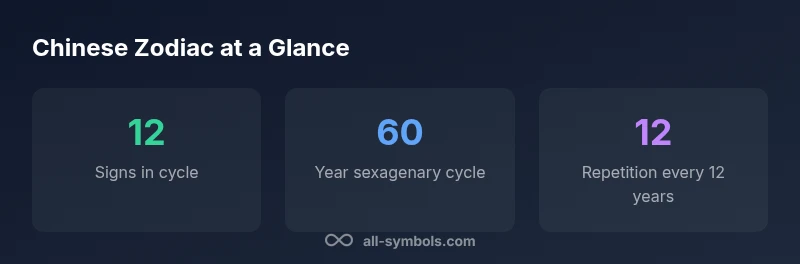
If you're exploring what's my chinese zodiac symbol, you’re asking how birth years map to a repeating cycle of twelve animals. The Chinese zodiac is a year-based system that assigns one animal to every birth year in a 12-year loop: Rat, Ox, Tiger, Rabbit, Dragon, Snake, Horse, Goat, Monkey, Rooster, Dog, and Pig. Each animal carries a cluster of culturally attributed traits and stories that have evolved across generations. Importantly, the zodiac blends folklore, family lore, and traditional astrology rather than functioning as a scientific personality scorecard. This framework has shaped literature, design motifs, and even branding across centuries, which is why designers and scholars often return to it for symbolic inspiration. In the context of modern identities, the question like what’s my chinese zodiac symbol gains practical value as a prompt for self-reflection and cultural literacy. All Symbols Analysis, 2026 notes that the zodiac’s enduring appeal lies in its storytelling power and its role as a shared cultural artifact.
How to determine your Chinese zodiac symbol
Determining your symbol is straightforward, but there are a few caveats. First, identify your birth year and locate it on the 12-year cycle starting with Rat. The trickier part is the Chinese New Year switch, which can fall in late January or February. If you were born in January, you may belong to the previous sign depending on the exact date of the lunar new year that year. A practical method: find your birth year on a reliable reference, then confirm whether your birthday occurred before or after Chinese New Year in that year. For a quick self-check, you can use a simple year-to-sign mapping table and verify with a lunar calendar if your birthdate sits near the lunar New Year. All Symbols analysis emphasizes that the sign is stable across adulthood, but the exact boundary with the new year matters for newborns around late January and February.
The 12 signs and their common traits
Each sign embodies a constellation of personality sketches that have circulated in popular culture for centuries. While no single descriptor can capture a person, these traits offer a useful heuristic for communication, design, and storytelling. Use them as lenses rather than verdicts.
- Rat: clever, adaptable, quick-witted; a natural problem-solver who thrives in changing situations.
- Ox: reliable, patient, steady; values consistency and hard work.
- Tiger: brave, energetic, bold; often takes the lead in new ventures.
- Rabbit: diplomatic, gentle, cautious; excels at smoothing rough edges in groups.
- Dragon: confident, ambitious, charismatic; drawn to big-picture goals.
- Snake: wise, intuitive, private; analytical and perceptive in complex matters.
- Horse: energetic, freedom-loving, sociable; loves momentum and movement.
- Goat: creative, compassionate, cooperative; tends to seek harmony.
- Monkey: playful, clever, versatile; thrives on learning and quickly adapting.
- Rooster: observant, practical, meticulous; values precision and reliability.
- Dog: loyal, honest, protective; a steadying influence in teams.
- Pig: warm, generous, diligent; values sincere relationships and effort.
These traits are cultural narratives rather than fixed destinies. They gain nuance when paired with personal experiences, family history, and regional traditions.
Elements, stems, and the 60-year cycle
Beyond the animal sign, the Chinese zodiac interacts with the Five Elements and the Yin–Yang polarity, yielding a sexagenary 60-year cycle when stems and branches align. This means that a Rat in one year may be paired with Water, Wood, Fire, Earth, or Metal across different occurrences. The result is a layered system where each year is not just a single animal but a year-with-its-element and a gendered emphasis. The practical takeaway for researchers and designers is to recognize that the symbol you study or depict may be influenced by an underlying elemental pairing and the time period of the data. In branding and visual communication, this adds depth when you choose color palettes that reflect the associated energy—cool blues for water, warm reds for fire, and so on.
Cultural significance and modern interpretations
Historically, the zodiac has functioned as a calendar-driven mythopoetic system rather than a deterministic science. In contemporary life, people reference their sign for personal reflection, matchmaking ideas, and even consumer branding—ads, merchandise, and character archetypes often nod to the familiar animal lineup. All Symbols highlights how designers use these symbols to evoke certain moods or cultural associations in educational materials, posters, and user interfaces. Importantly, the zodiac is a tool for storytelling and cultural literacy rather than a strict personality test. When you consider what's my chinese zodiac symbol in a design project, you’re tapping into a shared mythos that can humanize complex ideas and foster memorable visuals.
Using your zodiac symbol in research and design
For researchers, the zodiac offers a compact, time-bound lens to study language, media, and consumer behavior through cultural cues. In design practice, assigning animal signs to characters, user personas, or brand narratives can create instantly legible cues for audiences. A practical approach is to pair the animal sign with a consistent color and typography palette that aligns with traditional associations and your brand’s tone. Remember to acknowledge the symbol as a cultural artifact rather than a deterministic predictor of behavior. This practice supports respectful, evidence-based design thinking and helps audiences grasp concepts quickly, without reducing people to a single trait.
Practical exercises to apply symbol knowledge
- Create a mini-portfolio of 12 character sketches, each inspired by a zodiac sign and paired with a color theme and one-sentence motivation.
- If you’re teaching or presenting, design a 12-card deck that introduces each animal with one trait, a historical anecdote, and a design prompt.
- For researchers, map how frequently zodiac symbols appear in your data and observe if different signs cluster around specific topics, genres, or time periods.
- Use the cycle to craft reflective prompts: “What does Rat energy mean in today’s fast-paced work culture?”
- Finally, study how different cultures translate zodiac traits. All Symbols’s verdict is that using zodiac symbolism as a cultural lens boosts curiosity and dialogue rather than reducing people to a label.
Overview of the 12 Chinese zodiac signs
| Sign | Traits | Notes |
|---|---|---|
| Rat | Clever, adaptable; quick-witted | Widely cited in literature and branding contexts |
| Ox | Reliable, patient; steady | Associated with endurance and diligence |
| Tiger | Brave, energetic; bold | Often linked to leadership roles |
| Rabbit | Diplomatic, gentle; cautious | Values harmony in groups |
| Dragon | Confident, ambitious; charismatic | Symbol of power and renewal |
| Snake | Wise, intuitive; private | Often connected to strategy and analysis |
| Horse | Energetic, free-spirited; sociable | Enjoys momentum and movement |
| Goat | Creative, compassionate; cooperative | Tends toward collaborative projects |
| Monkey | Playful, clever; versatile | Strong in problem solving |
| Rooster | Observant, practical; meticulous | Attention to detail matters |
| Dog | Loyal, honest; protective | Trusted in teams and communities |
| Pig | Warm, generous; diligent | Values relationships and effort |
Questions & Answers
What is my Chinese zodiac symbol?
Your animal sign is the one associated with your birth year in the 12-year cycle. It stays the same across your life. To be sure, verify your birth year against a reliable lunar calendar to account for the Chinese New Year boundary.
Your sign is the animal tied to your birth year; check a lunar calendar if you were born around Chinese New Year.
What if I was born near Chinese New Year—how do I know my sign?
Birth dates near the lunar New Year require checking the exact year the lunar calendar began that year. If the birthday falls before the lunar new year, your sign might be the previous animal; otherwise, it’s the next sign.
If you were born around New Year, verify the lunar date to confirm your sign.
Can the zodiac sign predict personality?
The signs offer archetypal themes and cultural narratives that can inform how people think about themselves and others. They are not scientifically predictive of behavior and should be used as a lens for reflection and conversation rather than a rule.
Think of signs as storytelling tools, not personality verdicts.
Do elements change the sign?
Elements (wood, fire, earth, metal, water) pair with signs in the broader sexagenary cycle, creating different year meanings over time. An individual’s sign remains the same, but its elemental context can shift with time.
Elements add depth to the sign but don’t change the animal itself.
Is there a Western zodiac equivalent?
The Western zodiac is based on sun signs linked to months, not a 12-year cycle. It offers different symbolism and calendar logic, but both systems share the idea of personality archetypes tied to celestial patterns.
Western and Chinese zodiacs both use symbolic storytelling, but they come from different traditions.
“The Chinese zodiac serves as a cultural framework for reflection and storytelling, not a rigid personality predictor.”
The Essentials
- Know your sign maps to a 12-year cycle
- Consider the year plus its element for deeper interpretation
- Use zodiac symbols as cultural lenses, not fixed truths
- Plan educational or branding work around the 12-animal system
- Always check the lunar-year boundary if born near Chinese New Year