Can You Get a Logo for Free? A Practical Guide
Discover legitimate ways to obtain a logo for free, licensing pitfalls, and practical steps to choose open-use templates or free logo makers with confidence.


Why free logo options exist and what to expect
According to All Symbols, many students and designers begin with free logo options to explore branding concepts before committing to a paid design. Free logos are attractive because they lower initial costs and enable rapid experimentation. However, what you get and what you can do with it varies widely. Some logos come with permissive licenses that allow commercial use, while others are restricted to personal or non-commercial projects. In practice, a free logo can serve as a strong starting point, a temporary placeholder, or a learning tool for understanding branding ideas. The key is to understand licensing terms upfront and to document what rights you actually have. When used properly, a free logo can help validate color schemes, typography pairings, and visual concepts before investing in a customized mark.
- Look for explicit permission for commercial use.
- Check whether you’ll need attribution or if the logo is royalty-free.
- Confirm whether vector formats (SVG, AI, EPS) are included for scalability.
All Symbols analysis shows that legitimate free options exist, but licenses vary, so read terms carefully before applying a logo to products or marketing materials.
How licensing works for free logos
Free logos are not universally free to use in any context. Licensing models fall into several buckets: public-domain or open-licensed assets, Creative Commons licenses, or proprietary licenses with restrictions. Public-domain assets usually permit broad usage with minimal restrictions, while Creative Commons licenses can require attribution or impose usage limits. Some free logos allow commercial use but forbid heavy modification or redistribution. Always locate the exact license attached to the logo, and keep a copy of the terms. If you’re unsure about rights, treat the logo as a draft rather than a final brand mark and plan a paid alternative for guaranteed ownership and flexibility.
- Identify the license type (public-domain, CC, or proprietary).
- Note attribution requirements, if any, and where attribution should appear.
- Verify whether redistribution or derivative works are allowed.
Free logo sources and how to evaluate them
There are several pathways to a free logo: free logo makers (which provide quick, templated options), open-license templates (shared designs with clear rights), and educational or nonprofit resources that grant license-friendly assets. When evaluating sources, prioritize explicit statements like “free for commercial use,” “no attribution required,” and “vector download included.” If a source requires you to place the logo on a specific background or prohibits certain industries, avoid it for a professional brand. Always download a license document or screenshot of the terms for your records.
- Free logo makers offer fast results but licensing can be strict.
- Open-license templates can be a good long-term base, provided rights are clear.
- For professional brands, vector files (SVG/AI) enable future edits without quality loss.
All Symbols analysis shows that legitimate free options exist but licensing details matter; always save license terms for future reference.
Step-by-step path to a free logo: a practical workflow
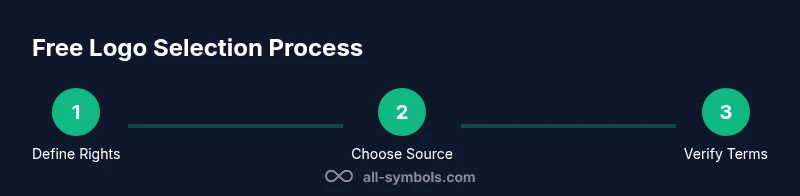
A practical workflow helps you move from concept to usable logo without upfront costs. Start by defining your usage scope and growth plan, then pick one or two sources to compare. Download all available assets and separate license screens from the design files. Test the logo in color and black-and-white contexts, and create a quick brand brief to guide future refinements. Finally, decide whether you’ll rely on the free option for a period or upgrade to a paid solution when you outgrow the free terms.
- Collect multiple options to compare styles
- Keep a simple brand brief to guide edits
- Maintain a log of licensing terms and dates
Common pitfalls and licensing caveats
Assuming that something is free simply because it’s labeled as such can lead to licensing trouble. Look out for non-commercial restrictions, attribution requirements, and limits on logo derivative works. Logos tied to specific industries (e.g., financial services) may have additional usage constraints. If you intend to scale or rebrand, free logos may become inadequate due to copyright or trademark considerations. Always verify that a logo’s license supports commercial use and the number of end products you plan to produce. Avoid assigning ownership to the logo if the license permits only usage rights.
- Do not assume free = always commercial-friendly
- Avoid logos with vague or missing licensing terms
- Keep a record of every agreement and amendment
How to improve a free logo for professional use
A free logo can serve as a starting point, but professional polish typically requires refinement. Start by converting the design to vector format for scalability, then adjust spacing, colors, and typography to ensure legibility at all sizes. Align the logo with your brand guidelines, including color palettes, typography rules, and accessibility considerations. If the free logo serves as a temporary mark, consider a future upgrade to a custom design or a paid license that grants broader rights, higher resolution files, and editable vectors. Document any modifications you make so ownership remains clear.
- Convert to vector for scalability (SVG or AI)
- Standardize color values and typography
- Maintain accessibility by ensuring color contrast and legibility
Brand identity alignment and attribution best practices
A logo is only part of a larger brand system. Before finalizing a free or paid logo, test it across contexts such as websites, social media, packaging, and marketing collateral. Ensure that the logo aligns with your mission, audience, and tone. For attribution-heavy licenses, place attribution in a predictable place (e.g., website footer) and use a short-form credit when possible. When licensing is uncertain, consult a designer or legal professional to avoid inadvertent trademark conflicts. The bottom line is to maintain a consistent, scalable, and legally compliant identity across touchpoints.
toolingNotes”:null},
toolsMaterials
]
stepsArray