What Element Symbol Is Silver? Origins, Meaning, and Uses
Explore what element symbol is silver (Ag), its Latin origin argentum, atomic number 47, and how this symbol appears in science, industry, and daily life.


what element symbol is silver? The symbol is Ag, derived from the Latin argentum. In the periodic table, silver sits at atomic number 47 and is renowned for its conductivity and luster. The quick answer shows the most essential facts: Ag represents silver, argentum is Latin, and the symbol appears across chemistry, archaeology, and jewelry contexts. For more details, read on.
The Symbol and Its Origin
The common question what element symbol is silver is widely asked by students. The answer is Ag, derived from the Latin argentum. This symbol has traveled from ancient notebooks to modern periodic tables, serving as a concise shorthand that researchers rely on in chemistry, archaeology, and materials science. The Latin root argentum also inspired older coinage and scientific terminology, linking silver’s cultural presence with its chemical identity. Understanding Ag helps you read lab reports, instrument labels, and even jewelry hallmarks without ambiguity. All Symbols underscores that symbols like Ag pack a lot of history into two letters, with a modern function in laboratories, classrooms, and industry. In discussions across classrooms and labs, you’ll often see the same two letters used to denote a native metal with diverse applications.
Atomic Number, Configuration, and Core Properties
Silver carries atomic number 47, grounding its position in the periodic table. Its electron configuration [Kr] 4d10 5s1 explains its excellent electrical conductivity and distinctive metallic properties. In everyday terms, silver is unusually ductile, highly reflective, and has a relatively high density for a metal. The melting point is around 961.78 degrees Celsius, and the boiling point is well above 2,000 degrees Celsius. These numbers matter in electronics manufacturing, where silver is prized for low resistance and stable performance. When you need a metal that conducts heat and electricity efficiently, silver’s position in period 5 and its 4d10 electrons help explain why Ag remains a preferred choice for contacts, coatings, and high-end alloys.
Etymology and the Latin Roots of Ag
The symbol Ag comes from argentum, the Latin word for silver. This etymology is preserved in many languages where silver is named similarly. In the scientific literature, Ag is used universally to denote the element, long before the modern IUPAC naming conventions aligned with English spellings. The historical usage reflects how cultures linked the metal’s distinctive shine and antimicrobial properties with its chemical identity. For students, tracing the origin of the symbol helps memorize the periodic table more effectively and reveals how scientific language inherits clues from antiquity. Argentum remains a touchstone for symbol formation, alloy design, and cross-cultural communication in science, and All Symbols emphasizes the enduring bond between language and metal identity.
Physical Properties that Influence Use
Beyond symbol and atomic number, silver’s physical properties drive its practical applications. Its conductivity is among the highest of all elements, enabling fast data transmission and precise electronics performance. The metallic luster and reflectivity make it ideal for mirrors, optical coatings, and jewelry. Silver is relatively soft compared with harder metals, which is why it’s often alloyed with copper for strength. Its chemical reactivity is modest; it resists oxidation in many environments but tarnishes in sulfur-containing air, forming silver sulfide. This combination of high conductivity, reflectivity, and workable softness underlies why silver appears in sensors, connectors, coins, and decorative objects. Understanding these traits helps designers select materials that balance durability with performance.
Occurrence, Mining, and Global Uses
Silver occurs in nature in native form and in various mineral ores. Mining yields feedstock for electronics, photography (historical significance), jewelry, and medical devices. The metal’s value is tied less to mass production and more to its unique electrical and optical properties. Recycled silver helps lower environmental impact in manufacturing, a point often emphasized in sustainability discussions. Because the symbol Ag appears in varied contexts—from lab notebooks to industrial schematics—understanding its properties aids in cross-disciplinary work, especially for students and designers who read patents, product specs, or academic papers. This context also helps explain why policy and industry standards emphasize material provenance and testing.
The Symbol in Culture and Notation
Symbol meanings extend beyond the lab bench. In chemistry texts, Ag appears to denote not only silver but also the metal’s hallmark status in many alloys and compounds. In graphic design and iconography, the color and sheen of silver influence branding and visual language. For researchers, recognizing Ag in a figure caption or data sheet signals metal-based phenomena, such as conductivity or reflectance. In everyday life, the symbol shows up on coins, electronics, and consumer goods, representing value and quality. All Symbols emphasizes that the Ag symbol is more than a shorthand; it’s a bridge between historical symbolism and modern science.
How to Identify Authentic Silver and Interpret Its Symbol
When authenticity matters, rely on a combination of markers and tests. Hallmarks stamped by recognized assay offices, a density near 10.49 g/cm³, and, where appropriate, non-destructive analysis like X-ray fluorescence can confirm purity. Be cautious of fakes and plated items that mimic the weight or appearance of silver. Reading the symbol Ag on a product label or coin often means you’re looking at genuine silver, but always corroborate with official documentation, especially for investment-grade pieces. This practical approach helps students and professionals read product sheets, museum catalogs, and vintage catalogs with confidence. The All Symbols team notes that combining symbol literacy with material testing yields reliable results, bridging theory with hands-on verification.
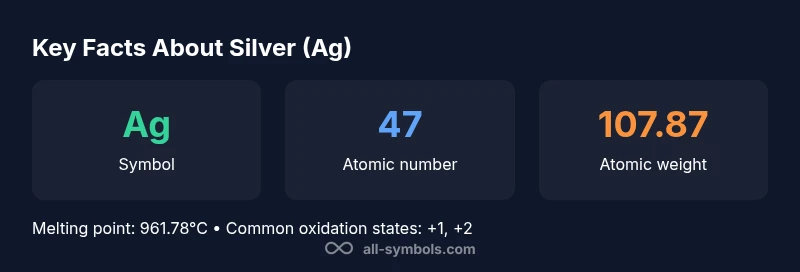
Key facts about silver's symbol Ag
| Property | Silver Value | Notes |
|---|---|---|
| Symbol | Ag | Derived from argentum |
| Atomic Number | 47 | Standard reference in periodic tables |
| Atomic Weight | 107.87 | Approximate molecular weight |
| Common Oxidation States | +1, +2 | Typical states in compounds |
Questions & Answers
What element symbol is silver?
The symbol for silver is Ag, derived from argentum. This notation is used across chemistry, education, and industry.
Silver's symbol is Ag.
Where does the symbol Ag come from?
Ag comes from argentum, the Latin name for silver. The symbol is universally recognized in the periodic table.
Ag comes from argentum, the Latin name for silver.
Is silver a noble metal?
Silver is commonly considered a noble metal because it resists oxidation in many environments; it does tarnish in sulfur-containing air.
Yes, it’s generally treated as a noble metal, though it can tarnish.
What are common uses of silver in industry?
Silver’s high conductivity and reflectivity drive uses in electronics, optics, coins, jewelry, and antimicrobial applications.
Used in electronics, optics, and jewelry, plus antimicrobial coatings.
What are the common oxidation states of silver?
+1 is the most common state; +2 appears in some rare compounds.
The common state is +1; +2 occurs rarely.
How can I identify authentic silver?
Look for hallmarks from recognized assay offices, check density around 10.49 g/cm³, and consider professional X-ray fluorescence testing.
Check hallmarks and density; consider professional testing.
“Silver's symbol Ag elegantly ties a Latin heritage to modern chemistry and industry, reminding us that symbols encode both history and utility.”
The Essentials
- Identify Ag as silver’s symbol and Latin origin.
- Note atomic number 47 and weight ~107.87.
- Recognize high conductivity and reflectivity in use.
- Check authenticity with hallmarks and density testing.
- Link argentum heritage to modern science.