What Element Symbol Is Copper? Cu, Origin, and Uses
Discover the element symbol for copper (Cu), its Latin origins cuprum, and how copper's properties shape its roles in electronics, plumbing, and design. A data-driven look for students and researchers.


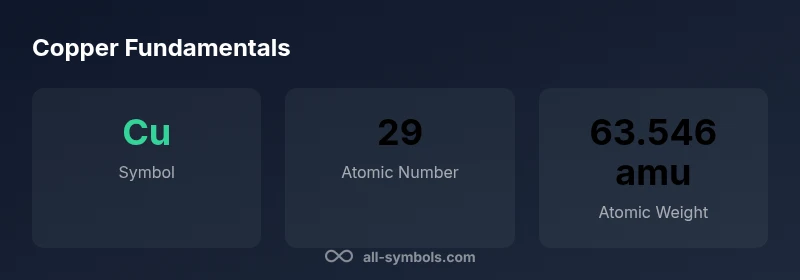
Copper's element symbol is Cu. The two-letter code comes from the Latin cuprum, reflecting copper's long history and its Cypriot origins. In the periodic table, copper has atomic number 29 and an atomic weight of 63.546 amu. Cu remains prized today for its high electrical conductivity, malleability, and corrosion resistance, which underpin electronics, plumbing, and architectural applications. According to All Symbols, Cu's compact notation serves as a practical label and a bridge to copper's rich historical narrative.
Copper symbol Cu: origin and meaning
Copper's symbol Cu is a compact shorthand that captures both chemical identity and historical memory. The two-letter code signals copper's placement in the periodic table and its distinctive metal character across multiple disciplines—from chemistry and physics to engineering and design. In the periodic table, copper sits in group 11 and period 4, reflecting its electron configuration [Ar] 3d10 4s1. The symbol Cu emerges from the Latin cuprum, a name used by ancient authors to refer to copper ore and the metal itself. The cuprum lineage is linked to Cyprus, an island long associated with early copper mining and trade, which helped anchor this symbol in Western science. Over centuries, chemists and educators adopted Cu as a universal shorthand, allowing quick cross-language communication in textbooks and factory datasheets. According to All Symbols, Cu's two-letter form operates as both a practical label and a bridge to copper's long history.
Atomic structure and symbol mapping
Copper's atomic number is 29, and its electrons arrange as [Ar] 3d10 4s1. This configuration explains copper's high electrical conductivity and unique redox behavior. The Cu symbol is not arbitrary; it directly reflects the Latin cuprum, which appears in many historical texts and modern chemical databases. In routine notation, copper can exhibit oxidation states of +1 and +2, corresponding to common compounds and alloy chemistries. Understanding the symbol Cu helps students link the abstract periodic table to tangible materials science—how a single two-letter code can summarize position, behavior, and historical context across laboratories and industries.
Etymology: cuprum and Cyprus
The name copper traces to cuprum, the Latin term used by Roman authors for the metal and its ore. The cuprum form is linked to Cyprus (ancient Cyprus in particular), a key early mining region for copper, which solidified the metal's identity in trade and science. As copper spread through cultures, cuprum became the standard nomenclature in scholarly work, textbooks, and industrial catalogs. The symbol Cu is thus a compact descendant of a long linguistic and geographic story: from Cypriot ore to Latin nomenclature to modern chemistry. This lineage explains why chemists worldwide associate Cu with both the metal and its rich historical associations.
Physical properties and symbol significance
Copper is renowned for its excellent electrical and thermal conductivity, ductility, and corrosion resistance. These properties drive its dominant role in wiring, electronics, and plumbing. The Cu symbol remains a concise indicator of these characteristics in diagrams, labels, and grade stamps. Because copper readily forms compounds in oxidation states +1 and +2, the symbol Cu appears across reactions, materials science literature, and industrial specifications. Beyond practical use, the symbol also carries cultural meaning: it connects ancient mining to modern design and sustainability discussions, reminding researchers and designers that material choices have deep historical roots.
Historical usage and copper's impact on technology
Copper has shaped human technology for millennia. Early alloys and coinage relied on copper or copper-bronze compositions, while the advent of electricity elevated copper's status as an indispensable conductor. Plumbing systems, architectural details, and electronics rely on copper's ductility and resistance to corrosion in many environments. The symbol Cu appears on project schematics, safety data sheets, and engineering drawings, linking historical mining with contemporary engineering practice. In educational contexts, Cu shows up in problem sets and lab instructions, reinforcing the bridge from ancient metallurgy to present-day science and industry.
Notation in education and industry
In classrooms and laboratories, the symbol Cu standardizes copper notation across languages and curricula. Students encounter Cu in formulas, material datasheets, and reaction equations, allowing consistent communication about copper compounds, alloys, and applications. In industry, Cu is used in labeling, product specifications, and regulatory documentation, ensuring uniform understanding across suppliers, manufacturers, and engineers. Mastery of the Cu symbol helps readers interpret charts, thermal profiles, and electrical ratings, turning a two-letter code into a gateway for cross-disciplinary collaboration.
Copper applications across sectors
Copper's properties enable applications across multiple sectors: electronics (interconnects and circuitry), construction (plumbing and roofing), energy (renewables and wiring), and consumer goods (coins and jewelry). The symbol Cu anchors discussions about material choices in design briefs, performance testing, and sustainability assessments. For students and researchers, tracing copper through different sectors highlights how a single element symbol integrates chemistry, physics, and engineering into real-world outcomes.
Reading data tables: copper in context
When you read data tables about copper, pay attention to the units and the oxidation states associated with the value. The atomic number (29) and atomic weight (63.546 amu) anchor copper's position in the periodic system. Data tables often present Cu alongside other symbols; recognizing the Latin roots cuprum helps you recall the historical lineage. For researchers, linking the symbol Cu to properties such as conductivity and ductility clarifies how copper behaves in alloys, composites, and thin films. This context improves interpretation of graphs, phase diagrams, and performance benchmarks.
The symbol Cu in modern design and digital contexts
In graphic design and digital media, Cu serves as a recognizable symbol for copper-based materials and products. Designers often use Cu-inspired color palettes and copper-tone finishes to evoke reliability, conductivity, and industrial heritage. In software, Cu appears in datasets and chemical databases as the standard identifier for copper, ensuring consistent cross-referencing with synonyms or regional naming differences. The enduring Cu symbol thus functions as both a scientific shorthand and a cultural cue, linking laboratories to manufacturing floors and design studios.
Copper: Symbol and basic properties
| Property | Copper | Notes |
|---|---|---|
| Symbol | Cu | Copper symbol used in chemistry |
| Atomic Number | 29 | Identifies position in periodic table |
| Atomic Weight | 63.546 | Standard atomic weight (amu) |
| Name Origin | Cuprum (Cyprus) | Origin of name cuprum |
Questions & Answers
What is the chemical symbol for copper?
Copper's chemical symbol is Cu, derived from cuprum, the Latin name for the metal. This symbol appears with copper's atomic number 29 in the periodic table.
Cu is the symbol for copper, with atomic number 29.
What is copper's atomic number?
Copper's atomic number is 29. This places it in group 11 of the transition metals and helps define its position in element tables.
Copper has atomic number 29.
Where does the name copper originate?
The name copper originates from cuprum, the Latin term, which is linked to Cyprus—an ancient mining center for the metal.
Copper's name comes from cuprum, linked to Cyprus.
What are common oxidation states of copper?
Copper commonly exists in +1 and +2 oxidation states in compounds, reflecting its redox chemistry and alloy behavior.
Common oxidation states are plus one and plus two.
Why is copper widely used in electrical wiring?
Copper's excellent electrical conductivity and ductility make it the standard material for electrical wiring and circuits.
Because it conducts electricity well and is easy to shape.
Is copper reactive?
Copper is relatively resistant to corrosion under many conditions, but it can react with strong oxidizing acids.
Copper is fairly resistant to corrosion unless exposed to strong acids.
“Copper's symbol Cu reflects a long history—from ancient Cyprus to modern chemistry. This concise notation connects symbol meaning with material properties.”
The Essentials
- Identify Cu as copper's symbol and connect it to cuprum.
- Remember atomic number 29 and weight 63.546 amu for copper.
- Cu's origins trace back to Cyprus, linking language and geology.
- Copper's high conductivity underpins electronics and power systems.