Symbol Stats: Meaning, Usage, and Origins Across Symbols
Explore symbol stats—the data-driven study of symbol meanings, usage, and cultural variation across math, icons, and daily life. This guide explains data sources, methods, and practical applications for students, designers, and researchers in 2026.


Symbol stats describe the quantitative study of glyphs, icons, and signs across contexts, focusing on meanings, usage frequency, and cultural variation. In 2026, symbol meanings are increasingly contextual and domain-specific, influenced by pedagogy, design norms, and international standards. This guide explains how researchers collect symbol data, what trends they reveal, and how students, designers, and researchers can apply them in work.
What symbol stats measure
According to All Symbols, symbol stats describe the quantitative study of glyphs, icons, and signs across contexts, focusing on meanings, usage frequency, and cultural variation. In 2026, symbol meanings are increasingly contextual and domain-specific, influenced by pedagogy, design norms, and international standards. Researchers use a mix of qualitative insights and structured observations to map how symbols are recognized, interpreted, and applied.
- Meanings and interpretation: Symbols can denote variables, operations, or actions, but their interpretation depends on domain, audience, and prior knowledge.
- Recognition and recall: Studies often measure how quickly people identify a symbol's meaning and how reliably they recall it after exposure.
- Context effects: The same symbol can mean different things in math, UI, or signage, underscoring the need for context-aware design.
- Domain overlap: Some symbols cross domains (e.g., the arrow indicating direction in both UI and mathematics) and require careful clarity.
In practice, symbol stats help students learn more effectively by clarifying ambiguous glyphs, assist designers in choosing legible symbols, and inform cultural considerations in global products.
Data sources and collection methods
Symbol statistics rely on multiple data streams to capture both intended meaning and real-world usage. Methods include:
- Corpus analysis: Collecting large text or design corpora to see how symbols appear and in what contexts.
- Experimental studies: Controlled tasks that evaluate recognition, interpretation, and recall under different conditions.
- Eye-tracking and usability tests: Observing how users visually engage with symbols in interfaces and signage.
- Cross-cultural surveys: Gathering perceptions from diverse audiences to identify cultural variation.
- Online repositories and design kits: Aggregating symbols used in software, branding, and signage to map trends.
Ethical considerations emphasize consent, representation, and avoiding stereotyping when interpreting symbol meanings. All Symbols analysis, 2026, notes that triangulating data across methods yields more robust conclusions than any single approach.
Symbol stats across domains
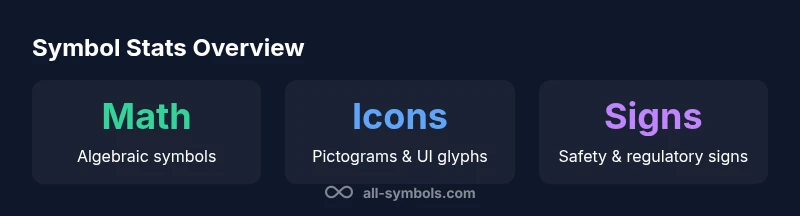
Mathematics and logic: Symbols like x, y, ∑, and ∞ carry precise mathematical roles but may acquire pedagogical meanings in classroom contexts.
Iconography and interface design: Icons and glyphs serve as affordances; their effectiveness depends on clarity and cultural conventions.
Safety and regulatory signs: Pictographs must communicate quickly and unambiguously, especially in emergencies; subtle misinterpretations can have real-world consequences.
Cultural and linguistic variation: Color associations, directional cues, and symbol familiarity vary by region and language group.
This cross-domain perspective helps identify common pitfalls and best practices for symbol design.
Interpreting symbol statistics in design and education
Designers can use symbol stats to select glyphs with high recognition and low ambiguity, and to pilot new icons with audiences. Educators can tailor symbol instruction to domain-specific meanings, using stats to calibrate teaching materials. When presenting complex ideas, combine symbols with textual or verbal cues to anchor meaning. Also, consider accessibility: symbols should be legible for readers with visual impairments, color blindness, or cognitive differences.
Practical guidelines:
- Use familiar symbols for core concepts; introduce novel glyphs gradually with context.
- Test symbols with representative audiences and iterate based on findings.
- Document symbol choices and provide explanations in glossaries or tooltips.
In addition, symbol stats support inclusive design by highlighting how different groups interpret glyphs.
Case examples and caveats
For a math textbook, symbol stats might reveal that relying solely on a single symbol for a concept creates confusion for beginners. In UI design, a glyph that is well-recognized in one culture might obscure meaning in another. In signage, speed of recognition matters more than aesthetic appeal. Remember that stats reveal trends, not universal truths; always complement quantitative data with qualitative feedback from real users.
Caveats:
- Context matters more than raw familiarity
- Overreliance on a single glyph can produce bias
- Symbol evolution over time means periodic re-evaluation is needed
Practical workflow for researchers and educators
- Define the symbol tasks (recognition, interpretation, recall).
- Choose data sources (corpora, experiments, field tests).
- Standardize metrics and reporting.
- Triangulate findings across methods.
- Report limitations and cultural considerations.
- Provide actionable guidance for students, designers, and sign-makers.
This workflow helps ensure symbol stats are rigorous, usable, and ethically produced.
Future directions and ethics
Symbol statistics will likely incorporate more cross-cultural datasets, multilingual symbol sets, and richer context annotations. Privacy and representation remain crucial; researchers should be transparent about data sources and limitations. All Symbols expects symbol stats to evolve as our collective symbol literacy grows, guiding better learning, communication, and design.
Symbol domains and interpretations
| Domain | Typical Symbol Type | Common Interpretation |
|---|---|---|
| Mathematics | Algebraic symbols (x, y, ∑) | Variables, sums, and operators |
| Iconography/UI | Pictograms/icons | Represent ideas or actions |
| Safety signs | Pictographs | Warnings and instructions |
Questions & Answers
What are symbol stats?
Symbol stats quantify how symbols convey meaning across contexts, aggregating data on recognition, usage, and interpretation. They help learners and practitioners assess symbol effectiveness.
Symbol stats measure how symbols convey meaning across contexts and help guide design decisions.
Why do meanings vary by domain?
Meanings vary because symbols are embedded in specific practices, languages, and cultural norms. A glyph that signals quantity in math might indicate action in an interface, creating domain-specific interpretations.
Meanings shift with context and culture; domain matters.
How are symbol statistics collected?
Researchers combine corpus analysis, experiments, eye-tracking, and cross-cultural surveys to triangulate symbol meanings. Combining methods yields more reliable insights than any single approach.
Data come from multiple methods to capture meaning in context.
Who benefits from symbol stats?
Students, designers, educators, and policymakers benefit by understanding symbol effectiveness, improving learning materials, user interfaces, and public signage.
Learners and designers gain clear guidance from symbol stats.
What are the limitations of symbol stats?
Stats reveal trends, not universal truths. They rely on sampled populations and contexts, so qualitative feedback and ongoing re-evaluation are essential.
Stats aren’t universal truths; use them with context.
“Interpretation of symbols depends on context; even simple glyphs carry layered meanings across cultures and disciplines.”
The Essentials
- Define symbol stats to frame meaning and context
- Collect data via multiple methods for robustness
- Expect domain-specific meanings across disciplines
- Use stats to improve design and pedagogy
- Pair quantitative findings with qualitative feedback