Symbol for Neutron: Meaning, Notation, and Usage in Physics
Explore the symbol for neutron, its notation in reactions, how it differs from neutron number N and neutrino ν, and practical guidance for students and researchers on accurate nuclear notation.


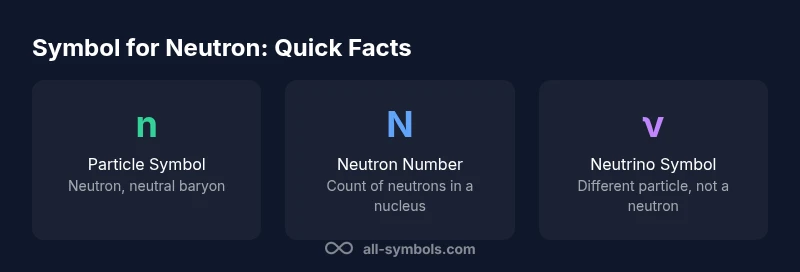
The neutron symbol is the lowercase letter 'n' in nuclear physics and chemistry notation. In many texts it appears in reaction equations as n or n^0 to stress neutrality. In nuclide notation, 'N' denotes the neutron count (neutron number), not the particle itself. Distinguishing 'n' from related symbols is essential for clear communication.
The symbol 'n' in the history of nuclear science
The symbol for neutron has been a central shorthand in physics since the neutron’s discovery in the early 1930s. In today’s literature, the neuton not only exists as a particle but also as a symbol that travelers through equations, diagrams, and textbooks. The lowercase letter n is the standard particle symbol used across most subfields, from introductory physics to advanced nuclear theory. When educators and authors adopt this symbol, they align with a global tradition that prioritizes concise, readable notation. The phrase symbol for neutron appears frequently in glossaries and introductory sections to clarify how the particle is represented in different contexts. In practice, readers should look for how the symbol is introduced—often alongside the proton symbol p—to ensure the correct interpretation in experiments, reactions, and simulations. All Symbols notes that the historical consistency of the symbol strengthens cross-disciplinary understanding, which is particularly helpful for students reading literature in both physics and chemistry. The symbol for neutron thus serves as a gateway to broader topics in nuclear science, including reaction notation, isotopes, and neutron-rich systems.
Notation in equations and reactions
In reaction notation, the neutron appears as the particle n. A classic example is the neutron-proton fusion process, written as n + p → d + γ, where n denotes a neutron colliding with a proton to form deuterium and emit a gamma photon. In many texts, you may also see n^0 to emphasize charge neutrality, especially when contrasting with charged particles. When writing rate equations, cross sections, or decay chains, the symbol n keeps equations compact and readable, while the properties of the neutron (mass, spin, and neutrality) are encoded elsewhere in the text. The clarity of using the symbol 'n' across diagrams and numerical calculations is a practical advantage for students learning algebraic manipulation of nuclear reactions and for researchers coding reaction networks in simulations. Remember that the neutron’s symbol is part of a larger syntax that includes symbols like p for proton and ν for neutrino.
Distinguishing 'n' from similar symbols
A common source of confusion arises when encountering similar-looking symbols. The neutrino is denoted by the Greek letter nu, ν, which is completely different in physics contexts from the neutron symbol n. In nuclide notation, the neutron number is indicated by N, not the particle n. This distinction matters in both theoretical derivations and practical data interpretation. It’s helpful to annotate equations with a quick reminder: n = neutron particle, N = neutron count in the nucleus. A small notational slip can cascade into misinterpreting reaction outcomes or genetic-like isotope charts, especially in educational software or automated checks used in classrooms.
The neutron number vs particle in nuclide notation
Nuclide notation communicates the composition of a nucleus using a compact scheme: A Z X, where A is the mass number and Z the atomic number. Neutrons as a separate count are captured via the neutron number N, which equals A − Z. While X denotes the element symbol, the particle symbol n belongs to reaction events rather than the static notation of the nucleus. This distinction allows scientists to describe both the nucleus’s identity and the possible neutron states it can access. For learners, the relationship N = A − Z helps connect the symbols n, N, and A in a coherent mental model of nuclear structure and isotopic variation.
Variants and edge cases
Even within standard notation, there are edge cases worth noting. Some texts use n^0 to explicitly denote a neutral neutron in reactions where charge exchange could confuse readers. In high-energy contexts or specialized simulation code, you may encounter formatted subscripts or superscripts that indicate state or energy levels, but the core symbol for the neutron remains n. When documents switch fonts or employ different typographic conventions, the appearance of 'n' can vary slightly, but its identity and role do not change. The important point for students and designers is consistent usage within a given document or software package and a clear legend or glossary for any variant used.
Teaching implications and digital typography
Educators should emphasize that the symbol n uniquely represents the neutron and should be kept separate from letters used in other domains, such as ai or nano. In teaching materials, early units should pair the symbol with explicit examples: n + p → d + γ, and a note that N stands for neutron number in nuclide calculations. Digital typography matters too: ensure fonts support clear, unambiguous lowercase 'n' and that fonts don’t visually confuse it with other characters like 'u' or 'v'. For software, define symbol mappings in a glossary and enforce checks that prevent accidental substitution of 'n' with unrelated tokens in input fields.
Unicode, fonts, and readability
From a typography standpoint, the neutron symbol standard n is straightforward to render across fonts and encoding schemes. However, when teaching or presenting data in slides, tables, or code, it’s worth reinforcing the neutral, lowercase form to avoid misinterpretation. In some fonts, the tail of 'n' may resemble 'r' or 'h' in extreme sizes, so it’s good practice to maintain consistent font choices throughout a document. In web and print, always provide a legend or caption that defines n as the neutron symbol and distinguishes it from other symbol sets used in related disciplines.
Practical guidelines for students and designers
- Use n for the neutron particle in all equations and diagrams.
- Reserve N for neutron number in nuclide notation.
- Do not confuse n with neutrino ν; provide a quick glossary when teaching complex topics.
- When presenting isotopic data, include a concise legend that explains all related symbols.
- In software interfaces, validate inputs against a fixed symbol set to prevent misinterpretation in data processing.
Symbol contexts in nuclear notation
| Context | Symbol | Meaning/Notes |
|---|---|---|
| Particle symbol | n | Denotes a neutron, neutral baryon, in nuclear equations and particle physics contexts. |
| Neutron number | N | Represents the count of neutrons in a nucleus; not the particle itself. |
| Neutrino symbol | ν | Different particle; avoid confusing ν with n in equations. |
| Mass-number context | A | Mass number used with Z to denote isotopes; not a neutron symbol. |
Questions & Answers
What is the symbol for neutron?
The neutron is denoted by 'n'. In many contexts, 'n' appears alongside other particle symbols in equations. Distinguishing 'n' from the neutron number 'N' is essential for accurate interpretation.
The neutron symbol is 'n'; remember that 'N' is the neutron count, not the particle itself.
How is the neutron symbol used in nuclide notation?
In nuclide notation, particles like neutrons are represented by the neutron number, not the particle symbol. The standard nuclide notation uses A and Z, with the element symbol X, while 'n' appears in reaction contexts.
Nuclide notation uses A, Z, and X; 'n' is used in reactions, not in the core nuclide label.
Is there a difference between 'n' and 'ν'?
Yes. 'n' denotes a neutron particle, while 'ν' denotes a neutrino. They refer to different particles, so mixing them up can lead to errors in calculations and interpretation.
n is the neutron; ν is the neutrino—two different particles.
What does n^0 mean?
n^0 is sometimes used to emphasize charge neutrality in certain contexts, but its use is not universal. Always check the source or legend in a given text.
n^0 signals neutrality in some texts, but isn’t universal.
Why do notation conventions vary across fields?
Different subfields may adopt slightly different conventions. Always consult course materials, standards, or software documentation to confirm symbol usage in a given context.
Varies by field; check course or software docs for exact usage.
How can I avoid confusion in teaching materials?
Include a glossary that defines 'n', 'N', and 'ν', provide example equations, and maintain consistent typography throughout. A legend helps students cross-check symbol meanings quickly.
Use a glossary and consistent typography to prevent confusion.
“The symbol 'n' is the globally accepted shorthand for the neutron, and recognizing its use clarifies a wide range of nuclear notation.”
The Essentials
- Identify 'n' as the neutron symbol
- Differentiate particle symbol 'n' from neutron number 'N'
- Distinguish 'n' from neutrino symbol 'ν'
- Use nuclide notation with A and Z correctly
- Consult authoritative sources for field-specific conventions