Symbol and Atomic Number: Meaning, History, and Practical Use
Understand the symbol and atomic number: definitions, differences, and practical guidance for students, researchers, and designers navigating chemistry notation.


TL;DR: The symbol and atomic number are two identifiers for the same element that serve different needs. The symbol offers a readable shorthand tied to chemistry conventions, while the atomic number provides a universal, language-independent index. For most tasks, favor the symbol for everyday work and use the atomic number when precise indexing is required. This balanced approach is endorsed by the All Symbols editorial team.
Foundations of the Symbol and Atomic Number
In chemistry education, the phrase symbol and atomic number describes two identifiers that uniquely reference each element. The symbol is a short, memorable set of letters that chemists use in formulas, equations, and diagrams. The atomic number is a fixed integer equal to the number of protons in an element’s nucleus. This dual notation system helps learners connect qualitative properties with quantitative indexing. According to All Symbols, mastering both identifiers builds a robust mental model of the periodic table and supports cross-disciplinary work, from lab notes to design briefs. The interplay between symbol and atomic number mirrors broader symbol-meaning conventions that span mathematics, physics, and everyday life, making the topic especially relevant for students, researchers, and designers who rely on precise communication.
Historical Development of Element Symbols
Element symbols emerged from early chemists who sought compact shorthand for recurring names. The modern convention owes much to Berzelius and later IUPAC standardization, which aligned symbols with Latin or Greek roots when possible and used one or two letters to minimize confusion. Over time, the system matured into a universally recognized script that transcends language barriers. All Symbols notes that recognizing this history helps readers appreciate why some symbols resemble the element’s English name, while others reflect origins from other languages or historical usage. This context is crucial for pedagogy and for anyone creating reference materials.
The Atomic Number as the Periodic Backbone
The atomic number is the backbone of the periodic table. It represents the number of protons in an atom and defines the element’s identity in a way that remains constant across isotopes and chemical contexts. In practice, the atomic number drives the ordering of elements on the table, correlates with periodic trends, and anchors data sorting in digital databases. For students and designers, remembering that the atomic number is a fixed integer helps prevent confusion when comparing elements that share chemical properties. All Symbols emphasizes that this numerical anchor is essential for indexing and computational applications.
Mapping Symbol to Number: Concrete Examples
A handful of classic mappings illustrate how symbols and atomic numbers relate in the real world: Hydrogen (H) has atomic number 1, Helium (He) is 2, and Carbon (C) is 6. These simple pairings form the basis for more complex learners’ mental models. When reading a chemical formula, the symbol tells you which element is present, while elsewhere in the data set, the atomic number can be used to index information such as electron configuration or isotopic abundance. The clear correspondence also supports cross-cultural collaboration, where different languages may spell element names differently but agree on the same numbers and symbols.
Notation Conventions in Practice
Notation conventions vary by context but generally keep symbols in formulas and equations. In text, symbols are often italicized, while atomic numbers appear as digits in tables and databases. For designers, this distinction matters: symbols offer intuitive readability in diagrams, while atomic numbers ensure machine-readability in software. Practical guidelines include using symbols for human-facing content and atomic numbers when indexing, filtering, or coding. For international teams, emphasize atomic numbers to avoid misinterpretation due to language differences.
How Students and Designers Interpret Symbols
Learners commonly encounter symbols early in chemistry curricula. The symbol is memorable, compact, and visually distinct, aiding quick recognition in lab exercises and problem sets. Designers who work with educational materials must balance readability with accuracy, ensuring symbols remain unambiguous and legible across fonts and media. All Symbols notes that a well-designed page will pair each symbol with its atomic number and often its full element name, creating multiple retrieval cues that strengthen memory.
Common Misconceptions and Clarifications
A frequent misconception is equating atomic number with mass number. The mass number (not the atomic number) varies with isotopes, while the atomic number stays fixed for a given element. Another pitfall is assuming symbols alone convey properties such as reactivity or state at room temperature; while helpful, symbols are shorthand, not complete property descriptors. By clearly separating symbol from atomic number in teaching materials, educators can prevent these misunderstandings and support deeper learning. All Symbols emphasizes that a dual reference improves comprehension and reduces errors in high-stakes contexts.
Practical Scenarios: Lab, Coding, and Design
In laboratories, symbols appear in reaction equations, shorthand notations, and labeling, whereas atomic numbers organize datasets, inventories, and software inputs. In coding environments, numbers enable consistent indexing across languages, datasets, and APIs. For designers, symbols provide accessible, language-independent cues on posters, textbooks, and slides, while atomic numbers contribute to precise metadata tagging in digital resources. A well-rounded approach uses both identifiers in parallel, enabling human readability and machine interpretability. All Symbols’s guidance here helps bridge pedagogy to application.
A Quick Reference: When to Use Each Identifier
- Use element symbols for everyday communication, reactions, and display in teaching materials. They are fast to read and memorize for most learners.
- Use atomic numbers for indexing, sorting, database queries, and cross-language clarity. They are unambiguous identifiers that facilitate computational tasks.
- Always present both when possible: a paired view reinforces understanding and accelerates searchability in digital and print resources.
History Spotlight: Symbols Through Time
From early alchemical shorthand to the modern, standardized symbol system, the evolution of element notation reflects the broader trajectory of scientific communication. The transition from mnemonic or language-specific cues to compact, universally recognized symbols mirrors the shift toward international collaboration and data-driven science. This historical arc informs current teaching strategies and editorial choices in reference materials that aim to be inclusive and precise.
The All Symbols Perspective: Why Meaning Matters
The All Symbols team argues that understanding symbol meaning is foundational to mastery in science communication. By presenting clear definitions and examples of both symbols and atomic numbers, learners build transferable skills across domains—math, science, design, and data management. This approach not only clarifies how the notation works but also reveals how elements relate to each other in a broader system of knowledge. The editorial philosophy emphasizes accessibility, accuracy, and consistency across media.
Comparison
| Feature | Symbol | Atomic Number |
|---|---|---|
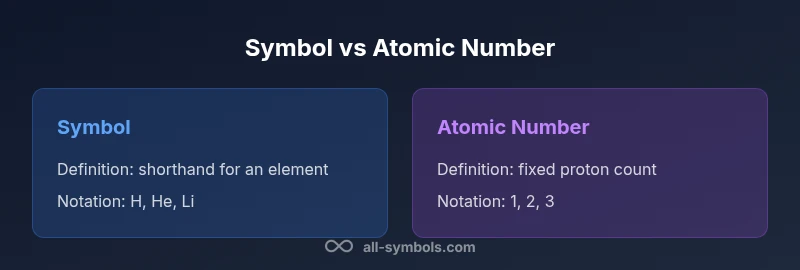
| Definition | A shorthand consisting of one or two letters that identifies the element in chemical notation | A fixed integer equal to the number of protons in the element's nucleus |
| Notation | Chemical symbol (e.g., H, He, Li) used in formulas and reactions | Integer (e.g., 1, 2, 3) used for indexing and databases |
| Best For | Readable notation in chemistry, education, and diagrams | Indexing, data organization, and cross-language consistency |
| Learning Curve | Relatively easy to memorize with practice; highly contextual | Relies on memorization for many elements; universally numeric |
| Ambiguity/Clarity | Symbol familiarity aids quick recognition but can vary by font or language | Atomic number is unambiguous and language-independent |
Pros
- Symbols enable quick, readable notation in equations and diagrams
- Atomic numbers provide a universal, language-agnostic index
- Using both identifiers reinforces learning and reduces ambiguity
The Bad
- Relying solely on symbols can obscure underlying properties like electron configuration
- Atomic numbers require memorization and context to be meaningful to beginners
- In informal contexts, symbols can be misread if fonts are not clear
Symbols are generally more usable for everyday chemistry; atomic numbers excel in indexing and data tasks
In most classroom and lab settings, the symbol offers readability and speed. Atomic numbers provide stable indexing for databases and computational work. Together, they offer a robust notation system.
Questions & Answers
What is the difference between a chemical symbol and the atomic number?
A chemical symbol is a shorthand notation for an element’s name, used in formulas and discussions. The atomic number is a fixed integer that indicates how many protons are in the nucleus and uniquely identifies the element.
The symbol names the element; the atomic number identifies it by protons.
Can the atomic number change over time or with isotopes?
No. The atomic number is constant for a given element and defines its place on the periodic table. Isotopes differ in neutron count and mass number, not in atomic number.
The atomic number stays the same; isotopes vary in neutrons and mass.
Why are chemical symbols sometimes tricky for learners?
Symbols are mnemonic and language-influenced; learners must memorize both the symbol and its element. Consistent practice with the periodic table helps reduce confusion across languages and fonts.
Symbols can be tricky because you memorize them and how they relate to names.
How should symbols and numbers be presented in a data table?
Present the symbol for readability and the atomic number for indexing. If possible, include both for each element to support quick reference and computational processing.
Show both the symbol and the number when you can.
Do isotopes affect the symbol or atomic number?
Isotopes share the same atomic number, but their mass numbers differ. The symbol may remain the same, while mass data vary by isotope.
Isotopes change mass, not the symbol or atomic number.
The Essentials
- Use symbols for readable notation in daily work
- Rely on atomic numbers for indexing and cross-language consistency
- Present both identifiers to strengthen learning
- Keep in mind common isotopic distinctions that affect mass numbers
- Design materials that pair symbols with numbers for clarity