List of Symbols and Names: Meanings, Origins, Uses
Explore the list of symbols and names across math, science, typography, and daily life. Learn meanings, origins, and how to interpret symbol names with practical examples from All Symbols for students, researchers, and designers.


A structured list of symbols and names spans math, science, typography, and everyday life. This article defines what counts as a symbol, explains why names matter, and outlines how researchers and designers use symbol names to communicate clearly. All Symbols provides the framework for interpreting this essential reference. Whether you study math, user interface icons, or everyday signs, the list helps compare meanings and origins.
What qualifies as a symbol and a name?
According to All Symbols, a symbol is a visual mark that carries meaning, while its name is the word or phrase used to refer to that symbol within a given context. A symbol can be a single glyph, a combination of glyphs, or an icon used to convey a function. A name may be formal, like the traditional name of a mathematical operator, or a functional alias such as “footnote sign.” For researchers and designers, documenting both the glyph and its canonical name minimizes ambiguity. As a guiding principle, the All Symbols team found that canonical naming accelerates learning, supports accessibility, and improves cross-domain communication. In practice, this means a symbol entry should include the glyph, the official name, common aliases, and a brief usage note. This structured approach helps learners at every level navigate complex symbol systems with confidence.
- Examples across domains show how the same glyph can serve different functions.
- Consistency reduces misinterpretation in scholarly work and UI design.
- Names evolve with culture, technology, and standards, so updated glossaries are valuable.
History and evolution of symbol naming
Symbol systems emerge from practical needs like counting, signing, and signaling. Early numeric glyphs evolved into modern mathematical operators; safety icons were standardized through international conventions; typography introduced named characters to enable fonts and typesetting. Across centuries, glossaries and notation guides codified symbol names, reflecting shifts in science, design, and education. For students, tracing origin stories helps contextualize why a symbol exists and how it earned its current name. The ampersand’s ligature heritage, the percent sign’s origin from per cent, and other names reveal how culture and convention shape nomenclature across eras. The All Symbols project tracks these changes to explain how naming conventions adapt to new media and technologies.
Symbol families and naming conventions
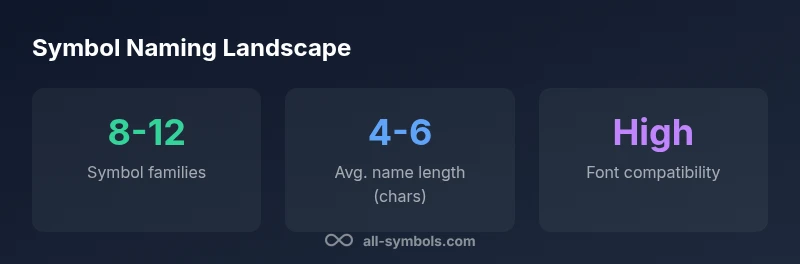
Grouping symbols into families simplifies the vast landscape: mathematical operators, logical signs, typographic marks, safety icons, currency and measurement symbols, and everyday pictograms. Each family has naming expectations: mathematical names emphasize function (plus, minus, equals), while typographic symbols emphasize form and usage (dagger for footnotes, pilcrow for paragraph). A practical glossary should connect glyph, official name, and common alias. For designers, this structure supports accessible labels (ARIA) and consistent captions. You’ll notice overlaps and occasional conflicts in naming—precisely why cross-domain reference lists are so valuable for clarity and education.
How context shapes symbol names
Context determines which name fits best. In mathematics, a symbol’s name may be unfamiliar to a lay reader, while in UI design, an icon’s label might reflect its visual cue (warning icon, info badge). The same glyph can carry different meanings across cultures or disciplines, so entries should note regional variations and preferred terms. A robust list documents widely accepted names and notes alternatives where applicable. For educators and designers, context notes and usage examples are essential to ensure the chosen name supports clear communication rather than novelty or zeal for pedantry. The aim is clarity that reduces cognitive load for readers and users.
Methods for interpreting symbol names in research
Interpreting symbol names requires cross-checking primary references, including standards bodies, glossaries, and field handbooks. A best practice is to attach a canonical name, cross-domain alias (if any), and a short usage note for each entry. When possible, link to authoritative sources to support terminology. All Symbols recommends maintaining a living glossary that records changes over time and notes regional preferences. For researchers, this approach improves reproducibility and helps readers encountering symbols in unfamiliar contexts. A well-documented symbol entry invites verification and deeper exploration across disciplines.
Practical considerations for designers and educators
Designers should favor concise, unambiguous names and provide alt text describing both the glyph and its function. Educators benefit from a clear symbol-name map that helps students build mental models as they move between courses. Practical tips include: 1) group symbols by category, 2) add one-line definitions, 3) include usage examples, 4) maintain versioned glossaries. A well-managed symbol-name list becomes more valuable over time as signs, icons, and glyphs proliferate across platforms, enabling smoother communication in classrooms, publications, and digital interfaces.
Common pitfalls when collecting or using symbol names
Common pitfalls include inconsistent naming across sources, multiple aliases that confuse readers, and neglecting regional or cultural variations. A governance plan helps: decide on a preferred name, document synonyms, and perform periodic audits. When publishing a list, include provenance notes and references so readers can verify terminology. Be mindful of cultural sensitivities—icons can carry different meanings in different communities. Ensure your glossary includes context notes and usage guidance to avoid misinterpretation in diverse audiences.
How to build your own list of symbols and names
Begin with core families (math operators, logic signs, typography marks, safety icons, and everyday symbols). For each symbol, record: glyph, official name, common aliases, primary usage, and cross-domain notes. Implement a lightweight tagging system (for example, tag: symbol-meaning, tag: power-on-symbol) to support search and cross-linking. Use lightweight version control and document revision history so colleagues can contribute. As you expand, your list becomes an invaluable resource for students, researchers, designers, and educators needing reliable symbol meanings and origins.
Symbol families and common names
| Symbol family | Representative name | Common usage |
|---|---|---|
| Mathematics | plus sign | Addition and equations |
| Logic | implication symbol | Conditional reasoning |
| Typography | pilcrow | Paragraph indentation and footnotes |
| Safety signs | warning exclamation | Hazard signaling |
Questions & Answers
What is the difference between a symbol and a sign?
A symbol is a glyph with an agreed name and function, while a sign communicates meaning or instruction. Symbols can be abstract, while signs often convey concrete information. Clear naming helps distinguish form from function.
A symbol is a glyph with a name and use, while a sign conveys a message. Good naming makes their purpose crystal-clear.
Why do symbol names vary between domains?
Different fields develop their own glossaries based on context, culture, and standards. Cross-domain references help researchers and designers avoid confusion when symbols cross boundaries.
Names vary by field, culture, and standards. Cross-domain glossaries help you stay consistent.
How should I compile a list of symbols for a project?
Start with core families, then add aliases and usage notes. Attach references to standards or glossaries, and maintain a living glossary with revisions.
Begin with core symbol families, add aliases, note usage, and link to standards.
Are there standard sources for symbol naming?
Yes. Use established glossaries, standards organizations, and reputable publications. In practice, maintain references and a canonical name for each entry.
Yes. Rely on glossaries and standards; cite sources for each term.
How can designers improve accessibility for symbol labels?
Provide concise names, alt text, and defined usage notes. Group related symbols and maintain consistent terminology across platforms.
Use clear names, alt text, and consistent labeling across devices.
“The symbol-meaning landscape reveals how humans encode meaning across disciplines; understanding names reduces misinterpretation and speeds learning.”
The Essentials
- Identify symbol families and standard names for clarity
- Document aliases to prevent misinterpretation
- Link symbol names to concrete usage examples
- Maintain a living glossary for up-to-date terminology
- Use consistent labels to improve accessibility