How to Sign an Already Signed Document: A Step-by-Step Guide
Learn how to countersign an already signed document with confidence. This educational guide covers preparation, legal considerations, physical and digital signing methods, and best practices to avoid common mistakes.


Countersigning an already signed document adds your approval to a finalized version. This guide explains when countersigning is appropriate, how to prepare the final copy, and the steps to perform a clear signature—handwritten or digital—while protecting integrity. You’ll learn practical tips, common mistakes to avoid, and how to verify changes with all parties.
Understanding countersignatures: why add your signature
According to All Symbols, countersignatures are a formal practice used to confirm ongoing consent on a document that has already been signed by others. In many professional settings, a second signature signals that all terms have been reviewed and agreed upon by an additional party or department. Countersigning can occur after amendments, when a contract requires multi-party approval, or when a witness or supervisor must acknowledge the revised version. The act of countersigning should be deliberate and traceable: the date, signer’s name, title, and role should be clearly associated with the signature. Consistency with the original signing style helps maintain readability and prevents misinterpretation. It’s essential to distinguish countersignature from endorsement or notarization, which serve different legal purposes.
Legal considerations when signing an already signed document
Before you countersign, review the document for version control and ensure you are legally permitted to sign. Do not alter the terms or insert new language in the signature area; if amendments are necessary, use a formal amendment or addendum and have all parties countersign it. Check whether your jurisdiction or the document type requires notarization or witness attendance. Ensure the countersignature is placed on the final version and in the designated signature block, with a clear date and name. Finally, verify that the countersignature does not invalidate any restrictive clauses or termination provisions that could be triggered by a new signature.
Practical scenarios: when countersigning is common
Countersigning happens in many real-world contexts: a board member approves a contract amendment, a supervisor ratifies a policy change, or a partner confirms a negotiated amendment to a joint venture. In corporate environments, multiple signatures may be required to validate changes to a master agreement. In legal or real estate documents, a second signature can indicate acceptance of revised terms or acknowledgment of deadlines. Understanding these scenarios helps you determine whether countersigning is appropriate and what information needs to appear on the signature line.
How to prepare the document for a second signature
Preparation is key to a clean countersignature. Begin by confirming you have the final version of the document and that all amendments are properly documented. Locate the designated signature block intended for the countersignature and ensure there is adequate space for your name, title, organization, and date. If you are signing digitally, ensure you are using the approved signing platform and that the document cannot be altered after signing. Print a clean copy if you must sign by hand, and avoid making any edits to the body of the document after the signer’s initials or signature have been applied.
Physical signing: process and best practices
When signing physically, use smooth, legible handwriting in a consistent ink color (often blue if the original is black) and sign on the specified line. Date your signature and include your title or role if required by the document. Do not erase or cross out any text; if a correction is required, obtain a formal amendment. Ensure your signature aligns with the style of the original signer to prevent confusion. If witnesses or notaries are required, arrange them before you sign and provide any requested identification.
Digital or electronic signing: when and how
Electronic signatures are widely accepted for many agreements, but ensure the platform you use complies with applicable laws and the document type. Do not modify the document after applying a digital signature; if changes are necessary, issue a new version and recountersign. Maintain an auditable trail: timestamps, signer identities, IP addresses, and certificate details should be preserved. If the document was originally signed on paper, consider scanning and securely re-uploading the final version with a new digital signature line to indicate the countersignature.
Notarization and witnessing: when it's required
Notarization or witnessing is not always required for countersignatures, but certain document types and jurisdictions demand it. If you suspect notarization is needed, contact a licensed notary and schedule a signing session. Bring valid photo ID and be prepared to present the original version and any amendment documents. Notarization adds an additional layer of authentication that can be important for enforceability, especially in real estate, finance, and government-related agreements.
Common mistakes and how to avoid them
Common mistakes include signing the wrong copy, signing before amendments are finalized, and altering terms after the fact. Avoid these by confirming you’re signing the final version, using the appropriate signature block, and keeping a clear record of changes. Do not sign in pencil or erase content. Always verify the document version and store countersigned copies in a secure repository for future reference.
Case studies: countersigning in real life
In a software licensing agreement, a countersignature confirmed an updated service level agreement after the primary signatories approved the amendments. In a real estate addon, a landlord countersigned an addendum to reflect new lease terms, after tenants provided consent and a notary verified the identities. These examples illustrate how countersigning provides a formal acknowledgement of changes while preserving the integrity of the original document.
Tools & Materials
- Original document (final version)(The copy you will countersign on should be the final, version-controlled document.)
- Second signature line or space(Ensure there's a clearly designated area for the new signature.)
- Pen (blue or black; high-quality ink)(Use smooth-flowing ink to prevent smudging.)
- Printed/digital copy of the final document(Optional reference copy if countersigning digitally or for discussion.)
- Notary or witness (if required by jurisdiction)(Some documents require a witness or notary.)
- Identification documents(Carry government-issued ID if notary/witness is involved.)
- Electronic signing account or software(If countersigning digitally, ensure access to the signing platform.)
- Version control log or amendment list(Record changes and dates for auditability.)
Steps
Estimated time: 15-30 minutes
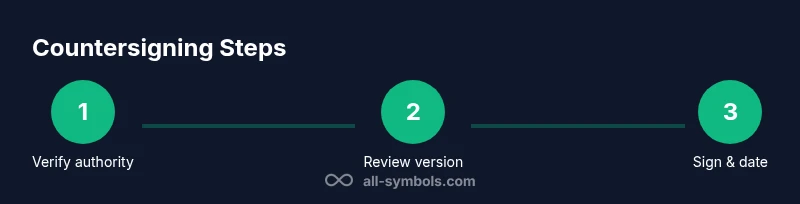
- 1
Verify authority to countersign
Confirm you are authorized to countersign and that the document allows a countersignature. If your role or policy restricts who may countersign, obtain the necessary approvals before proceeding.
Tip: Check your organization's signing limits and escalation path; when in doubt, consult legal. - 2
Review the original document version
Open the final version and locate the countersignature area. Ensure all amendments are documented and that the body of the document reflects agreed changes without inadvertent edits.
Tip: Compare the final version with the amendment log to confirm accuracy. - 3
Prepare the correct signature block
Make sure you are signing in the designated area and that your name, title, and organization appear clearly. If signing digitally, verify your profile and certificate settings.
Tip: Never sign in the margin or on an unrelated line. - 4
Sign clearly and date accurately
Sign legibly and date the signature line. If the document requires your title or role, include it to avoid ambiguity for future readers.
Tip: Use the same signature style as the original signer if possible. - 5
Maintain consistency with the original signer
Do not alter terms or insert new text in the body after signing. If changes are needed, use a formal amendment that all parties countersign.
Tip: Document any agreed amendments separately and reference them in the final version. - 6
Arrange notary or witness if required
If required, arrange for a notary or witness to observe the countersignature. Bring valid ID and the final document for verification.
Tip: Call ahead to ensure availability and understand any local requirements. - 7
Distribute updated copies and record metadata
Provide all parties with countersigned copies. Update version dates and store a secure digital or physical record with an audit trail.
Tip: Maintain a centralized repository with clear naming conventions. - 8
Confirm acceptance and retention
Verify that all parties have received the countersigned document and retain it for future reference. Set reminders for renewal or review if applicable.
Tip: Create a retention schedule and tag the file for easy retrieval.
Questions & Answers
What does countersigning mean?
A countersignature is an additional signature by another party to indicate consent or approval after the document has already been signed. It validates the continued agreement of all involved parties.
A countersignature is another signature showing ongoing approval after the first signatures.
Can you countersign a document if you weren't part of the original agreement?
Only if the document’s terms and the designated signature blocks allow it. If in doubt, consult the contract terms or legal counsel.
It depends on who the signatories are and what the document allows.
Is countersigning the same as notarizing?
Not necessarily. Notarization is a separate process that verifies identity and the authenticity of the signature, and it may be required depending on the document and jurisdiction.
Notarization is a separate step and isn’t always required.
What should I do if the document changes after countersigning?
Do not sign new changes. Instead, issue a formal amendment or addendum and have all parties countersign that amendment.
If changes happen after you sign, request a formal amendment and countersign it.
Do I need to sign the original copy as well?
Typically you sign the final version being countersigned. You may also keep a copy for your records; ensure the final version is the one in circulation.
Sign the final version and keep a copy for your records.
How should I store countersigned documents?
Store both digital and physical copies in a secure, organized repository with clear naming and dating.
Keep digital and physical copies safe and easy to retrieve.
Watch Video
The Essentials
- Identify when countersigning is appropriate and allowed.
- Use the correct signature block and date for clarity.
- Do not alter the document after countersigning; use amendments if needed.
- Obtain notary or witness support when required by law.
- Archive countersigned documents securely with full metadata.