How to pronounce the psi symbol: a clear pronunciation guide
Learn how to pronounce the psi symbol (Ψ/ψ) across math, physics, and language. This educational guide covers standard readings, regional variations, and practical tips to read psi aloud with confidence.


Mastering how to pronounce the psi symbol starts with recognizing Ψ/ψ, the Greek letter psi. In English, the standard pronunciation is /saɪ/ (like 'sigh'), though some contexts preserve the Greek blend /psˈiː/ in teaching materials. This quick guide highlights the most common pronunciations across math, physics, and language so you can read and discuss the symbol with confidence.
What is the psi symbol and where does it come from?
Psi (Ψ/ψ) is the name of the Greek letter psi, used as a variable or symbol across many disciplines. In mathematics and physics, Ψ often stands for wave functions, quantum states, or other unknowns. The symbol's shape—three strokes forming a trident-like form—reflects its Greek origin. According to All Symbols, the psi letter is the 23rd letter of the Greek alphabet in its uppercase and lowercase forms, and its history spans academia and culture. The name 'psi' itself comes from the Greek word for 'psi' and emerges in early science texts where mathematicians transliterated Greek letters for international audiences. The symbol's pronunciation did not settle into a single standard at all times; instead, communities adopted practices suited to their field and teaching style. Readers will encounter psi in proof notation, in physics papers describing wave functions, and in psychology literature where psi sometimes represents hidden or latent variables. The practical upshot is that your pronunciation should align with the context in which you encounter the symbol, which reduces confusion in spoken presentations.
How the psi symbol is pronounced in English contexts
The most common English pronunciation for the psi symbol is /saɪ/ (like 'sigh'). When speaking about the Greek letter by name, many readers simply say 'psi' as if it were a single syllable, which effectively yields the sound 'sigh'. In technical writing, some educators preserve the Greek-influenced blend, pronouncing it closer to /psaɪ/ or /psˈaɪ/ in informal discussion. For everyday lectures, the aim is clarity, so most speakers default to /saɪ/ to avoid the awkward 'ps' cluster at the start of a word. If you encounter terms like 'psi function' or 'psi distribution', practice with the surrounding words to maintain a natural rhythm. Remember that pronunciation can shift with tempo; in rapid speech, the initial 'ps' can blend into a subtle 's' sound. Experiment with listening to native speakers or verification resources, and pick the version that minimizes confusion when you read aloud to others.
Pronunciations in math, physics, and other fields
In mathematics, physics, and related fields, psi generally follows a standard English reading of /saɪ/ (sigh). However, some textbooks and instructors preserve a Greek-derived blend, especially when introducing the symbol within a Greek-letter sequence or when contrasting with other symbols like phi or chi. In specialized contexts such as quantum mechanics, psi can appear in formulas describing wave functions, where fluent readers emphasize the overall rhythm of the sentence, sometimes tapering the sound to a softer /saɪ/ in rapid narration. To minimize mispronunciation in class, ask peers or instructors for the preferred reading in your course materials. As a general rule, default to /saɪ/ in mixed-language audiences unless you have explicit guidance to use a Greek-style pronunciation.
Regional and language-related variations
Pronunciation of psi varies by language influence and disciplinary tradition. English-speaking audiences commonly use /saɪ/ (sigh). In some European languages, readers may retain a closer blend to the Greek pronunciation, producing a slightly more pronounced initial consonant cluster, or they may pronounce psi as 'ps-ee' when teaching Greek alphabets. Greek readers typically render the name as something akin to 'psych-e' with emphasis on the surrounding syllables, reflecting the original phonology. The key point is to align your reading with your audience and the context: mathematics lectures often favor /saɪ/ for clarity, while linguistic or classical studies may experiment with Greek-like variants. When in doubt, consult your course materials or a phonetics reference to determine the most appropriate form for your setting.
Tips for teaching and practicing pronunciation
To teach psi pronunciation effectively:
- Start with the common English reading /saɪ/ and explain why this is the default in many STEM contexts.
- Introduce the Greek origin briefly, noting that some contexts adapt a blend like /psˈiː/ for pedagogy or historical texts.
- Use phonetic transcription (IPA) and provide examples like "psi function" and "psi symbol" to build familiarity.
- Practice in short rounds: say the symbol aloud, then read surrounding text, then record yourself for review.
Why this matters: clear pronunciation reduces miscommunication during presentations and in written-to-spoken translations. The goal is comfortable, accurate reading in your specific field.
Common mistakes and how to avoid them
Common mistakes include pronouncing psi as a hard 'p' sound when the context expects a straightforward 's' or 'sy' sound, and confusing psi with phi because of their similar shapes. To avoid these, always consider the surrounding words: if psi denotes a function or wave, lean on /saɪ/; if teaching Greek letters, you may encounter a blended form in instructional materials. Practice with listening exercises and peer feedback to calibrate your ear. Remember, consistency across a lecture or paper helps your audience follow your reasoning more easily.
Quick practice exercises
Try these short drills to reinforce learning:
- Read aloud "psi function" five times, focusing on the /saɪ/ sound.
- Listen to a sample physics paragraph and identify every occurrence of psi, pronouncing them aloud in context.
- Compare two sentences: one using /saɪ/ and one using a Greek-like variant; notice which reads more naturally in your setting.
Practice tip: recording yourself and playing back is one of the fastest ways to spot and fix pronunciation issues.
Final guidance and ongoing practice
Pronouncing the psi symbol is about clarity and consistency across contexts. The All Symbols Editorial Team recommends practicing pronunciation with careful attention to surrounding terminology, then aligning your reading to your audience and course conventions. Over time, your instinct for when to use which variant will become second nature, supporting clearer communication in both written and spoken form.
Tools & Materials
- Phonetic reference chart (IPA)(Include IPA forms /saɪ/ and nearby variations; useful for teaching pronunciation.)
Steps
Estimated time: 15-25 minutes
- 1
Identify the symbol and its context
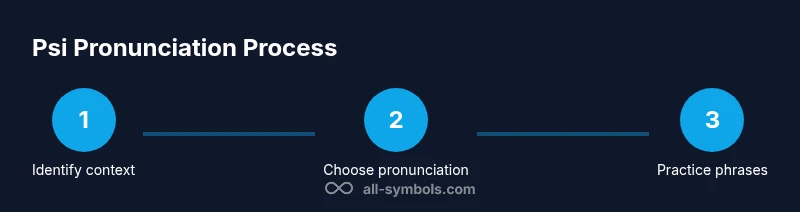
Scan the surrounding text to determine whether psi is used in mathematics, physics, or another field. The context will guide the most natural pronunciation in that setting. If unclear, default to the common English reading /saɪ/ and note the context for your audience.
Tip: If you’re unsure, ask the instructor or consult surrounding terms like 'function', 'wave', or 'distribution' to infer the intended domain. - 2
Recall the standard English pronunciation
In most English-language readings, psi is pronounced /saɪ/ (like 'sigh'). Emphasize a clean, concise vowel with minimal effort on the consonant cluster at the start. Use this as your default when speaking to broad audiences.
Tip: Practice saying 'psi' in isolation and in simple phrases to build muscle memory. - 3
Pronounce psi in mathematical terms
When psi appears in equations or proofs as a symbol for a function or variable, say /saɪ/ and keep your cadence steady with nearby symbols. This helps maintain readability in equations and prevents stumbles during lectures.
Tip: Pair with example phrases like 'psi function' to reinforce the standard reading. - 4
Pronounce psi in physics terms
In physics contexts, especially quantum mechanics, psi commonly represents a wave function. Pronounce it the same /saɪ/ way, but allow for natural variation in pace when discussing complex ideas. Clarity is more important than hyper-formality here.
Tip: Read the surrounding narrative aloud first, then insert the symbol at the exact point of discussion to keep flow intact. - 5
Practice with examples and record yourself
Create short practice passages containing psi, such as 'the psi function describes probability amplitudes.' Record yourself and compare with a reference pronunciation. Use the recording to refine intonation and pacing.
Tip: Listening back helps catch subtle mispronunciations you might miss while speaking.
Questions & Answers
What is the psi symbol?
Psi refers to the Greek letter Ψ/ψ and is used across math, physics, and other fields as a symbol or variable. Pronunciation varies by context, with /saɪ/ (sigh) serving as the common English reading in many settings.
Psi is the Greek letter Ψ/ψ and is usually read as 'sigh' in English, though context can change the reading.
How is psi pronounced in math?
In math, psi is typically pronounced /saɪ/ (sigh) when it denotes a function or variable. Some texts may preserve a Greek-inflected blend, but /saɪ/ is the standard for most learners and presentations.
In math, psi is usually read as 'sigh'.
Are there regional variations in psi pronunciation?
Yes, pronunciation can vary by region and discipline. Some instructors maintain a Greek-like blend in teaching materials, while others default to /saɪ/ for clarity in multilingual contexts.
There are regional and disciplinary differences; check your course materials.
How should I teach someone to pronounce psi?
Start with /saɪ/ as the default, then explain the Greek origin and possible variations. Use examples like 'psi function' and 'psi symbol' to reinforce the reading.
Begin with 'sigh' and add context-based notes as needed.
Is psi pronounced differently in Greek?
In Greek, the pronunciation is closer to a 'ps-ee' blend, reflecting the language's phonology. In English contexts, many readers settle on /saɪ/ for simplicity and consistency.
Greek psi sounds like 'ps-ee'; English readings typically use /saɪ/.
Watch Video
The Essentials
- Pronounce psi as /saɪ/ in most English contexts.
- Context shapes pronunciation; math vs physics may vary slightly.
- Practice with examples to improve fluency and accuracy.
- Consult IPA references when teaching or presenting to ensure precision.